Molde para palas de ventilador de aire frío
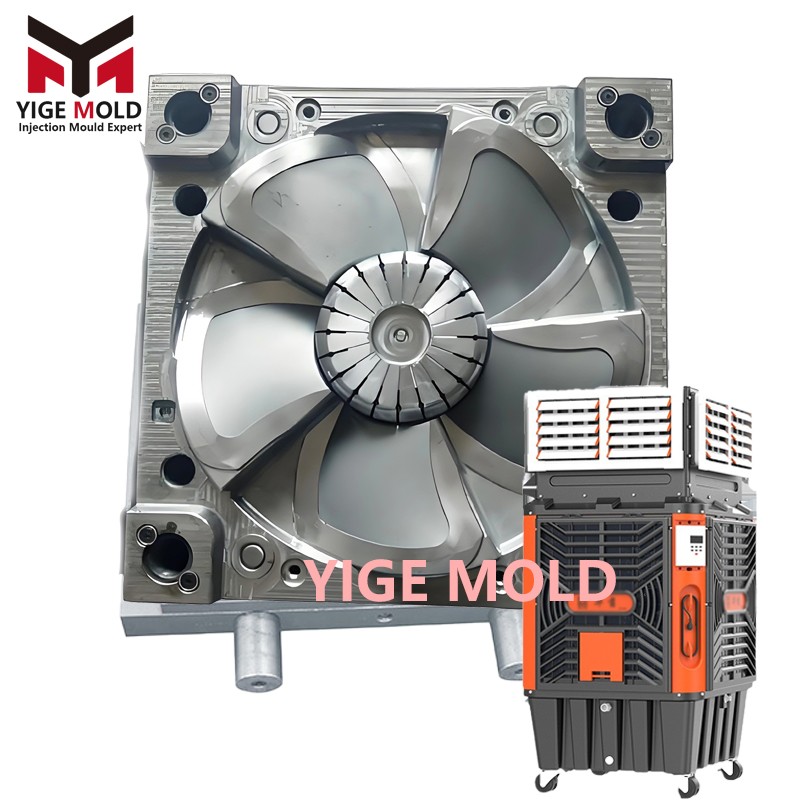


In-depth Analysis of Cold Fan Blade Molds: The Perfect Fusion of Aerodynamics and Precision Injection Molding
Within the modern cooling and ventilation equipment industry chain, the cold fan (also known as an air cooler or evaporative cooler) holds a significant market position due to its high energy efficiency and mobility. As the "heart" of the device, the manufacturing quality of the fan blades directly determines the unit's airflow volume, noise control, and operational stability. Supporting the mass production of this core component is the cold fan blade mold. Unlike ordinary daily commodity molds, fan blade molds belong to the category of high-precision, thin-walled, complex-surface injection molds. Their design and manufacturing integrate multidisciplinary technologies, including aerodynamics, polymer materials science, and precision machining.
I. Material Selection and Considerations for Material Properties
Cold fan blades operate under high-speed rotation for extended periods, imposing extremely high requirements on material strength, toughness, and fatigue resistance. Consequently, mold designers must deeply understand the physical properties of the molding materials during the early stages.
Currently, Polypropylene (PP) and Nylon (PA) are the most common materials for cold fan blades. PP offers low density, good processability, and low cost, but it has a high molding shrinkage rate (typically between 1.5% and 2.0%). In contrast, Nylon (such as PA6 and PA66) provides excellent wear resistance, high strength, and good self-lubrication, effectively reducing operational noise. However, it has high water absorption, making dimensional stability harder to control.
Based on these material characteristics, the selection of mold steel must balance wear resistance with polishability. High-quality blade molds typically use high-hardness pre-hardened steel or corrosion-resistant mirror-finish stainless steel (like S136). Since blade surfaces are mostly highly twisted curved surfaces requiring extremely high surface smoothness (usually mirror-level to reduce wind resistance), the mold cavity requires meticulous polishing. Furthermore, for glass-fiber reinforced materials like Nylon, the mold steel must possess strong corrosion and abrasion resistance to withstand the erosion of the cavity surface by the glass fibers.
II. Precision Mold Structure and Runner System Design
Cold fan blades typically feature a large aspect ratio, highly twisted airfoil structures, and thin walls (generally between 0.8mm and 2.2mm). These special geometric features pose significant challenges to mold structural design.
-
Parting Surface and Cavity Layout: To ensure aerodynamic performance, the parting surface design must be extremely smooth to avoid obvious parting lines that could affect dynamic balance. Complex curved surface parting along the blade's maximum profile line is commonly employed. For multi-blade impellers, molds often adopt a multi-cavity layout (e.g., 3 cavities, 5 cavities), demanding extremely high machining precision to guarantee consistency across all cavities.
-
Gating System and Hot Runner Technology: Filling balance is a core difficulty in mold design. Using traditional center-point gates can easily lead to melt jetting, trapped air, and inconsistent filling times among blades, resulting in severe warpage. Therefore, modern high-quality blade molds widely utilize multi-point balanced hot runner systems (such as valve gate nozzles). Through simulation with mold flow analysis software (like Moldflow), engineers precisely calculate runner dimensions and gate locations to ensure molten plastic fills the tip of every blade simultaneously and synchronously, controlling filling time differences between cavities within a minimal range (e.g., within ±0.05 seconds). This effectively manages weld line location and internal stress distribution.
-
Cooling System Design: Due to the thick root and thin tip of the blade, uneven cooling can easily cause bending deformation. The mold interior typically features conformal cooling channels. Cooling circuits are densified near the high heat-load blade roots, while high thermal conductivity materials (like beryllium copper inserts) are used in thin-walled areas to enhance heat dissipation. This ensures uniform mold temperature and compresses the molding cycle to an optimal state.
III. Core Technical Challenges: Demolding and Dynamic Balance Control
The success of a blade mold is ultimately reflected in the smoothness of demolding and the dynamic balance performance of the finished product.
-
Variable Draft Angle Demolding and Ejection Mechanism: The curvature of blade surfaces changes dramatically, making the setting of draft angles extremely critical. Insufficient draft leads to high ejection resistance, product scratching, or even cracking; excessive draft alters the airfoil angle, affecting airflow and pressure. Therefore, molds often employ local variable draft design, combined with a composite ejection scheme integrating ejector plates and local ejector pads. The plate provides gentle overall support, while micro flat ejector pins apply force precisely to rigid areas like the blade root, ensuring uniform stress distribution during ejection without deformation.
-
Micron-Level Precision and Dynamic Balance: Cold fans are highly sensitive to noise and vibration, requiring mold machining accuracy to reach micron levels. Machining errors for the mold cavity usually need to be controlled within ±0.02mm. Any minor dimensional deviation or weight imbalance is amplified during high-speed rotation, causing impeller vibration, casing scraping, or excessive noise. Thus, the mold undergoes strict Coordinate Measuring Machine (CMM) inspection during manufacturing and fine dynamic balance debugging during the trial molding phase.
-
Color vs. Shrinkage Rate Trade-off: During injection molding, changes in material formulation (e.g., adding black masterbatch to create black blades) can significantly alter crystallization patterns, flowability, and cooling shrinkage rates. Even minute formulation differences can lead to dimensional deviations of several tenths of a millimeter in the finished product. Consequently, for blades of different colors or materials, molds often require fine-tuning or even redesign, followed by prolonged reliability verification, to ensure the final product matches the original dimensional precision.
IV. Mold Maintenance and Industrial Value
As high-precision molds, daily maintenance of cold fan blade molds is crucial. Regular cleaning of vent slots, lubrication of sliders and ejector pins, and checking for clogged cooling channels are necessary measures to extend mold life. Additionally, rust prevention and anti-collision protection must be ensured during storage and transportation.
From an industry perspective, a superior cold fan blade mold not only significantly boosts production efficiency (shortening cycles, reducing scrap rates) but also directly endows the terminal product with competitive advantages like low noise, high airflow, and long service life. As consumer demands for appliance quality continue to rise, blade molds are evolving towards lighter weight, higher precision, and greater environmental friendliness (such as adapting to thin-wall designs). For manufacturing enterprises, mastering the core design and manufacturing technologies of blade molds is key to standing out in the fiercely competitive market for cooling equipment components.