

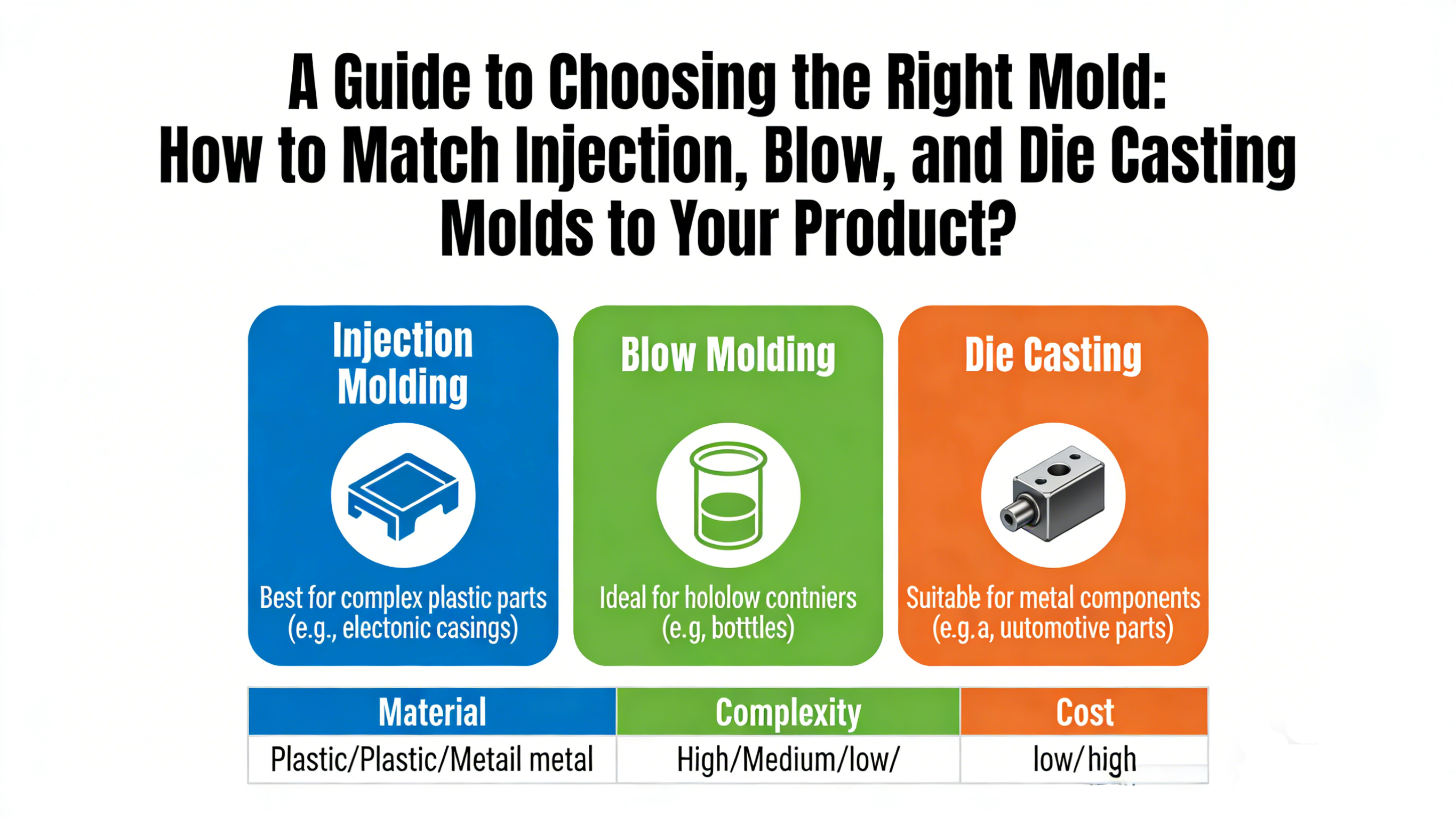
A Guide to Choosing the Right Mold: How to Match Injection, Blow, and Die Casting Molds to Your Product?
In manufacturing, selecting the right mold is a critical step in the product design and production process. Different types of molds correspond to different materials, processes, and product characteristics. This article details the key differences between injection molds, blow molds, and die-casting molds, helping you make the optimal choice for various product scenarios.
1. Injection Molds: The Epitome of Precision and Efficiency
Core Process: Molten plastic is injected into a closed mold cavity, cooled and solidified, then ejected as a finished part.
Applicable Materials: Various thermoplastic plastics (e.g., ABS, PP, PC, PA), thermosetting plastics (e.g., phenolic resin, epoxy resin), and some elastomers.
Typical Products:
-
Precision structural parts: electronic device housings, gears, connectors
-
Daily necessities: toys, tableware, storage boxes
-
Automotive interiors: dashboard components, buttons, panels
-
Medical supplies: syringes, reagent kits, instrument housings
Advantages:
-
High precision and repeatability, suitable for complex geometries and fine features
-
High surface finish, often ready for decorative use
-
High production efficiency and automation
-
Can form complex structures in one piece, reducing assembly steps
Limitations:
-
High mold cost, especially for multi-cavity or complex molds
-
Part size limited by clamping force and shot capacity of the injection molding machine
-
Typically used for solid or thick-walled parts, not ideal for large-area, thin-walled hollow products
When to Choose: Injection molding is the first choice when the product is solid or thick-walled, requires high dimensional accuracy, good surface quality, and production volume is sufficient to amortize the high mold cost.
2. Blow Molds: The Specialized Solution for Hollow Products
Core Process: A thermoplastic parison is placed in a mold and inflated with compressed air, conforming to the mold cavity. It is then cooled to form a hollow product.
Main Variants: Extrusion blow molding (for bottles, containers), injection blow molding (higher precision, e.g., for medical bottles), stretch blow molding (biaxial orientation, e.g., for PET bottles).
Applicable Materials: Polyethylene (PE), Polypropylene (PP), Polyvinyl Chloride (PVC), Polyethylene Terephthalate (PET), etc.
Typical Products:
-
Packaging containers: beverage bottles, oil bottles, cosmetic bottles, medicine bottles
-
Industrial products: chemical barrels, water tanks, automotive air ducts
-
Daily necessities: toys, sports equipment, furniture parts
Advantages:
-
Specialized for producing hollow products with relatively uniform material distribution
-
Can form hollow products with complex curves
-
Mold cost is generally lower than injection molds for comparable sizes
-
Suitable for containers with handles or irregular openings
Limitations:
-
Dimensional accuracy and detail definition are generally inferior to injection molding
-
Wall thickness control is more challenging than injection molding; parting lines are noticeable
-
Typically cannot form solid parts or highly intricate internal structures
When to Choose: Blow molding has clear advantages when the product is hollow, cost-sensitive, and extreme dimensional accuracy is not the highest priority. It is almost exclusive for applications like liquid packaging and large containers.
3. Die-Casting Molds: High-Volume Casting for Metal Parts
Core Process: Molten metal (alloy) is injected at high pressure and speed into a metal mold cavity, where it rapidly cools and solidifies under pressure.
Applicable Materials: Non-ferrous alloys with relatively low melting points, such as aluminum, zinc, magnesium, and copper.
Typical Products:
-
Automotive parts: engine housings, transmission cases, structural brackets
-
3C products: laptop housings, motor housings, heat sinks
-
Hardware: locks, handles, gears
-
Household appliances: power tool housings, vacuum cleaner parts
Advantages:
-
Enables high-speed production of complex metal parts, much more efficient than other metal forming processes
-
Good dimensional stability and high part strength
-
Good surface quality, suitable for subsequent plating, painting, etc.
-
Enables thin-wall casting, saving material
Limitations:
-
High requirements for mold material (hot-work tool steel), resulting in very high mold cost
-
Risk of casting defects like porosity and shrinkage
-
Generally not suitable for high-melting-point metals like iron and steel
-
Mold life is affected by erosion from high-temperature molten metal
When to Choose: Die casting is an economical and efficient choice for mass-producing complex, high-strength metal parts where the material is a low-melting-point alloy like aluminum, zinc, or magnesium. It is not for plastic products.
4. A Three-Dimensional Decision Framework: How to Make an Informed Choice?
When evaluating a specific product, systematically assess it from the following three dimensions:
1. Material Dimension (Material First)
-
Plastic or Metal? This is the fundamental divide. Choose injection or blow molding for plastic; die casting for metal alloys.
-
Specific Plastic Type? Thermoplastics may suit all three processes (with different tendencies); thermosets can only be injection molded. PET bottles require stretch blow molding.
-
Hollow Required? If yes, blow molding becomes a strong candidate.
2. Product & Design Dimension
-
Solid or Hollow Structure? Hollow products lean towards blow molding.
-
Requirements for Precision, Surface Finish, Detail: High requirements favor injection molding (plastic) or die casting (metal).
-
Wall Thickness Characteristics: Large-area, thin-walled hollow parts – blow molding; complex thin-walled metal parts – die casting; thick-walled or solid plastic parts – injection molding.
-
Size: Very large hollow containers (e.g., chemical barrels) are typically blow molded; very large metal structural parts may require other processes.
3. Cost & Production Volume Dimension
-
Expected Volume: Die-casting molds have the highest cost, requiring very high volumes to amortize; injection molds are next; blow molds may have relatively lower costs.
-
Mold Budget: If the budget is tight and the product suits, consider blow molding.
-
Cycle Time and Efficiency Requirements: Die casting and injection molding have short cycles and high efficiency; blow molding cycles are relatively longer, affected by cooling.
5. Cross-Application and Innovation Trends
With technological advances, boundaries are blurring:
-
Injection Blow Molding: Combines injection and blow molding; a preform is injection molded, then transferred to a blow mold for inflation, used for high-precision medicine bottles.
-
Multi-Material/Multi-Color Injection Molding: Completes injection of multiple materials or colors within one mold, enhancing product function and aesthetics.
-
Microcellular Foam Injection Molding: Introduces supercritical fluid to reduce weight and warpage.
-
Vacuum Die Casting: Reduces internal porosity in die castings, improving mechanical properties.
Conclusion
There is no "best" mold, only the "most suitable" process. Injection molds reign supreme for precision plastic molding, blow molds specialize in cost-effective hollow products, and die-casting molds are powerful for mass-producing complex metal parts. When making a decision, be sure to consider the three pillars: product material, design structure, and production economics. When necessary, engage in in-depth communication with mold suppliers and process engineers. The right choice not only determines whether a product can move from drawing to reality but also directly impacts product quality, cost control, and market success.
Post time:2026-03-25