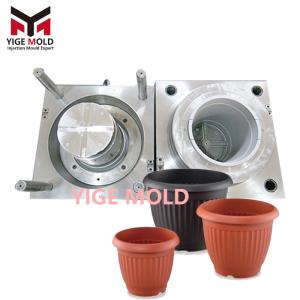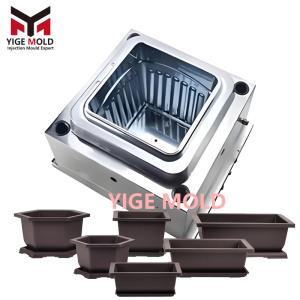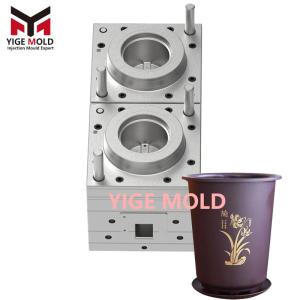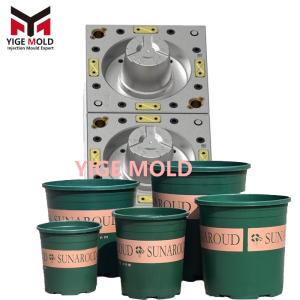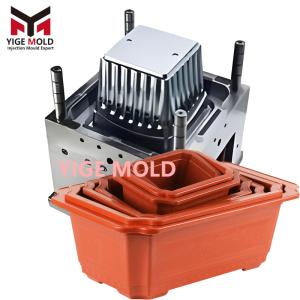
Flower Pot Mold
Introduction to the Classification of Plastic Flower Pot Injection Molds
Plastic flower pot injection molds are core tooling used to produce various flower pots via the injection molding process. Their classification system revolves around product function and structure, aesthetic realization methods, production efficiency, and specialized processes.
1. Classification by Pot Function and Structure (Design Starting Point)
Different pot functions determine the mold's core internal mechanisms.
-
Basic Drainage Pot Mold
-
Features: Simple structure with multiple drainage holes at the bottom.
-
Mold Key: Requires ejector pins on the core to form the drainage holes. Pin layout must balance drainage efficiency and ejection stability.
-
-
Nesting/Stackable Pot Mold
-
Features: Sidewalls are designed with special tapers or interlocking ribs to allow empty pots to stack efficiently, saving logistics space.
-
Mold Key: Often requires angled lifters or sliders to release the interlocking features. Demands high dimensional accuracy for the pot rim.
-
-
Self-Watering/Reservoir Pot Mold
-
Features: Complex structure with double walls, water reservoirs, water level indicators, and wick channels.
-
Mold Key: Most complex mold structure. Requires numerous internal lifters and sliders to form internal cavities. Often incorporates complex mechanisms like unscrewing cores or hydraulic cylinder actuators. Represents the highest cost and technical complexity.
-
-
Pot with Integrated Saucer/Attached Tray Mold
-
Features: The pot and saucer are molded as one unit or snap together securely.
-
Mold Types:
-
Integrated: Requires Gas-Assisted Injection Molding (GAIM) or complex tunnel sliders to form hollow connections.
-
Separate Snap-Fit: Requires two independent but correlatively designed molds.
-
-
2. Classification by Aesthetic Finish and Surface Treatment (Value Proposition)
Pot aesthetics are a critical market differentiator.
-
Texture Etching (Mold Texture) Mold
-
Process: Chemical etching on the cavity surface to create textures like terracotta, stone, wood grain, or weaving.
-
Features: The most mainstream and cost-effective decorative method. Texture depth and fineness are key metrics.
-
-
Sandblasted Surface Mold
-
Process: The cavity surface is sandblasted to achieve a uniform matte, frosted finish.
-
Features: Often used for modern, minimalist pots. Lower cost than etching.
-
-
Mold with Inserted Texture Inserts
-
Process: Precisely machined (e.g., CNC engraved, electroformed) inserts with 3D patterns are embedded into the cavity.
-
Features: Enables high-precision logos,浮雕(relief), or complex geometric patterns. Inserts are replaceable.
-
-
Two-Color/Multi-Color Injection Mold
-
Process: Utilizes mold rotation or index plate technology to inject two different colors/materials sequentially.
-
Application: Produces high-end pots with contrasting rim colors or colored stripes. Mold complexity and cost increase significantly.
-
3. Classification by Mold Structure and Gating System (Production Efficiency Core)
-
Hot Runner Mold (Standard)
-
Advantages: The absolute mainstream choice. Saves material (no sprue waste), shortens cycle time, and improves pressure transmission for full part formation.
-
Application: Used in almost all mass-production pot molds, especially multi-cavity configurations.
-
-
Three-Plate Mold Structure (Mainstream)
-
Advantages: Uses pin-point gates. Gates are auto-cut and leave minimal marks, typically placed on the hidden bottom, ensuring perfect exterior appearance.
-
Application: Pots with high aesthetic requirements on the sidewalls.
-
-
Two-Plate Mold Structure
-
Features: Simple and robust structure, but gates are usually edge gates or direct sprue gates, leaving visible marks on the side or inside.
-
Application: Basic pots with low aesthetic demands, or large, thick-walled pots.
-
4. Classification by Production Efficiency and Cavity Layout
-
Multi-Cavity Mold
-
Features: Cavity numbers are often 4, 8, 16, 32, or even 64. The soul of mass production, driving per-unit cost to a minimum.
-
Challenge: Requires perfect runner balancing and uniform cooling to prevent inconsistent shrinkage between cavities.
-
-
Stack Mold
-
Features: Two or more sets of cavities are stacked vertically, nearly doubling output without requiring a larger injection molding machine clamp force.
-
Application: Especially suitable for producing low-height pots like shallow trays, succulent pots, or seedling trays.
-
-
Single-Cavity Mold
-
Application: Oversized landscape pots, artistically shaped pots, or pots with extremely complex functional structures.
-
5. Classification by Specialized Molding Processes
-
Gas-Assisted Injection Molding (GAIM) Mold
-
Application: For producing large, thick-walled pots (e.g., large stone-look planters).
-
Purpose: Injects nitrogen gas during molding to create hollow sections, preventing surface sink marks, reducing internal stress, saving material, and shortening cooling time.
-
Summary: Typical Configuration and Design Focus
For mainstream commercial plastic flower pots (e.g., gallon pots, decorative resin pots), the mold's "golden configuration" is:
"Hot Runner Three-Plate Mold + Multi-Cavity Layout (e.g., 16 cavities) + Etched Surface Texture + Nesting/Stacking Feature"
Core Design Focus:
-
Cooling System Optimization: Pots have large projected areas and uneven wall thickness. Efficient cooling channel design is critical for cycle time and warpage prevention.
-
Venting Design: Deep cavities easily trap air. Adequate venting channels are essential on parting lines, inserts, and ejector pins.
-
Ejection System: Pots often have significant draft angles. The balance and reliability of the ejection system are paramount.
-
Material & Texture Matching: Different plastics (PP, PE, ABS) have different shrinkage rates, requiring precise calculation to ensure texture clarity and dimensional accuracy.
Plastic flower pot injection molds are a prime example in the consumer plastics industry of perfectly combining practicality, aesthetics, high efficiency, and low cost.