

 Injection Mold Development Pitfall Guide: 8 Core Q&As from Lead Time and MOQ to Precision Standards
For many companies and product developers new to injection molding, the journey from a CAD drawing to a physical product is often full of unknowns. How long does it take to develop a mold? What is the minimum threshold for low-volume trial production? What if you don't have 3D drawings? These questions directly impact project execution and cost control. This article provides in-depth answers to the 8 most critical questions in injection mold development to help you streamline your thoughts and efficiently advance your project.
1. How long does it actually take to develop an injection mold?
Mold development is not an overnight process. The lead time primarily depends on the complexity of the mold structure, machining process requirements, and the customer's approval efficiency. Typically, the entire process includes design review, material procurement, precision machining (CNC, EDM, etc.), assembly, mold trials, and adjustments.
- Simple Molds: For standard small molds with a single structure and no complex side-actions, the development cycle is usually 30-45 days (approx. 4-6 weeks).
- Medium-Complexity Molds: Standard production molds featuring sliders, lifters, or multiple cavities generally take 60-90 days (approx. 8-12 weeks).
- High-Complexity Molds: Molds involving multi-directional side-actions, hot runner systems, mirror polishing, or large-scale automotive/medical-grade molds typically require 120-180 days (approx. 12-20 weeks or longer).
Note: If you urgently need to validate a design, aluminum rapid prototyping molds are a great option, producing samples in as fast as 10-21 days.
2. What is the Minimum Order Quantity (MOQ)? Can we do low-volume trial molding?
Technically speaking, injection molding has no absolute MOQ; producing even a single part is feasible. However, from an economic perspective, the cost advantages of injection molding typically kick in at 500 to 1,000 pieces or more, as this helps amortize the mold cost effectively.
For market testing before a new product launch, low-volume trial molding is absolutely viable. Most manufacturers support trial orders ranging from 100 to several thousand pieces. If your requirement is under 100 pieces, we highly recommend prioritizing 3D printing or CNC machining for prototyping to save tens of thousands of dollars in mold tooling costs.
3. How long is the mold warranty? Are repairs free for non-human damage?
The industry-standard warranty period is typically 1 year (some manufacturers offer 3-6 months). During the warranty period, if non-human damage is caused by mold design defects or machining quality issues, the mold manufacturer is responsible for free repairs.
Additionally, reputable mold factories usually offer lifetime maintenance services. After the warranty expires, if wear or minor damage occurs, the manufacturer will repair the mold to restore production capacity, charging only reasonable fees for materials and labor.
4. Can we use STEP/IGS files for molding? What if we don't have 3D drawings?
STEP and IGS formats are perfectly acceptable for mold making. They are universal 3D intermediate formats that can be seamlessly imported into almost all mainstream CAD software. To ensure maximum precision, we recommend exporting in the STEP AP242 version.
If you only have physical samples, 2D drawings, or even hand-drawn sketches, you can absolutely commission the mold factory to handle the design. Most manufacturers offer reverse engineering services, rebuilding high-precision 3D models by 3D scanning physical parts. For 2D drawings, engineers can reconstruct the 3D structure and simultaneously provide DFM (Design for Manufacturability) optimization suggestions.
5. Does the mold belong to the customer or the manufacturer?
Mold ownership depends on how the tooling costs are covered. There are typically three models:
- Customer Fully Paid (Sales Mold): The customer owns 100% of the mold. The manufacturer merely stores it and uses it for production. The customer has the right to retrieve the mold at any time.
- Manufacturer Funded (In-house Mold): The customer does not pay a separate tooling fee; instead, the manufacturer amortizes the mold cost into the unit price. Ownership remains with the manufacturer until the agreed-upon purchase volume is reached.
- Partial Amortization: The customer pays a partial deposit upfront. Once the cumulative purchase volume reaches the agreed target, the manufacturer refunds the remaining tooling fee, and ownership officially transfers to the customer.
Recommendation: Always clearly define ownership and transfer conditions in the contract to avoid future disputes.
6. How do overseas customers receive samples and inspect molds?
For overseas clients, established mold factories have a standardized cross-border delivery process:
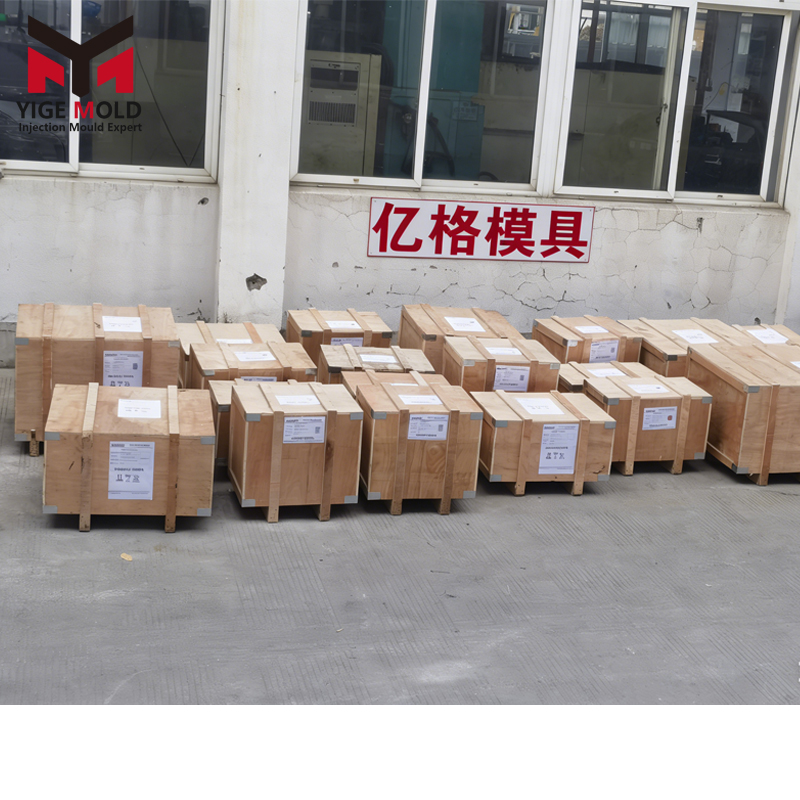
- Sample Shipping: After the mold trial, samples are shipped via international express couriers like DHL, FedEx, or UPS, accompanied by detailed mold trial reports, dimension inspection reports, and material certificates. For final mold delivery, molds are packed in fumigated wooden cases with moisture-proof film to ensure safe ocean freight.
- Inspection: We support remote video inspections (showing real-time mold operation and part ejection) and document-based inspections (providing full sets of 2D/3D drawings, heat treatment reports, etc.). If conditions allow, customers are also welcome to visit the factory for on-site mold trial inspections.
7. Can textures be changed on a textured mold? How much does it cost?
Yes, textures on a mold can be changed, but the existing texture must first be removed (usually via chemical etching) before re-texturing. The cost depends on the texture type and surface area:
- Standard Textures (e.g., MT series): Approx. 80-150 RMB per square decimeter; lead time is 3-5 days.
- Precision/Custom Textures (e.g., laser engraving or exclusive textures): Approx. 200-500 RMB per square decimeter; lead time is 5-7 days. Some custom designs may require additional licensing or design fees.
Note: Before re-texturing, the condition of the mold steel must be evaluated. Additionally, textured sides usually require an extra 1-3° of draft angle to prevent the part from sticking or damaging the texture during ejection.
8. What is the minimum achievable tolerance? What are the precision standards?
The tolerance of injection-molded parts is jointly determined by material shrinkage rates, mold precision, and molding process parameters.
- Standard Injection Parts: Conventional tolerances range from ±0.1mm to ±0.5mm.
- Precision Injection Parts: Most precision components can be consistently held within ±0.025mm to ±0.125mm. For highly demanding structural parts, top-tier precision mold factories can control critical dimensions to within ±0.005mm (5μm).
- Industry Standards: In China, the standard reference is GB/T 14486-2008 (divided into MT1-MT7 grades, with MT1 being the highest). Internationally, ISO 20457 or the North American ASME Y14.5 (GD&T) standards are commonly used. As a rule of thumb, the machining precision of a precision mold should be at least 1/3 of the required part tolerance.
Post time:2026-06-25