Transparent Household Trash Can Mold
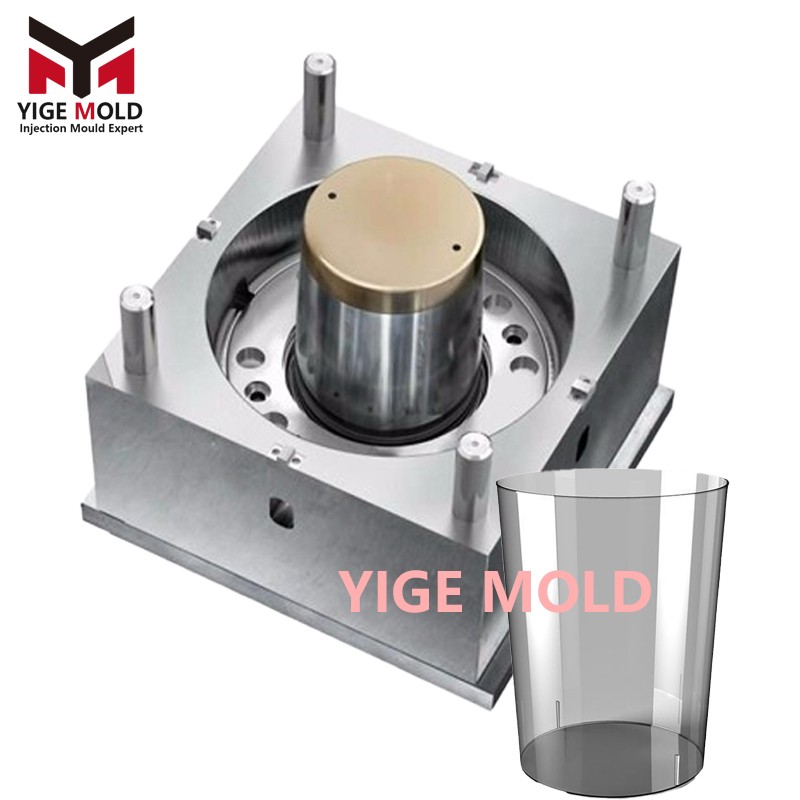
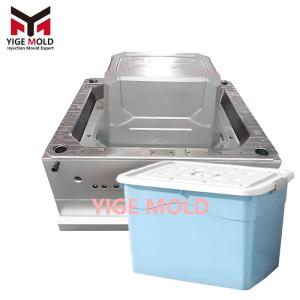
A Transparent Household Trash Can Mold represents a specialized category of injection mold tooling, engineered to manufacture visually clear, structurally sound, and aesthetically consistent plastic trash cans. Achieving perfect clarity demands a higher level of precision, material science understanding, and surface finishing expertise compared to standard opaque bin molds. This guide explores the technical nuances, design imperatives, and manufacturing excellence required for producing superior transparent trash solutions.
I. The Unique Challenges of Clarity
Creating a transparent trash can is not merely about using clear plastic. The mold itself is the primary determinant of final optical quality. Key challenges include:
-
Flawless Surface Reproduction: Any imperfection on the mold cavity surface—microscopic scratches, tooling marks, or uneven polish—will be magnified and visible in the final transparent part. A flawless, optical-grade finish is non-negotiable.
-
Elimination of Flow and Cooling Defects: Common injection molding defects that are often tolerable in opaque parts become glaringly obvious in transparent ones. This includes:
-
Flow Lines & Weld Lines: Weak seams where molten plastic fronts meet, causing visible lines or haze.
-
Sink Marks & Voids: Internal shrinkage that creates cloudy or distorted areas.
-
Burn Marks & Silver Streaking: Caused by trapped air or degradation, creating blemishes.
-
-
Material-Specific Processing: Transparent plastics like GPPS (Polystyrene), PET, PMMA (Acrylic), or COP/COC have distinct flow characteristics, cooling rates, and thermal stability requirements that the mold must accommodate perfectly.
II. Core Design and Engineering Imperatives
The mold design for a transparent trash can is fundamentally driven by the pursuit of optical perfection and structural integrity.
-
Optical-Grade Cavity Finishing: The mold core and cavity must be polished to a SPI A-1 (Mirror Finish) standard, often involving diamond paste polishing. This flawless surface is the first prerequisite for clarity.
-
Advanced Gating Strategy: Gate location, type, and size are critical. Edge gates, film gates, or submarine gates are often preferred over sprue gates to minimize visible gate vestige. The goal is to allow the plastic to fill the cavity in a laminar, wave-free front.
-
Superior Cooling System Design: To prevent cloudiness and warpage, cooling must be exceptionally uniform. Baffles, bubblers, or conformal cooling channels that follow the cavity contour are essential to maintain a consistent temperature across the entire part, ensuring even crystallization (for semi-crystalline materials) or solidification.
-
Venting Perfection: Inadequate venting traps air, causing burns and streaks. Precision-machined venting at the end of fill and along parting lines is vital, yet must be shallow enough to prevent plastic flash.
III. The Manufacturing Process: A Commitment to Precision
At Yige Mold, our process for crafting a Transparent Household Trash Can Mold is built on meticulous execution:
-
Precision Machining: We utilize state-of-the-art CNC machining centers to achieve near-net-shape geometry, followed by precision EDM (Electrical Discharge Machining) for intricate details, minimizing the need for aggressive manual polishing that can introduce waves.
-
Micro-Polishing Expertise: Our master polishers employ a multi-stage process, progressing through increasingly fine abrasives and diamond compounds to achieve a defect-free, optical-grade surface.
-
Material Selection for Durability: We recommend and use high-hardness, corrosion-resistant stainless steel molds (e.g., S136, 420 Stainless Steel). These steels polish to a superior finish and resist the abrasive additives sometimes found in clear plastics, maintaining their finish over long production runs.
-
Validation Through Scientific Molding: The mold is validated using Design of Experiments (DOE) methodology. We meticulously document the precise combination of melt temperature, injection speed, pressure, and cooling time required to produce optically perfect parts consistently.
IV. The Yige Mold Advantage: Specialized Expertise for Transparent Products
Choosing Yige Mold for your transparent bin project provides distinct strategic benefits:
-
Dedicated Experience: We have a proven track record in clear product tooling, understanding the unique interplay between material, mold, and process parameters.
-
Technology Investment: Our facility is equipped with the specific machinery and finishing technology required to achieve and measure optical-grade surface quality.
-
Preventive Design: Our upfront Moldflow analysis is specifically tuned to predict and eliminate flow lines, air traps, and cooling variations that threaten clarity, saving costly tooling revisions.
-
Guaranteed Consistency: We deliver not just a mold, but a fully optimized and documented process window, ensuring your mass production yields batch-to-batch consistency in clarity and quality.