

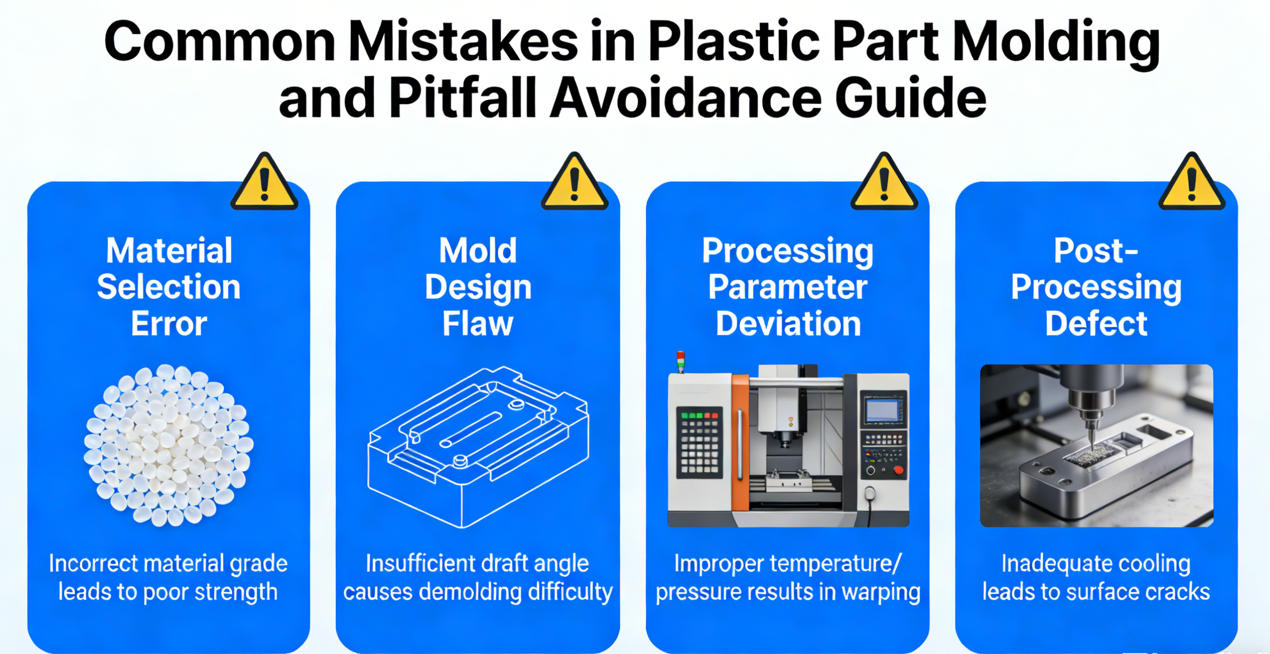
Common Mistakes in Plastic Part Molding and Pitfall Avoidance Guide
For importers and brand owners of daily household plastic products, plastic part molding is a critical link that directly affects product quality, production efficiency, and overall cost. However, many beginners and even experienced buyers often fall into avoidable misunderstandings during the molding process, leading to delayed delivery, increased costs, or even unqualified products that fail to meet market demands. This guide summarizes the most common mistakes in plastic part molding and provides practical solutions to help you avoid pitfalls and ensure a smooth molding process.
Plastic part molding for daily necessities—such as kitchenware, bathroom accessories, cleaning tools, and storage containers—has unique requirements for appearance, precision, and mass production stability. The following mistakes are particularly prevalent in this field, and understanding how to avoid them can save you time, money, and unnecessary trouble.
Mistake 1: Overlooking DFM Analysis Before Molding
One of the most frequent and costly mistakes is skipping Design for Manufacturability (DFM) analysis before starting mold production. Many buyers rush to confirm the mold design based solely on their product drawings, ignoring whether the design is compatible with the molding process. For example, unreasonable wall thickness (too thick or uneven), insufficient draft angles, or improper undercut designs often lead to defects such as shrinkage, warping, difficulty in demolding, or even mold damage during trial runs.
Pitfall Avoidance: Insist on asking your mold manufacturer to provide a detailed DFM report before mold production. A professional manufacturer will analyze your product design, point out potential issues, and propose optimized solutions—such as adjusting wall thickness uniformity, adding appropriate draft angles (usually 1-3° for daily plastic products), or modifying undercut structures to ensure smooth molding. This small step can avoid major rework costs and delays later.
Mistake 2: Blindly Pursuing Low Mold Costs
Cost control is important for daily household products, which are often low-margin and high-volume. However, many buyers make the mistake of choosing the cheapest mold quote without considering the quality of materials and craftsmanship. Some manufacturers cut corners to lower prices—using inferior mold steel (such as low-grade carbon steel instead of P20 or 718H), reducing the number of cooling channels, or skipping heat treatment processes. This leads to short mold life, frequent failures during mass production, and increased maintenance costs, which ultimately exceed the initial savings.
Pitfall Avoidance: Focus on cost-effectiveness rather than the lowest price. When comparing quotes, ask for details about mold materials, heat treatment processes, cooling system design, and quality control standards. For high-volume daily plastic products, investing in high-quality mold steel (such as 718H for general use or S136 for products requiring high surface finish) and a reasonable cooling system will extend mold life, reduce production downtime, and save costs in the long run.
Mistake 3: Ignoring Mold Trial and Defect Handling
Another common mistake is neglecting the importance of mold trial and rushing to mass production after a single trial run. Many buyers think that as long as the plastic part can be demolded, the mold is qualified. However, problems such as uneven surface finish, dimensional deviations, flash, or sink marks may not be obvious in small-batch trials but will become serious during mass production, leading to a large number of defective products.
Pitfall Avoidance: Insist on multiple mold trials until all defects are resolved. After each trial run, ask the manufacturer to provide a detailed trial report, including product dimensional inspection data, surface quality photos, and defect analysis. Common defects such as flash can be solved by adjusting mold clamping force or trimming the mold cavity; shrinkage can be improved by optimizing injection parameters or adjusting the cooling system. Only when the trial products meet your quality standards can you start mass production.
Mistake 4: Unclear Communication on Tolerance and Quality Standards
Daily household plastic products often have specific requirements for dimensional tolerance and surface quality (such as no scratches, no burrs, or a matte finish). However, many buyers fail to clearly communicate these standards with the mold manufacturer, leading to inconsistencies between the final product and their expectations. For example, a plastic food container with excessive dimensional deviation may not fit its lid, while a bathroom accessory with surface scratches may fail to pass market inspections.
Pitfall Avoidance: Clearly specify tolerance requirements (such as ±0.05mm for key dimensions) and surface quality standards in the contract. Provide sample references if possible, and require the manufacturer to conduct strict quality inspections before delivery—including dimensional measurement with CMM equipment and surface quality checks. Regular communication during the molding process also helps resolve potential misunderstandings in a timely manner.
Mistake 5: Neglecting After-Sales Service and Mold Maintenance
Many buyers pay little attention to after-sales service when choosing a mold manufacturer, only to face difficulties when the mold needs maintenance or modification. Molds for daily plastic products are subject to wear and tear during long-term mass production, and without proper maintenance and timely after-sales support, mold life will be greatly shortened, and production will be interrupted.
Pitfall Avoidance: Choose a mold manufacturer with perfect after-sales service, including mold repair, maintenance guidance, and modification services. Ask about the manufacturer’s after-sales response time and whether they provide spare parts. In addition, establish a regular mold maintenance system—such as cleaning the mold cavity, checking the ejection system, and lubricating moving parts—to extend mold life and ensure stable production.
In conclusion, plastic part molding for daily household products requires careful planning, clear communication, and a focus on quality and cost-effectiveness. By avoiding the above common mistakes and following the pitfall avoidance guide, you can ensure that your mold production is smooth, your products meet market standards, and your investment achieves maximum returns. If you are looking for a reliable Chinese mold manufacturer specializing in daily household plastic molds, we have rich experience in exporting high-quality molds and can provide one-stop service from design and molding to after-sales support.
Post time:2026-04-08