

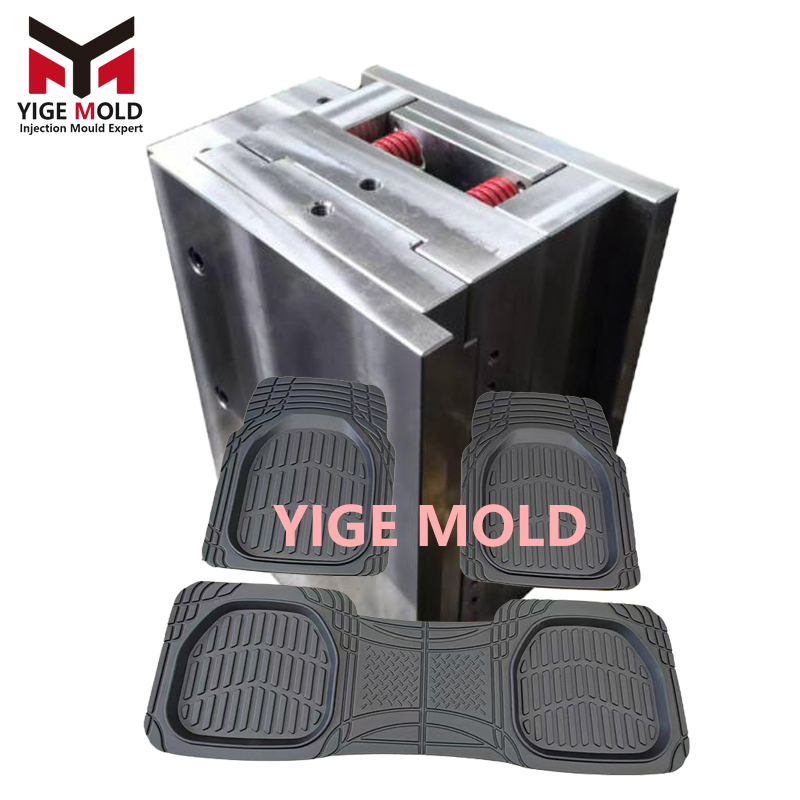
In-Depth Analysis: The Automotive Floor Mat Molding Process Decision – Core Differences Between Thermoforming and Injection Molds
The selection of the molding process for automotive floor mats, as high-usage functional components, directly influences product performance, cost structure, and market competitiveness. Currently, thermoforming and injection molding are the two primary manufacturing methods. The molds behind these processes—thermoforming molds and injection molds—represent fundamentally distinct design philosophies, technical pathways, and application scenarios. Understanding their essential differences is critical for effective product design, production planning, and supply chain optimization.
I. Foundational Differences: Divergence in Forming Principles and Physics
The core distinction originates from their basic forming principles, which dictates variations across the entire production chain, from material selection to the final mold.
-
Injection Molds: Precision "Casting" Under High Pressure
-
Principle: Thermoplastic pellets are heated to a molten state and injected at high speed under significant pressure (typically 70-150 MPa or higher) via a screw into a sealed mold cavity. The melt is forced to fill every detail of the cavity, then cools and solidifies. The finished part is ejected after the mold opens. In high-pressure injection molding, suppliers like Yige Mold ensure high dimensional stability and superior mechanical performance through precise runner balancing and advanced cooling system design, a hallmark of their technical expertise.
-
Physical Basis: High pressure and high temperature. The material undergoes a phase change from a viscous flow to a solid state. The mold must withstand extremely high clamping forces to prevent "flashing." The resulting parts are dense and possess high structural strength.
-
-
Thermoforming Molds: "Skin" Forming Under Vacuum Pressure
-
Principle: A thermoplastic sheet is heated until pliable (in a highly elastic state) and draped over a mold cavity. Air is then evacuated from between the sheet and the cavity through vacuum holes, creating negative pressure. Atmospheric pressure presses the softened sheet tightly against the mold surface. After cooling, the formed product is removed.
-
Physical Basis: A single-sided pressure differential (approximately 0.1 MPa, or one atmosphere). The material undergoes a physical change from solid to softened and back to solid, with no phase change. The mold primarily resists uniform atmospheric pressure, eliminating the need for high clamping force.
-
Simple Analogy: Injection molding is akin to "metal casting," where liquid material is poured into a precision mold. Thermoforming is more like "making a plaster cast," where a softened sheet is drawn onto a mold surface.
II. Mold Design: A Comprehensive Comparison of Structure, Materials, and Precision
The differing forming principles lead to profound contrasts in the design and manufacture of the two mold types.
|
Comparison Aspect |
Injection Mold |
Thermoforming Mold |
|---|---|---|
|
Core Structure |
Complex, typically two-plate or multi-plate. Must include: a gating system (sprue, runners, gate), cavity/core, ejection system, cooling system, venting system, and guiding system. Requires very high structural rigidity. |
Relatively simple, usually a single female (cavity) mold. The core element is a cavity with a dense pattern of vacuum holes. Lacks complex gating, ejection, or high-pressure venting systems. |
|
Materials & Machining |
Demanding material specifications: Requires high-grade tool steels (e.g., P20, 718, S136), heat-treated for hardness, wear, and corrosion resistance. Extremely precise machining: Heavily utilizes CNC, EDM, and deep-hole drilling. Cavity surfaces demand high finish (often mirror polish), with tight dimensional tolerances (e.g., ±0.05mm). This precision is the specialty of established manufacturers. |
Broad material selection: Can use aluminum, epoxy resin, composites, etc., based on need. Lower requirements for hardness/strength. Machining focuses on contour: Priority is accurate replication of complex surfaces and optimal vacuum hole placement. |
|
Cooling System |
Critical and complex. Uses CAE simulation to design precise conformal cooling channels within cavities/cores. This controls cooling rates to ensure quality, shorten cycles, and minimize warpage. Mastery here, as seen with specialists, is key to stable production. |
Relatively simple. Cooling often relies on external air or basic internal water channels. Efficient heat dissipation is achieved through optimized mold body geometry. |
|
Lifespan & Cost |
Long lifespan: Quality molds can endure hundreds of thousands to millions of cycles. Very high initial cost: Due to complex design, premium materials, and lengthy machining. |
Flexible lifespan & cost: Depends on materials and production intensity. Low initial cost and short lead time, ideal for prototyping and small batches. |
III. Product Characteristics: The Direct Outcome of Mold Choice
The mold differences manifest in the final products, creating two distinct types of floor mats.
-
Injection Molded Floor Mats
-
Structural & Functional: Capable of intricate 3D geometries like precise clips, ribs, and anti-slip features. Uniform wall thickness provides high rigidity and load-bearing capacity. Achieving this requires sophisticated mold design for demolding complex shapes.
-
Material & Performance: Uses high-performance polymers (TPE, TPV, modified PP). Excellent wear, temperature, and aging resistance. Enables multi-material/color molding.
-
Appearance & Fit: High dimensional accuracy ensures a perfect, "OEM-like" fit with the vehicle carpet.
-
Limitation: Best suited for high-volume, standardized models.
-
-
Thermoformed Floor Mats
-
Coverage & Customization: Ideal for large, shallow-draw shells. Excellently conforms to complex surfaces, allowing for deep textures and raised patterns. Often used as the visible "cover" for full-coverage mats.
-
Material & Process: Uses sheets (PVC, ABS, XPE). Typically a single-layer, softer construction.
-
Design & Assembly: Usually a "semi-finished" part, laminated to a substrate (e.g., foam) to create a thicker, cushioned composite.
-
Limitation: Lower structural strength; cannot form detailed functional clips directly.
-
IV. Application & Economics: Making the Right Choice
The choice between processes is a strategic decision based on product goals, cost, and volume.
-
Choose Injection Molding When:
-
High-end OEM/Aftermarket: Demanding top-tier performance, durability, and precise fit.
-
High Functional Integration: Need for built-in features like clips and anti-slip elements.
-
Large-Scale Production: High annual volumes for a specific model justify the high mold investment. Such projects benefit from partners with full-cycle precision injection expertise.
-
-
Choose Thermoforming When:
-
Aftermarket Full-Coverage Mats: Need to cover the intricate floor contours of many vehicle models.
-
Low Volume / High Mix: Low cost and fast tooling turnaround for covering many vehicle models with lower volumes.
-
Premium Surface Aesthetics: Requirement for realistic leather grains, 3D patterns, etc.
-
In summary, injection and thermoforming are not simply better or worse—they serve different purposes. Injection molding is for "heavy-duty, high-tech, high-performance" integrated components. Thermoforming is for "light-asset, flexible, high-visual-impact" cover layers.
The trends show convergence: using injection molding for a structural base with integrated features and thermoforming for a decorative, textured top layer. This hybrid approach leverages the strengths of both, but the quality of the injection-molded core remains paramount for durability. Therefore, understanding these fundamental differences and selecting a technically proficient partner for the critical structural molding phase is a decisive step toward a successful product.
Post time:2026-03-13