Plastic fish tank injection mold
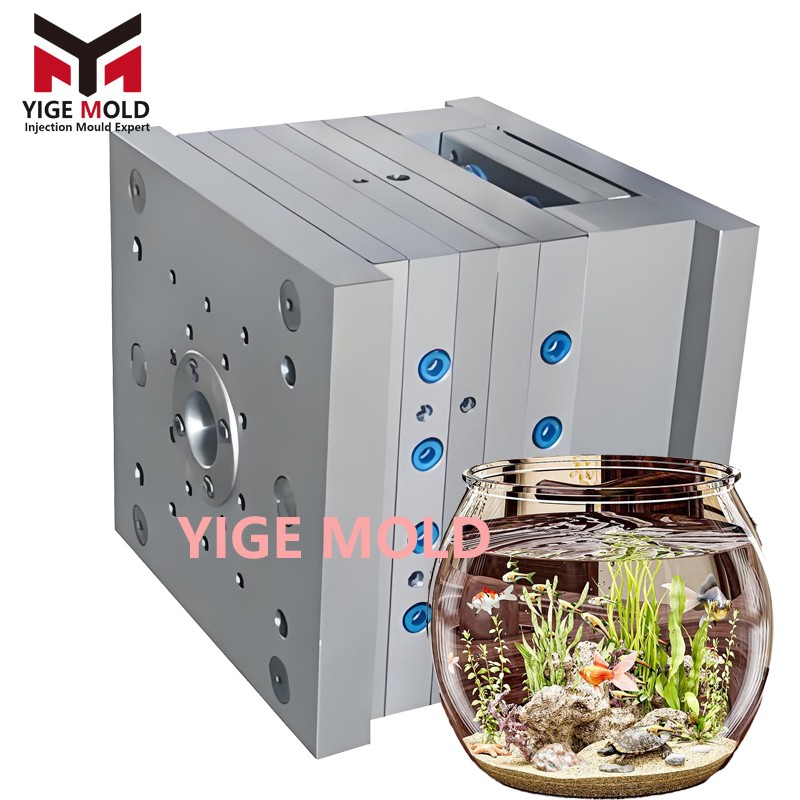
Plastic Fish Tank Injection Mold: The Fusion of Precision Engineering and Optical Art
A plastic fish tank injection mold is a specialized tooling designed and manufactured for producing fish tanks made from transparent engineering plastics such as acrylic and polycarbonate. Its core mission is to shape molten plastic into thin-walled shells possessing exceptional optical properties, structural integrity, and integrated complex functionalities in a repeatable, precise manner for mass production. Every detail of its design and manufacturing revolves around the three core challenges: combating internal stress, pursuing a mirror finish, and achieving stable demolding.
I. Design Philosophy: The Battle for "Clarity" and "Flatness"
Mold design is not simply replicating the product shape; it involves pre-calculating and compensating for the material's physical behavior under high temperature and pressure. Its core design philosophy includes:
-
Gating System Design: The Commander of Melt Flow
-
Strategic Layout of the Hot Runner System: To avoid material waste and optical defects from cold slug wells, large fish tank molds universally employ a hot runner system. The sequentially valve-gated hot runner system is key. By using multiple independently timed valve gates, it precisely guides the convergence points of the individual melt fronts, "herding" the inevitable weld lines to the tank's non-viewing corners or areas later covered by bonded reinforcement ribs, thereby achieving a "seamless" appearance on the main viewing surfaces.
-
Runner Sizing and Thermal Balance Calculations: The runner diameter, angles, and heater band layout require precise thermodynamic calculations to ensure consistent temperature and pressure drop as the melt flows through each branch, achieving synchronized filling.
-
-
Cooling System Design: The Art of Heat Exchange
-
Conformal Cooling Channels: Traditional straight drilled channels cannot meet the need for uniform heat dissipation across large planar areas. Modern designs employ 3D-printed conformal cooling channels or shaped copper cooling inserts. These channels are distributed like a "capillary network" 3-5mm from the cavity surface, enabling equidistant, isothermal cooling across all part zones. This is the most effective method to eliminate warpage and internal stress.
-
Zoned Independent Temperature Control: The mold is divided into multiple independent cooling circuits. Cooling density is increased for thick sections (e.g., edges, ribs) and decreased for thin walls to achieve overall simultaneous solidification.
-
-
Cavity and Core Design: The Foundation of Rigidity and Precision
-
Integrated Rigidity Reinforcement: To prevent micron-level elastic deformation under hundreds of tons of injection pressure (which causes uneven wall thickness and optical distortion), the moving and fixed plates are made from heavy-duty pre-hardened mold steels (e.g., P20, 718). Dense internal support pillars, dowel locks, and interference-fit shear edges are designed to form a "rigid fortress."
-
The Extremes of Venting and Surface Finish: Perimeter venting channels with depths of only 0.015-0.025mm are designed at the parting line and all insert seams. The cavity surface undergoes dozens of polishing steps, from #400 to #15,000 diamond compound, achieving an SPI-A1 grade (mirror finish). Some high-end molds receive an electroless nickel plating to further enhance hardness, wear resistance, and release properties.
-
-
Ejection System Design: Ensuring a Smooth Parting
-
Due to the strong adhesion between the plastic and the high-gloss cavity, the ejection system requires careful design. Large-area nitrogen springs are commonly used to assist mold opening, providing a smooth initial force. The ejection system employs a combination of large-diameter ejector pins and blade ejectors, and may include compressed air assist channels that introduce air between the part and cavity during ejection to break the vacuum, ensuring the part is released smoothly, without deformation or scratches.
-
II. Manufacturing Process: From Blueprint to "Steel Crystal"
-
Precision Machining: Cavity inserts are roughed and finished using high-speed CNC milling. Critical mating surfaces are machined by slow wire EDM, achieving accuracies of up to ±0.003mm. The final fit of the parting surfaces relies on precision surface grinding and hand scraping to ensure a complete seal and prevent flash.
-
Specialty Polishing: Mirror polishing is a craftsmanship-dependent "art." The process, from stone grinding, progressive sanding with abrasive paper, to fine polishing with diamond compound on ultrasonic machines, must be conducted in a Class 10,000 cleanroom to prevent dust embedding. The polishing direction must strictly align with the designated demolding direction.
-
Assembly and Debugging: This is the stage that "breathes life into the mold." All moving components (guide pins, ejector pins, slides) are hand-fitted for smooth operation. Cooling channels undergo high-pressure flow testing and flow balance debugging to ensure consistent flow across all circuits. Finally, a mold tryout under clamping pressure checks the parting line contact under tonnage.
III. Material-Specific Design Adaptations
Mold design must be deeply integrated with the properties of the target plastic:
-
For Acrylic (PMMA): It has a high shrinkage rate (~0.5%) and is prone to internal stress. The mold cooling system must be exceptionally efficient and uniform, and gate sizes need to be appropriately larger to reduce shear heating.
-
For Polycarbonate (PC): Its high hardness demands greater wear resistance from the mold steel.
Conclusion
The plastic fish tank injection mold is the negative space of an "optical palace" carved in steel. Its value lies not in its own weight, but in its ability to precisely recreate, countless times, a space that combines mechanical strength with visual transparency. From every runner balance calculation in the hot runner, to every conformal path of the cooling channels, down to every nanometer-level polish mark on the cavity surface, it embodies the wisdom of defying physical laws in pursuit of engineering perfection. It is not merely a production too