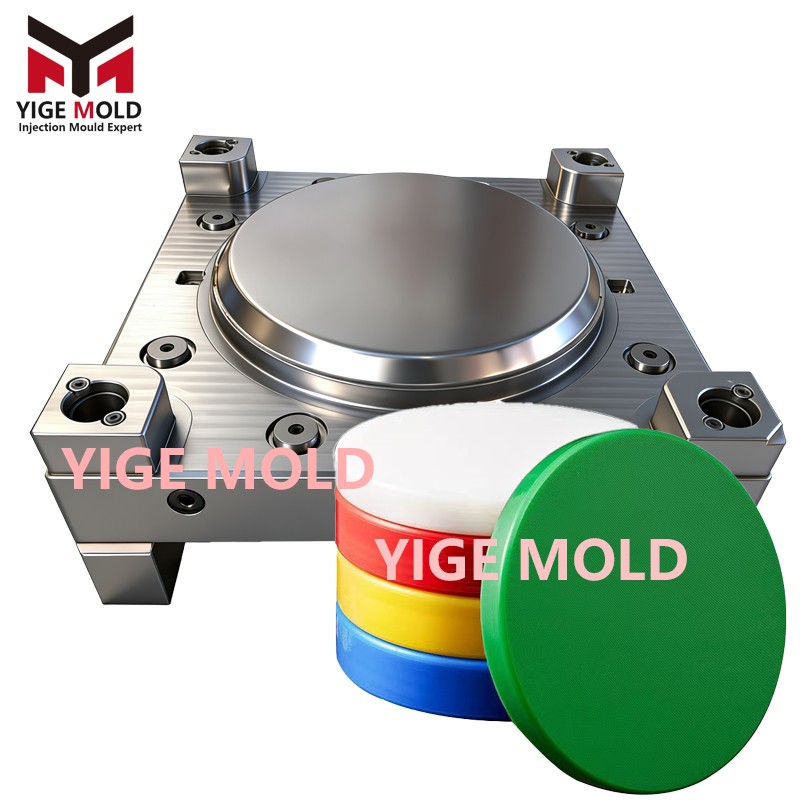
Round plastic chopping board injection mold
 Round Plastic Chopping Board Injection Mold: A High-Standard Manufacturing System for Food-Contact Products
I. Product Positioning and Technical Characteristics
The round plastic chopping board injection mold is a precision molding system within the category of food-contact plastic product molds, specifically designed for producing circular cutting platforms that meet modern kitchen hygiene requirements. This type of mold must not only fulfill the basic function of structural shaping but also satisfy multiple special requirements including food-grade safety standards, knife-cut and impact resistance, and antibacterial/anti-mold properties. Compared to square chopping board molds, round molds must address unique technical challenges in design, such as uniform shrinkage control, edge integrity maintenance, and center-area cooling.
Round chopping boards typically have standard specifications of 300-450mm diameter and 15-25mm thickness, featuring a centrally symmetric design. The mold must achieve radial, uniform melt flow from the center outward through a precise, balanced hot runner system, avoiding density variations and stress concentration caused by differing flow paths. Surface treatment must meet food-grade mirror finish standards (Ra ≤ 0.025μm), ensuring no microscopic pores that could harbor food residue.
II. Mold Structural Design Engineering
1. Radial Gating System
A center pin-valve hot runner system is employed, with the gate located at the geometric center of the board. Hot nozzles use titanium alloy for corrosion resistance and uniform heat transfer. The sprue is designed as a tapered, expanding structure with a 3-5° taper for smooth melt transition. Runners adopt a radial fan-shaped design, with 8-12 runners evenly distributed. Each runner's cross-sectional area decreases by 15-20% from the center outward, ensuring balanced flow in all directions. Gate diameter is φ1.5-2.0mm, using a submarine (tunnel) gate design that shears automatically after molding.
2. Multi-Layer Composite Cooling System
Addressing the characteristics of thick-walled circular parts, a three-layer cooling structure is designed. The first layer is for surface rapid cooling: channels are φ8mm diameter, spaced 60-80mm apart, arranged in a spiral pattern, 8-10mm from the cavity surface. The second layer is for intermediate balanced cooling: φ10mm diameter channels arranged concentrically, 15-18mm from the surface. The third layer is for core slow cooling: φ12mm diameter channels in a grid pattern, 25-30mm from the surface. Each layer circulates independently, with temperature variation controlled within 2°C.
3. Vacuum-Assisted Venting System
Annular venting grooves are machined on the parting line: depth 0.015-0.020mm, width 5-8mm, covering over 80% of the circumference. At the flow ends (edge areas), 8-12 porous vent inserts are installed: porosity 30-35%, pore size 10-20μm. The center area integrates a vacuum venting device, evacuating the cavity to -0.08MPa before injection to effectively eliminate air traps. Ejector pins are of the vented type, with 0.3mm x 0.02mm venting slots along the shaft.
4. Anti-Deformation Support Structure
The bottom features a radial rib system: 12-16 main ribs, rib height 6-8mm, width 4-6mm, with R2-R3 fillets at the roots. Circular reinforcing bosses (diameter 15-20mm, height 2-3mm) are placed at rib intersections. The edge area incorporates an annular reinforcing rib: width 8-12mm, thickness 60-70% of the wall thickness. All reinforcing structures use graduated transition designs to avoid abrupt stress changes.
III. Materials Engineering Application
1. Mold Steel Selection
Cavities and cores use corrosion-resistant mirror polish steel S136 SUPR (hardness HRC 48-52), offering excellent polishability and wear resistance. Sliders and lifters use high-toughness mold steel H13 (hardness HRC 48-52), with surface nitriding treatment. The hot runner system uses a stainless steel and copper alloy composite structure, improving thermal conductivity by 30%. Mold plates use pre-hardened steel P20 (hardness HRC 30-35) to ensure overall rigidity.
2. Plastic Material Compatibility
Food-grade High-Density Polyethylene (HDPE) is the primary material: Melt Flow Index 0.3-0.5 g/10min, density 0.95-0.96 g/cm³. 2-3% antibacterial masterbatch (silver-ion or zinc oxide type) is added, achieving an antibacterial rate ≥99.9%. Color masterbatch uses food-grade organic pigments with migration resistance meeting FDA standards. Toughening agent addition is 5-8%, achieving falling dart impact strength ≥60 kJ/m². Anti-mold agent addition is 0.5-1.0%, achieving mold resistance grade 0 after 28 days.
3. Surface Treatment Technology
The food-contact surface undergoes a nine-stage mirror polishing process: 400# sandpaper rough grind → 600# sandpaper medium grind → 800# sandpaper fine grind → 1000# sandpaper precision grind → 3μm diamond compound pre-polish → 1μm diamond compound medium polish → 0.5μm aluminum oxide fine polish → chromium oxide ultra-fine polish → final buffing with wool wheel. Final surface roughness Ra ≤ 0.015μm, gloss ≥95 GU. Non-appearance surfaces receive VDI 18 spark erosion texture, depth 0.8-1.2mm.
IV. Manufacturing Process Control
1. Cavity Precision Machining
Five-axis simultaneous high-speed machining centers are used: spindle speed 15,000-20,000 rpm, feed rate 8,000-10,000 mm/min. Rough machining leaves 1.5-2.0mm stock, semi-finishing leaves 0.3-0.5mm stock. Finish machining uses a small depth-of-cut, high feed rate strategy: depth 0.1-0.2mm, feed 3,000-5,000 mm/min. Curved surfaces are machined with ball-nose end mills, stepover 0.05-0.08mm. Rib slots are machined with φ3-φ4mm diameter solid carbide end mills using helical interpolation.
2. Hot Runner System Assembly
Hot nozzles are installed with an interference fit: interference 0.01-0.015mm. Nozzle and manifold use taper seal: taper 15°, contact area ≥85%. Heating bands use ceramic material, maximum operating temperature 450°C. Thermocouples are installed to a depth 2-2.5 times the nozzle diameter, measurement accuracy ±0.5°C. The system undergoes a 48-hour aging test, temperature fluctuation ≤ ±1°C.
3. Cooling System Testing
Water channels undergo a 1.5 MPa pressure test, holding for 30 minutes with no leakage. Flow test ensures flow rate difference between circuits ≤5%. Temperature field testing uses thermal imaging cameras, surface temperature difference ≤3°C. Cleanliness testing uses particle counters: particles ≥0.5μm ≤100 particles/L.
V. Molding Process Parameters
1. Temperature Control
Barrel temperature settings: Zone 1 180-190°C (feed), Zone 2 200-210°C (compression), Zone 3 210-220°C (metering), Zone 4 220-230°C (nozzle). Mold temperatures: Surface area 40-50°C, Intermediate area 45-55°C, Core area 50-60°C. Hot runner temperatures: Sprue 220-230°C, Runners 210-220°C, Gates 200-210°C.
2. Pressure Control
Injection pressure uses four-stage control: Stage 1 30-40MPa (gate breakthrough), Stage 2 60-70MPa (rapid fill), Stage 3 50-60MPa (packing), Stage 4 40-50MPa (hold). Back pressure 8-12MPa, screw decompression 3-5mm. Hold time is calculated as 2.5-3 seconds per mm of wall thickness; cooling time as 25-30 seconds per mm.
3. Speed Control
Injection speed uses three-stage control: Stage 1 20-30mm/s (slow past gate), Stage 2 60-80mm/s (rapid fill), Stage 3 30-40mm/s (end deceleration). Screw speed 80-100 rpm, plasticizing time 20-25 seconds. Mold opening speed uses a slow-fast-slow profile, maximum speed 500 mm/s.
VI. Quality Inspection Standards
1. Dimensional Accuracy Inspection
Diameter tolerance ±0.3mm, thickness tolerance ±0.2mm, flatness ≤0.4mm/300mm, warpage ≤0.5mm. Rib height tolerance ±0.1mm, width tolerance ±0.15mm. Weight tolerance ±3%, density deviation ≤0.5%.
2. Surface Quality Inspection
Mirror area roughness Ra ≤ 0.02μm, gloss ≥95 GU. Texture area roughness Ra 1.6-3.2μm, texture depth uniformity ≤0.1mm. Color uniformity ΔE ≤ 1.0, free from flow marks, splay, bubbles, etc. Edge integrity check: no short shots, flash, or other defects.
3. Performance Testing
Drop impact test: 500g steel ball free fall from 1m height, surface shows no cracks. Knife cut test: Standard kitchen knife cuts 5000 times, cut depth ≤0.2mm. Load test: Uniform 50kg load applied for 24 hours, deformation ≤0.3mm. Heat resistance test: Soak in 100°C boiling water for 1 hour, dimensional change rate ≤0.2%.
4. Hygiene and Safety Testing
Heavy metal migration test: Lead ≤0.01 mg/dm², Cadmium ≤0.005 mg/dm². Formaldehyde migration ≤1.5 mg/dm². Antibacterial performance test: Staphylococcus aureusand E. coliantibacterial rate ≥99.9%. Mold resistance test: 28-day incubation Grade 0 (no mold spots).
VII. Production Efficiency Optimization
1. Rapid Molding Technology
Optimizing the gating system reduces injection time to 8-10 seconds. Variotherm mold temperature technology reduces cooling time by 20-25%. Developing quick ejection mechanisms reduces ejection stroke time to ≤3 seconds. Automated part removal systems control single cycle time to 45-50 seconds.
2. Multi-Cavity Mold Design
Developing 1x2 or 1x4 multi-cavity molds, cavity spacing 180-220mm. H-type runner layout ensures fill time difference between cavities ≤0.1 second. Independent temperature control systems keep temperature difference between cavities ≤1.5°C. Balanced ejection systems maintain ejection synchronization error between cavities ≤0.05 seconds.
3. Energy Management System
Hot runner uses PID closed-loop control, reducing energy consumption 30%. Cooling system uses variable frequency control, reducing pump energy use 40%. Ceramic insulation layers added externally to the mold reduce heat loss 25%. Optimizing heating power configuration reduces total power 20%.
VIII. Maintenance and Care System
1. Daily Maintenance
Clean parting line and vents each shift using specialized mold cleaner. Check hot runner wiring and thermocouples to ensure reliable connections. Lubricate guide pillars, sliders, and other moving parts with food-grade grease. Check cooling water flow and clean filters.
2. Periodic Maintenance
Perform comprehensive maintenance every 10,000 cycles, including disassembly, cleaning, wear inspection, and seal replacement. Refurbish polished working surfaces to restore mirror finish. Check heating element resistance values; replace if deviation exceeds 10%. Calibrate temperature control system to ensure measurement accuracy.
3. Preventive Maintenance
Establish a mold health file recording total cycles, maintenance history, and process parameters. Develop a preventive maintenance plan, replacing wear parts proactively based on usage. Maintain a spare parts inventory, keeping 2-3 sets of critical components. Train certified maintenance personnel.
IX. Application Field Expansion
1. Household Series
Diameter 300-350mm, thickness 18-20mm, weight 1.2-1.8kg. Surface features a fine satin texture, slip resistance coefficient 0.7-0.8. Colors use a categorization system: Red - raw meat, Blue - seafood, Green - vegetables, White - cooked food. Bottom has 4-6 anti-slip feet, height 3-4mm.
2. Commercial Series
Diameter 400-450mm, thickness 22-25mm, weight 2.5-3.5kg. Material uses high-strength HDPE, drop impact strength ≥80 kJ/m². Edge design includes a juice groove: width 12-15mm, depth 5-6mm. Bottom has reinforced structure, load capacity ≥100kg.
3. Special Applications
Antibacterial board: Adds nano-silver antibacterial agent, antibacterial rate ≥99.99%. High-temperature resistant board: Uses PP material, withstands 120°C. Lightweight board: Uses microcellular foaming technology, weight reduced 30%. Smart board: Integrates weighing sensor, accuracy ±1g.
X. Economic Benefit Analysis
Mold manufacturing cost: RMB 250,000-400,000, service life 800,000-1.2 million cycles. Per-unit production cost: RMB 2-4, market price RMB 20-60, gross margin 60-80%. Material utilization rate ≥96%, defect rate ≤0.2%. Automated production saves labor cost 70%, equipment utilization ≥90%.
Example for a 350mm diameter board mold: Investment RMB 300,000, daily capacity 2,400-3,000 pieces, annual output value RMB 4-6 million. Functional upgrades increase product added value 40-60%. Material optimization reduces costs 15-20%. Efficiency improvements shorten payback period to 10-15 months.
The technical level of a round plastic chopping board injection mold directly determines the final product's market competitiveness and user satisfaction. From material selection to structural design, from manufacturing processes to quality control, each stage requires meticulous professionalism. As consumer demands for kitchen hygiene continue to rise and materials science advances, these molds will continue to develop towards higher hygiene standards, longer service life, and smarter functionalities. Mold manufacturers must establish a comprehensive food-grade quality management system and master advanced processing and inspection technologies to maintain a competitive edge in this niche sector with extremely high safety and quality requirements, providing safe and reliable food preparation tools for kitchens worldwide.