PVC Flooring Mold
Comprehensive Technical Analysis of PVC Flooring Injection Molds
Chapter 1: Product Definition and Process Positioning
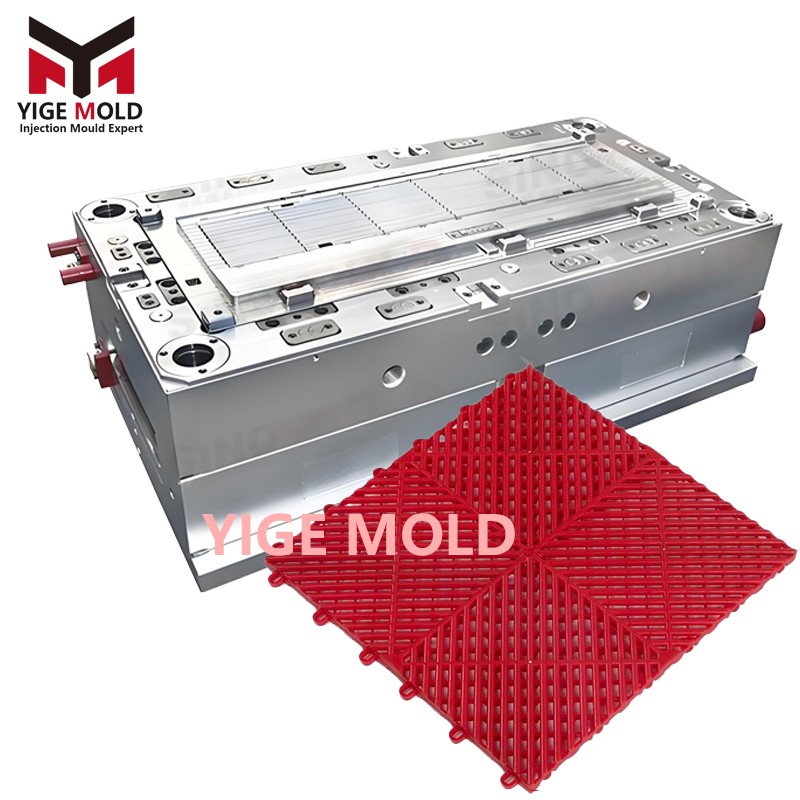
A PVC flooring injection mold is a specialized tooling system used for manufacturing various types of flooring with polyvinyl chloride (PVC) as the core raw material. Fundamentally different from the widely used calendering and extrusion processes, injection molding technology is dedicated to producing high-end flooring materials featuring three-dimensional structures, precise assembly interfaces, and complex surface textures. Typical products include SPC (Stone Plastic Composite) click-lock flooring, multi-layer composite flooring, shaped mosaic tiles, and flooring products with special functional structures. The core advantage of this process lies in its ability to complete the integrated molding of the wear layer, decorative layer, substrate layer, and functional structures of a flooring product in a single injection cycle, thereby ensuring the product possesses excellent dimensional stability, interlayer bonding strength, and overall mechanical properties. The products must strictly comply with major domestic and international technical specifications, including EN 13329 (EU resilient flooring standard), ASTM F1700 (US commercial flooring standard), and GB/T 4085 (China PVC flooring standard). These standards impose mandatory requirements on flooring dimensions and tolerances, abrasion resistance (number of revolutions), impact resistance, fire rating, and environmental indicators.
Chapter 2: Mold System Structure and Design Specifications
PVC flooring injection molds belong to the category of large, precise, and complex mold systems. Their design is based on the principles of multi-cavity layout, high efficiency, and stability.
2.1 Large Multi-Cavity Mold Structure
To meet the economic requirements of large-scale production, molds commonly employ a one-mold-multi-cavity design. Typical cavity layouts are 1x4, 1x6, 1x8, and up to 1x12. The mold's projected area is enormous, typically ranging from 2 to 8 square meters, which demands extremely high rigidity from the mold body. The mold mainframe adopts a heavy-duty three-plate structure, with plate thickness not less than 600mm, optimized by Finite Element Analysis (FEA) to ensure minimal deformation under massive clamping forces. The mold must be matched with large injection molding machines with clamping forces between 1600 and 4000 tons. Consequently, the parallelism requirements for the mold plates are extremely stringent, needing to be controlled within a deviation of no more than 0.02mm per meter of length. Guide pillars and bushings use ball-bearing structures and are equipped with a centralized lubrication system to ensure guiding accuracy and longevity under long-term, high-load operation.
2.2 Integrated Multi-Functional Modules
To achieve the "single-shot" molding of complex flooring, the mold integrates several functional subsystems:
-
Decorative Layer In-Mold Insertion System: This system is used to accurately feed and fix pre-printed decorative foils (e.g., wood grain, stone pattern foils) into the cavity before injection. It includes a multi-axis robotic arm automatic foil feeding mechanism, a micro-porous vacuum adsorption plate covering the entire cavity area (positioning accuracy required to be within ±0.3mm), and an infrared preheating device. The preheater softens the decorative foil to 80-120°C, facilitating perfect adhesion between the foil and the molten PVC substrate under injection pressure, eliminating bubbles and wrinkles.
-
Three-Dimensional Texture Formation System: The floor's surface feel and visual effect are directly replicated from the microscopic morphology of the mold cavity surface. This system uses technologies like laser engraving, chemical etching, or EDM texturing to create textures such as leather grain, wood grain, and stone patterns on the mold steel surface, with depths ranging from several microns to several hundred microns. For products requiring a soft, elastic feel, the mold employs microcellular foaming technology. By precisely controlling the gas counter-pressure within the cavity, a uniform microcellular foam structure is formed in the skin layer, with an adjustable expansion ratio between 1.5 and 3 times.
-
Precision Locking System Molding: This is the core of SPC click-lock flooring molds. The mold must be capable of forming complex three-dimensional locking tongues and grooves, including "Click" and "Lock" types. For this purpose, the mold incorporates precisely engineered side-core pulling mechanisms. These mechanisms are typically driven by hydraulic cylinders, capable of 360-degree rotation or linear motion to form the undercuts and cantilevered structures of the locking features. The ejection system also employs strategies like secondary ejection or delayed ejection to ensure the locking features are not damaged or stretched during ejection. Some high-end molds integrate in-line laser scanning devices to perform non-contact measurement of critical locking dimensions before ejection.
Chapter 3: Key Technology Implementation and Material Application
3.1 Multi-Layer Gradient Co-Injection Technology
PVC injection-molded flooring is typically a multi-layer composite structure. The mold and process must achieve the orderly combination of different material formulations in both space and time. A typical gradient structure includes:
-
Super Wear-Resistant Transparent Layer: Thickness approximately 0.3-0.7mm, material is PVC blended with a high proportion (e.g., over 30%) of aluminum oxide or silicon carbide particles, ensuring a product surface wear resistance exceeding 15,000 revolutions.
-
Decorative Layer: The pre-inserted printed foil providing the pattern.
-
High-Stiffness Substrate Layer: Thickness 3-6mm, forming the main body of the floor. Material is PVC filled with a large amount (60-80%) of calcium carbonate, with foaming agents added as needed to adjust density (typically 1.6-1.8 g/cm³) and weight.
-
Balancing/Stabilizing Layer / Acoustic Layer: Thickness 0.5-2mm, composed of materials like soft PVC, EVA, or IXPE foam, serving to balance stress, improve underfoot feel, and reduce impact noise (can achieve below 15dB).
The mold, through specially designed runner and gate systems combined with precise sequential control, enables the sequential filling, superposition, and fusion of these melts or pre-inserted materials with different viscosities and flow characteristics.
3.2 Mold Surface Treatment and Texture Creation Technology
The treatment of the cavity surface directly determines the floor's appearance and tactile quality. Main technologies include:
-
Chemical Etching and Sandblasting: Through steps like photosensitization, masking, and corrosion, macroscopic textures like matte, fine sand, and leather are formed on the mold steel surface. Gloss can be precisely controlled within a range of 5-50 GU.
-
Laser Engraving: Using high-power lasers to vaporize material on the mold surface, creating microscopic textures with controllable depth and angle, achieving precision up to ±2 microns. This is the primary method for creating fine textures that imitate real wood grain pores and annual rings.
-
Surface Hardening and Anti-Friction Coatings: To improve mold life, prevent premature texture wear, and enhance release properties, cavity surfaces are often treated with nitriding, PVD (Physical Vapor Deposition) chromium plating, or DLC (Diamond-Like Carbon) coating. DLC coating can increase surface hardness to over HV3000, equivalent to a 3H pencil hardness, significantly improving the mold's scratch resistance.
Chapter 4: Temperature Control and Runner System
4.1 Multi-Zone Independent Temperature Control
PVC injection molding for flooring is extremely sensitive to temperature. The mold must achieve precise zonal temperature management. A typical mold may be divided into 6 or more independent temperature control zones:
-
Decorative Surface Zone: Uses high-temperature oil circulation (85±1°C) to ensure proper softening and adhesion of the decorative foil.
-
Locking and Edge Zones: Uses medium-temperature water control (55±2°C) to ensure sufficient material crystallization in these areas for high strength.
-
Substrate Thick-Wall Zones: Uses low-temperature water (15±1°C) or even chilled water to accelerate cooling and prevent sink marks.
-
Special Rapid Cooling Zones: For areas near the gate of the super wear-resistant surface layer, instantaneous cooling technologies like liquid nitrogen injection may be used to prevent material degradation.
Dozens of high-precision thermocouples or fiber optic temperature sensors are embedded inside the mold to provide real-time temperature data feedback for closed-loop control.
4.2 Hot Runner System Design
Given the product's large size and wide projected area, a hot runner system is essential to reduce runner scrap and ensure pressure transmission. The system uses sequentially controlled valve-gated hot runners. The number of gates is carefully designed according to the cavity layout. Hot runner manifolds and nozzles use internal heating, and heater power density must be evenly distributed to prevent local overheating leading to PVC degradation. Runner inner walls require high polishing and chrome plating to reduce melt flow resistance and prevent material stagnation and degradation.
Chapter 5: Precision Manufacturing, Assembly, and Commissioning
5.1 Key Machining Accuracy Requirements
The manufacturing precision of the mold is the foundation for ensuring floor quality:
-
Cavity Flatness and Profile: The cavity forming the floor surface must have an overall flatness better than 0.03mm over a 600mm span, typically measured in a constant temperature workshop using a large CMM or laser tracker. The profile of 3D textures must highly match the 3D digital model.
-
Locking Feature Fit Dimensions: Sliders and inserts forming the locking tongues and grooves must achieve micron-level machining accuracy. Fit clearance is typically controlled between 0.05-0.15mm and must be verified through digital comparison using 3D scanning.
-
Motion Mechanism Accuracy: All moving components like sliders, lifters, and ejector pins must act with high synchronization and precise timing, with positional repeatability better than 0.02mm.
5.2 Application of Special Machining Processes
-
5-Axis High-Speed Milling: Used for roughing and semi-finishing of large, complex curved surfaces and fine textures.
-
Precision EDM (Electrical Discharge Machining): Used for machining sharp corners, deep slots in locking features, and textures on hardened materials, using graphite or copper-tungsten electrodes with strictly controlled electrode wear.
-
Hand Polishing and Texture Finishing: Master craftsmen perform final hand polishing on cavity surfaces to achieve specific gloss requirements and blend texture transitions for a natural appearance.
5.3 Assembly and Trial Run Commissioning
Mold assembly is a systematic project. Assembly technicians must ensure the accurate placement of thousands of components, smooth operation of all moving mechanisms without sticking, and leak-free sealing of cooling channels and hydraulic circuits. During the trial run phase, process engineers must repeatedly adjust the injection machine's multi-stage injection speed, pressure, and temperature parameters, and optimize the packing pressure profile until the produced flooring meets all standards for dimensions, weight, appearance, locking force, and physical properties. This process can last several weeks and incur significant debugging costs.
Chapter 6: Molding Process Parameters and Quality Control
6.1 Typical Injection Molding Process Window
Taking the production of a standard 4mm thick SPC click-lock flooring plank as an example, its injection cycle typically ranges from 40 to 60 seconds. A complete injection cycle includes the following key stages:
-
Injection Phase: Employs multi-stage injection control. The first stage uses low speed and low pressure (e.g., 40MPa, 15% speed) to advance, ensuring the melt smoothly penetrates and wets the decorative foil, avoiding wrinkling or displacement. The second stage switches to high speed and high pressure (e.g., 100MPa, 85% speed) for rapid filling of the main cavity. The switch from velocity control to pressure control (V/P switchover) occurs when the cavity is 96%-98% filled.
-
Packing and Cooling Phase: Employs a three-stage or more decreasing packing pressure strategy to compensate for melt shrinkage during cooling, prevent sink marks, and control product density. For example, first-stage packing at 80MPa for 0.8 seconds, followed by gradual reduction. Cooling time is proportional to the square of the product thickness and must be precisely calculated to ensure the product is sufficiently set upon demolding.
-
Material Drying and Process Stability: PVC material is sensitive to moisture and must be thoroughly dried (e.g., 2-4 hours at 80-90°C). Barrel temperature settings must avoid overheating and degradation of PVC, typically set in the range of 160-200°C from the rear to the front zone.
6.2 In-Process and Finished Product Quality Monitoring
-
In-Mold Monitoring: Piezoelectric or strain gauge pressure sensors installed at key cavity locations monitor pressure distribution and balance during filling in real-time, providing data for process optimization.
-
In-Line Dimensional Inspection: Uses machine vision systems or laser distance meters to perform 100% online sampling or full inspection of thickness, flatness, and key locking dimensions of ejected flooring, calculating the Process Capability Index (Cpk) to ensure production stability.
-
Performance Testing: Regular samples are sent to the laboratory for destructive testing according to relevant standards, including abrasion resistance, impact resistance, dimensional stability, and locking pull-out force tests.
Chapter 7: Mold Maintenance, Servicing, and Lifecycle Management
7.1 Systematic Maintenance Procedures
To ensure the long-term stable operation of the mold, a strict preventive maintenance plan must be implemented:
-
Daily Maintenance: Clean parting lines and vent slots before and after each shift; check lubrication of all moving parts; confirm proper operation of heater bands and thermocouples.
-
Periodic Servicing:
-
Every 50,000 to 80,000 cycles: Dismantle and clean ejector pins and plates; inspect and replace guide bushings for all ejector pins and sleeves; calibrate terminals and thermocouples of the hot runner system.
-
Every 150,000 to 200,000 cycles: Dismantle main sliders and lifter mechanisms, inspect for wear, repair or replace worn parts; professionally polish cavity surfaces to restore finish and texture clarity.
-
Every 300,000 to 500,000 cycles: Perform a comprehensive mold overhaul, including dismantling all movable components, checking plate parallelism and guide pillar/bushing clearance, cleaning all cooling channels, inspecting hydraulic system seals, and, if necessary, performing restorative polishing or local welding repair on the cavity.
-
7.2 Expected Life of Key Components
Under normal use and maintenance, the design life of mold components is as follows:
-
Cavity and Core: The main steel body life can reach 800,000 to 1.2 million cycles. Surface textures can be extended through multiple repairs (e.g., re-etching, re-machining after laser cladding).
-
Hot Runner System: Heaters, thermocouples, and other consumables require regular replacement, but the manifold and nozzle main structure life can exceed 1.5 million cycles.
-
Hydraulic and Mechanical Moving Components: The life of seals for cylinders, slider guides, bearings, etc., is approximately 500,000 cycles, requiring periodic replacement.
-
Temperature Control and Sensor Systems: In a good environment, their service life can exceed 1 million cycles.
Chapter 8: Production Efficiency and Economic Analysis
8.1 Production Efficiency Indicators
A well-designed PVC flooring injection mold, under matched injection machine and stable process conditions, demonstrates its production efficiency mainly in:
-
Cycle Time: For mainstream 4-5mm thick flooring, the cycle can be controlled within 40-55 seconds. Cycle time is significantly affected by product thickness, structural complexity, cooling efficiency, and material properties.
-
Overall Equipment Effectiveness (OEE): Including planned mold changes, maintenance time, and unplanned downtime, the OEE for efficient production can reach over 85%.
-
First-Pass Yield: Through stable process control and online monitoring, the first-pass yield for mass production can be maintained above 99.5%.
8.2 Cost Structure and Investment Analysis
-
Initial Mold Investment: Depending on the mold's complexity, size, number of cavities, material selection, and configuration level, the cost of a set of PVC flooring injection molds ranges from 800,000 to 2,000,000 RMB or even higher.
-
Per-Unit Production Cost: Mainly includes raw material cost (PVC resin, fillers, additives, decorative foil), energy consumption (electricity, water), equipment and mold depreciation, labor, and management fees. The comprehensive production cost for a standard 4mm thick, approximately 1 square meter flooring plank is roughly between 3.2 and 4.5 RMB.
-
Energy Consumption Indicator: The comprehensive energy consumption (injection machine, dryer, cooling system, etc.) per kilogram of PVC injection-molded flooring typically ranges from 0.8 to 1.2 kWh.
-
Investment Payback Period: Assuming stable market demand and full production scheduling (e.g., two-shift operation), the payback period for the mold investment is generally between 12 and 18 months.
In summary, a PVC flooring injection mold is a high-tech-intensive product that integrates mechanical design, materials science, thermodynamics, fluid dynamics, and precision manufacturing. Its successful application can not only produce high-performance, high-value-added PVC flooring products but also places comprehensive demands on the production enterprise's technical management, quality control, and production scheduling capabilities. Its development and advancement are the key hardware foundation driving the PVC flooring industry's transformation and upgrading towards high-end, functional, and efficient manufacturing.