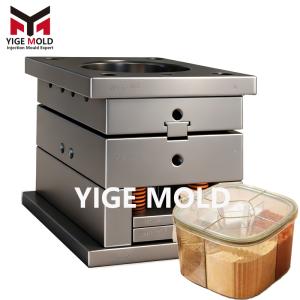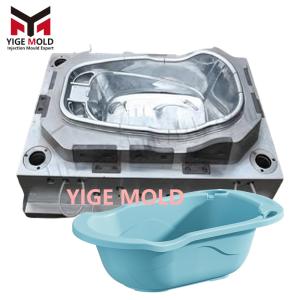
Toy Storage Box Mold
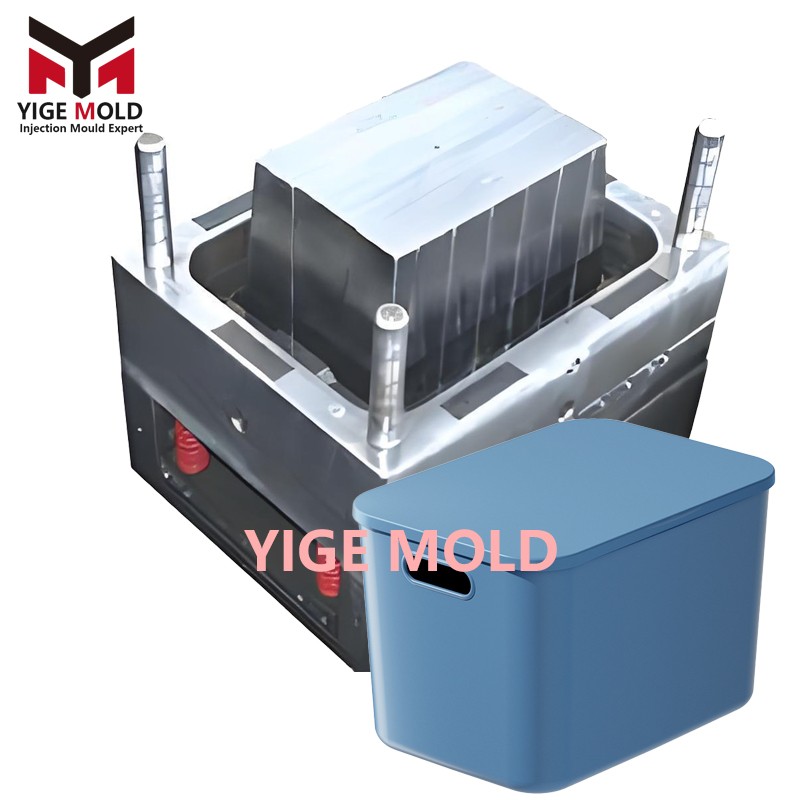
 Comprehensive Technical Analysis of Toy Storage Box Mold
I. Product Characteristics and Market Demand
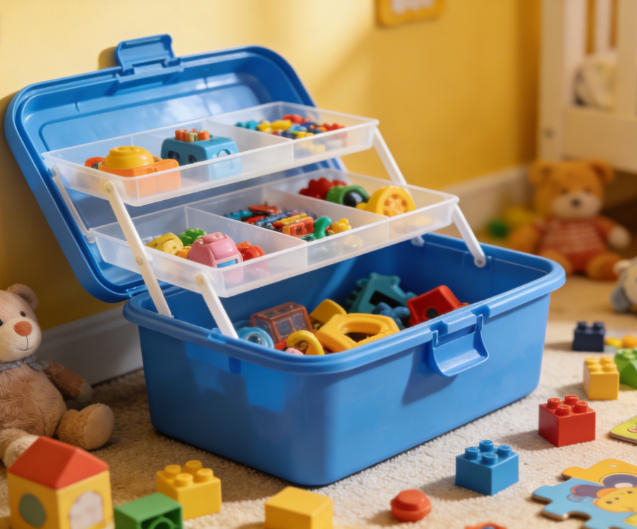
Toy storage boxes, as essential storage tools for children's homes and preschool education institutions, exhibit the following distinct features:
-
Safety Requirements: All edges must be designed with R2-R5 fillets to avoid sharp corner injuries; materials must comply with the EN71-3 heavy metal migration standard.
-
Structural Functionality: The box body and lid must include anti-pinch designs (gap 8-12 mm), and the box bottom must have anti-slip structures.
-
Aesthetic Design: Surfaces often require cartoon patterns, gradient colors, or translucent effects.
-
Durability Indicators: Must withstand children standing on them (load-bearing capacity ≥50 kg) and drop tests (10 drops from 1 m height without cracking).
II. Innovative Mold Structure Design
2.1 Multi-Cavity Efficient Layout
-
Adopts a balanced 1x4 or 1x6 cavity layout, with cavity spacing ≥80 mm.
-
Designs a balanced runner system, ensuring filling time difference between cavities ≤0.15 seconds.
-
Implements a central point gate combined with a hot runner system to achieve automated production.
2.2 Composite Core-Pulling Mechanism
-
Box Handle Forming System:
-
Uses hydraulic angled lifters for concave handle areas, with a core-pulling angle of 15°.
-
Implements dual guidance devices, controlling core-pulling stroke accuracy to ±0.02 mm.
-
Designs anti-stick structures to reduce demolding resistance.
-
-
Box Lid Snap-Fit Mechanism:
-
Employs a slider+T-slot linkage structure to achieve undercut depths of 5-8 mm.
-
Sets pre-reset devices to automatically reset all sliders before mold closing.
-
Designs snap-fit clearance as 0.1-0.15 mm.
-
2.3 Multi-Functional Ejection System
-
Main ejection uses a stripper plate structure (ejection area accounting for 70% of the projected area).
-
Adds air-assisted ejection devices in local deep cavity areas.
-
Implements staged ejection stroke control: first stage 5 mm slow pre-ejection, second stage full-stroke rapid ejection.
III. Mold Material Optimization Plan
3.1 Steel Selection Configuration
|
Component Name |
Material Selection |
Hardness Requirement |
Surface Treatment |
|---|---|---|---|
|
Cavity & Core |
P20 Pre-hardened Steel |
HRC 29-33 |
Polished to #3000 grit |
|
Sliders & Angled Lifters |
718H Steel |
HRC 33-37 |
Nitriding treatment |
|
Wear-Resistant Parts |
Powder Metallurgy Steel |
HRC 50-55 |
Hard chrome plating |
|
Hot Runner System |
High-Temperature Alloy |
HRC 40-45 |
Oxidation treatment |
3.2 Special Area Reinforcement
-
Snap-fit forming areas use 718H inserts with thickness ≥15 mm.
-
Anti-slip pin areas on the box bottom use beryllium copper inserts to enhance cooling.
-
Gate areas feature replaceable inserts for easier maintenance.
IV. Key Points in Molding Process Control
4.1 Injection Parameter Optimization
-
Temperature Control: Barrel temperature segmented control (180-220°C), mold temperature maintained at 45-55°C.
-
Pressure Adjustment: Injection pressure 80-110 MPa, packing pressure controlled with decreasing profile.
-
Speed Curve: Uses slow-fast-slow three-stage injection, fast stage filling speed 300-400 mm/s.
-
Cooling Time: Based on wall thickness of 2.5-4 mm, cooling time set at 25-35 seconds.
4.2 Defect Prevention Measures
-
Sink Mark Control:
-
Rib thickness controlled at 50-60% of main wall thickness.
-
Sets cooling wells in sink mark risk areas.
-
Extends packing time to 120% of gate freeze time.
-
-
Deformation Correction:
-
Predicts deformation through mold flow analysis, designs counter-deformation compensation.
-
Sets non-uniform cooling channels, enhances cooling in high-risk areas.
-
Uses shaping fixtures after ejection, holding time 2-3 minutes.
-
V. Surface Treatment Technology
5.1 Texture Processing Technology
-
Uses chemical etching to create matte surfaces (Ra 1.6-3.2 μm).
-
Laser engraving for cartoon patterns, depth 0.1-0.3 mm.
-
UV transfer printing for high-gloss logo effects.
5.2 Color Effect Implementation
-
Two-color injection molding: hard plastic (PP) + soft plastic (TPE) combination.
-
Gradient colors: Achieved through special gate design to control weld lines.
-
Pearl effect: Special mold surface polishing (Ra ≤0.012 μm).
VI. Mold Manufacturing Precision Control
6.1 Machining Process
-
Rough Machining Stage:
-
Cavities use high-speed milling, leaving 0.3 mm finish machining allowance.
-
Uses φ20 mm diameter tools for large-area material removal.
-
-
Finish Machining Stage:
-
Uses ball end mills (R3-R6) for surface finish machining.
-
Stepover controlled at 0.08-0.12 mm, surface roughness Ra ≤0.8 μm.
-
-
Special Machining:
-
Snap-fit areas use slow wire EDM, precision ±0.005 mm.
-
Handle fillets use five-axis simultaneous machining.
-
6.2 Inspection Standards
-
Cavity dimensional tolerance: ±0.03 mm.
-
Slider fit clearance: 0.02-0.03 mm.
-
Ejector pin hole position tolerance: ±0.01 mm.
-
Parting surface flatness: 0.02 mm/100 mm.
VII. Mold Maintenance Management System
7.1 Preventive Maintenance Plan
|
Maintenance Cycle |
Maintenance Items |
Technical Standards |
|---|---|---|
|
Every 10k cycles |
Clean parting surfaces |
No oil stain, no damage |
|
Every 30k cycles |
Check slider guides |
Clearance ≤0.03 mm |
|
Every 50k cycles |
Measure cavity dimensions |
Tolerance within ±0.05 mm |
|
Every 100k cycles |
Replace wear parts |
Replace according to original specifications |
7.2 Repair Technical Specifications
-
Surface Repair:
-
Minor scratches repaired with diamond grinding paste.
-
Damage depth ≤0.1 mm repaired via EDM.
-
Severe damage addressed with insert replacement.
-
-
Dimension Restoration:
-
Worn areas treated with laser cladding.
-
Combined with electroplating repair, plating thickness 0.01-0.03 mm.
-
Secondary precision machining after repair.
-
VIII. Quality Assurance System
8.1 Process Control Indicators
-
Product weight stability: ±0.5%.
-
Lid opening/closing force: 3-8 N·m.
-
Stacking fit clearance: 1-2 mm.
-
Color consistency: ΔE ≤1.0.
8.2 Testing and Verification Methods
-
Functional Testing:
-
Opening/closing life test: ≥30,000 cycles.
-
Load-bearing test: 50 kg load maintained for 24 hours.
-
Drop test: 10 drops from 1 m height.
-
-
Environmental Testing:
-
High-temperature test: Placed at 60°C for 48 hours.
-
Low-temperature test: Placed at -20°C for 24 hours.
-
UV aging test: 300 hours of irradiation.
-
IX. Cost Control Strategies
9.1 Material Optimization
-
Uses standardized mold bases to reduce customization costs.
-
Uses ordinary steel for non-critical parts.
-
Optimizes mold dimensions, reducing steel usage by 15-20%.
9.2 Production Efficiency Improvement
-
Designs quick mold change systems, changeover time ≤15 minutes.
-
Optimizes cooling system, reducing molding cycle time by 20%.
-
Achieves automated production, reducing manual intervention.
X. Application Case Analysis
10.1 Successful Case Parameters
-
Mold dimensions: 800×600×450 mm.
-
Molding cycle: 40 seconds.
-
Daily output: 12,000 pieces (three-shift system).
-
Mold life: ≥1.5 million cycles.
-
Product qualification rate: ≥99.2%.
10.2 Technical Difficulties Overcome
-
Lid Deformation Control: Achieved planarity within 0.5 mm/m through non-uniform cooling design.
-
Snap-Fit Strength Assurance: Optimized slider structure, ensuring snap-fit fatigue life ≥50,000 cycles.
-
Surface Effect Uniformity: Developed specialized polishing processes, ensuring consistency in multi-cavity production.
Conclusion
The design and manufacture of toy storage box molds require comprehensive consideration of multiple requirements including child product safety, structural functionality, production efficiency, and cost-effectiveness. Adopting a combined material solution of P20 and 718H, along with reasonable mold structure design and precise process control, can achieve high-quality, high-efficiency production goals. In practical applications, a comprehensive mold maintenance system should be established, regularly inspecting wear in key areas and performing timely preventive maintenance to ensure long-term stable operation of the mold. With the continuous development of injection molding technology, there is still room for further improvement in intelligent control, quick mold changes, energy saving, and consumption reduction for such molds, warranting continued attention and technological innovation.