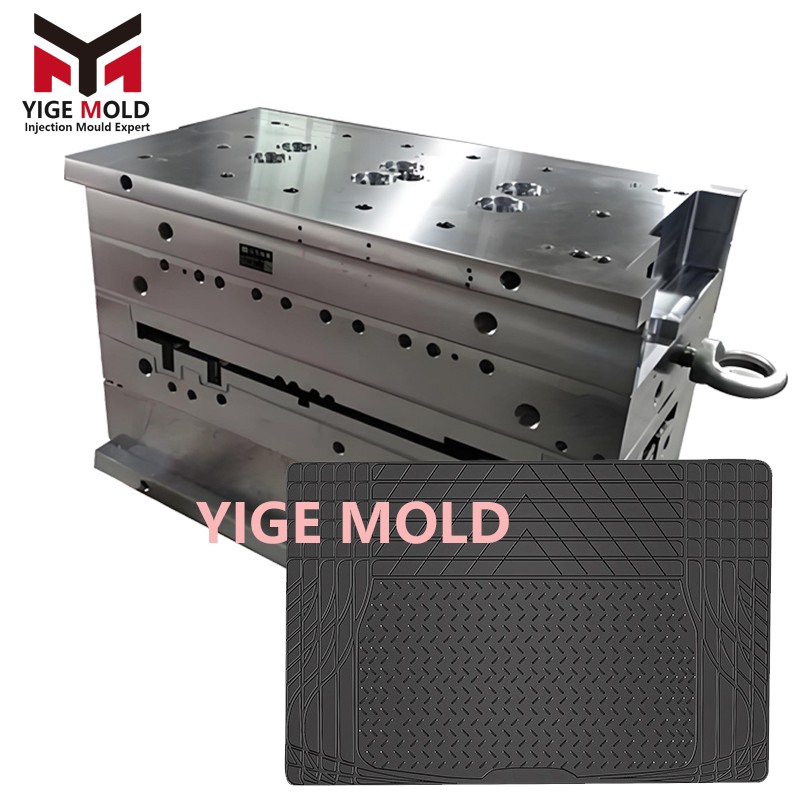
Trunk mat mold
Introduction to Automotive Trunk Mat Molds
In the precision manufacturing system of the modern automotive industry, molds are hailed as the "Mother of Industry." Their importance cannot be overstated. They not only determine the final form of a product but also concern production efficiency, cost control, and product quality. Within the vast field of automotive parts, the automotive trunk mat mold, as the core tool for producing this key interior accessory, plays an indispensable role with its unique technical requirements and market value. It is not merely a medium for transforming plastic granules into practical products but a crucial link in realizing the personalization, functionality, and quality of automobiles.
The Core Position and Technical Requirements of Molds
As an accessory that car owners often prioritize purchasing, the function of the automotive trunk mat has long surpassed simple "paving." It undertakes multiple functions such as waterproofing, anti-fouling, wear resistance, anti-slip properties, and protecting the original car's carpet or metal cargo area. Therefore, the design and manufacturing level of the mold used to produce it directly determines the quality of the final product. An excellent trunk mat mold must achieve a 1:1 precise fit between the product and the vehicle's trunk space. This requires that the contour data of the mold cavity must be derived from high-precision 3D scanning of the original vehicle and processed via Computer Numerical Control (CNC) milling for days or even weeks. Surface texture treatment of the mold is also an art; whether it is diamond patterns or maple leaf textures for aesthetics, or anti-slip patterns for enhanced friction, all must be pre-formed on the mold through precision carving or etching processes, which significantly varies in complexity and cost.
Mainstream Molding Processes and Mold Types
Currently, the production of automotive trunk mats mainly relies on two mainstream plastic molding processes: Injection Molding and Thermoforming (Vacuum Forming). The differences in these process routes have also given rise to two types of molds that differ significantly in structure, cost, and precision.
The Injection Molding process represents the high-end manufacturing standard in the current market and is particularly favored by car owners pursuing high quality and environmental performance. The molds used in this process, known as injection molds, typically consist of a moving half and a fixed half, which close to form a hollow cavity identical to the product's shape. During production, plastic granules such as TPE (Thermoplastic Elastomer) or PVC are fed into an injection molding machine, melted into a liquid state at high temperatures, and then injected into the closed mold cavity under high pressure and speed. After cooling and setting, the mold opens to yield the finished product. The development cost of injection molds is extremely high, with a complete set costing hundreds of thousands of RMB. However, its advantages are equally prominent: the product is integrally molded without any adhesives, ensuring environmental friendliness and no odor; high precision ensures a good fit and perfect edge finishing; and the product possesses good toughness and resilience, resisting curling or deformation over long-term use. This process is particularly suitable for producing high-end TPE full-coverage trunk mats with strict environmental and texture requirements.
In contrast, the Thermoforming process and its corresponding thermoforming molds offer a more cost-effective path. Thermoforming molds have a relatively simple structure, usually consisting of only a male or female mold, costing far less than injection molds. The production process involves heating plastic sheets (such as TPO or modified PVC) to a softening state and then using vacuum suction to make them adhere closely to the mold surface, forming the shape after cooling. The advantage of thermoforming lies in its short mold development cycle and low cost, making it particularly suitable for small-batch, customized production with high variety. However, its limitations are also apparent: products tend to be harder, with a less comfortable feel than injection-molded products; since it is formed by stretching sheets, thickness and precision control are less accurate than injection molding, potentially leading to edge curling over time. Therefore, thermoforming is more commonly applied to the production of trunk mats with relatively less stringent precision requirements.
The Symbiotic Relationship Between Materials, Processes, and Products
The choice of mold is closely linked to the material, performance, and cost of the final product, forming a complete value chain. Choosing an injection mold implies the selection of 100% pure high-performance raw materials like TPE, resulting in high-end products with soft texture and environmental safety, but also incurring high mold development costs. Conversely, choosing a thermoforming mold means greater flexibility in materials, such as using lower-cost TPO blends to achieve a more competitive market price, though comprehensive product performance may be compromised.
Furthermore, detailed mold design directly impacts the user experience. For instance, advanced mold designs may incorporate "multi-cavity" hot runner systems, allowing the simultaneous manufacture of multiple products in a single cycle, greatly enhancing production efficiency. Some molds also reserve partition structures like umbrella grooves or storage compartments within the cavity, enabling the produced trunk mat to add organizational utility beyond mere protection. These ingenious designs reflect the evolution of mold manufacturing from "capability to produce" to "excellence in production."
In summary, although the automotive trunk mat mold is small, it embodies the wisdom of precision manufacturing. It connects upstream raw materials with the downstream consumer market, serving as a microcosm of the refined and personalized development of the automotive industry. From high-precision CNC machining to complex surface treatments, and from expensive injection molds to flexible thermoforming molds, every choice of technical path seeks the optimal balance between cost, efficiency, and quality, ultimately providing car owners with an in-car space solution that is both aesthetically pleasing and practical.