Boot mat mould
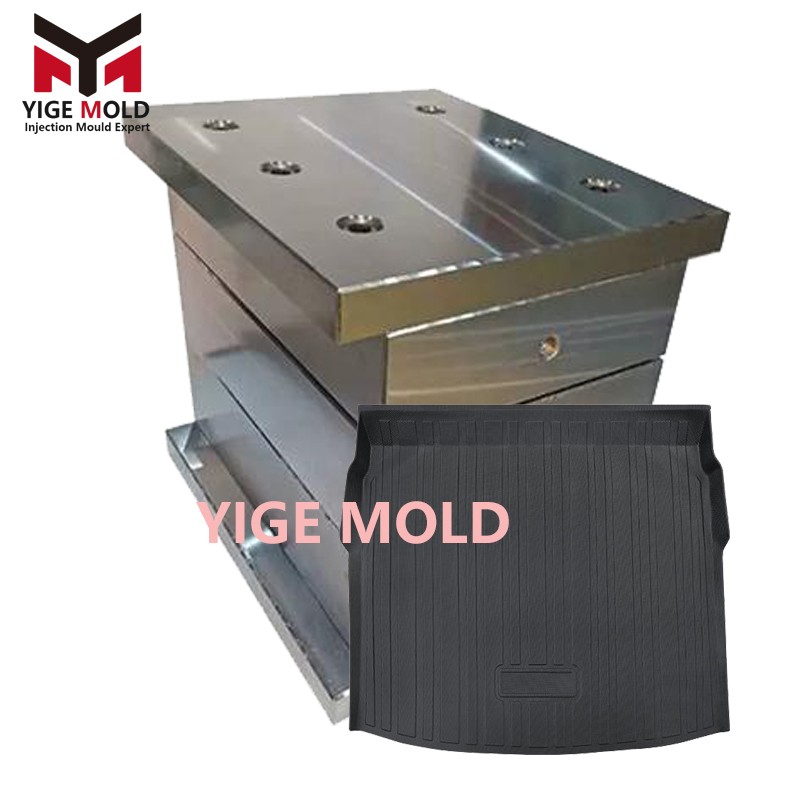
Automotive Trunk Mat Injection Molds: An In-depth Analysis of Precision Manufacturing and Process Advantages
In the grand system of modern automotive manufacturing, molds are accorded the prestigious title of the "Mother of Industry." Among them, the automotive trunk mat injection mold stands out as a quintessential precision tool. It serves not only as the core vehicle for transforming polymeric materials like Thermoplastic Elastomers (TPE) into functional protective products but also as the critical bridge connecting vehicle data to physical entities. Unlike traditional universal mats, trunk mats produced via injection molding demand that the mold possess an exceptionally high replication capability, restoring the complex spatial structure of a vehicle's trunk with millimeter-level precision.
Precise Adaptation and Data Reconstruction
The development of an automotive trunk mat injection mold begins with a deep digital reconstruction of the trunk space. Since dimensions, wheel arch shapes, spare tire well depths, and hook positions vary even among different model years of the same vehicle, mold design must adhere to the rigorous standard of "one mold per vehicle model." Engineers first utilize high-precision 3D scanning technology to capture the point cloud data of the original vehicle, followed by reverse engineering modeling in Computer-Aided Design (CAD) software.
During the structural design phase, the core challenge lies in managing the molding stability of large-area thin-walled parts. To prevent defects like short shots or warping, these molds typically employ a needle-valve hot runner system. This system precisely controls the injection time and pressure of the molten plastic. Coupled with a multi-point gating design, it effectively reduces shear stress, ensuring the material flows smoothly through long flow channels. Furthermore, the design of cooling channels is critical; conformal cooling technology is often used, where water lines closely follow the cavity surface. This ensures that areas of varying thickness cool synchronously, minimizing residual internal stress.
Deep Coupling of Process and Structure
The performance of the injection mold directly dictates the physical characteristics of the final product. Unlike single-sided molds used in other processes, injection molds consist of two precision-closed halves—a moving half and a fixed half—forming a complete 3D cavity. During production, pure TPE granules are melted and then injected into the closed mold cavity under high pressure.
This fully enclosed molding method endows the mold with exceptional structural expressiveness. The cavity surface can be processed via precision EDM (Electrical Discharge Machining) or laser etching to create complex textures, such as anti-slip lychee patterns or 3D geometric designs. More importantly, injection molds can form (3D) products with reinforcing rib structures. Engineers design thickened ribs at key stress points within the mold, giving the produced trunk mat excellent flexural resistance while maintaining flexibility.
Comparative Analysis: Injection Molding vs. Thermoforming
Before delving deeper into the construction of injection molds, it is necessary to compare them with the commonly used thermoforming (vacuum forming) molds to highlight the absolute advantages of the injection process in manufacturing high-end trunk mats. The essential difference lies in the handling of material form and molding pressure.
Thermoforming molds have a relatively low development cost, typically requiring only tens of thousands of RMB. Their principle involves heating a flat plastic sheet until soft and then using vacuum suction to make it adhere to a single-sided mold. While cost-effective, this process has inherent physical limitations:
- Thickness Limitation: The product thickness is limited by the original sheet and cannot be thickened locally.
- Surface Finish: Since it is single-sided molding, the back of the product is often rough and lacks fine structural design.
- Durability: Thermoformed products have high internal stress due to physical stretching. Over time, they are prone to curling and deformation that cannot be restored. The texture tends to be hard, similar to ordinary plastic.
In contrast, while the development cost of an injection mold can reach hundreds of thousands of RMB, the quality improvement it brings is revolutionary:
- Material Purity: The injection process uses 100% pure TPE granules, liquefied at high temperatures and injected into a fully enclosed double-layer mold under high pressure. This ensures the product is integrally molded without any adhesives, guaranteeing it is environmentally friendly and odorless.
- Structural Integrity: Injection molds can (endow) products with a thickness of 10mm to 25mm and allow for complex reinforcing ribs and anti-slip spikes on the back. This gives the finished product excellent rubber-like texture, flexibility, and resilience.
- Recovery: Even if deformed under long-term heavy pressure, an injection-molded mat can automatically recover due to its thermal recovery characteristics, whereas thermoformed products cannot be repaired once deformed.
- Precision: The precision of injection molds ensures a perfect fit with the car body, with flawless edge handling, completely eliminating safety hazards like jamming the accelerator or brake pedals.
Material Characteristics and Manufacturing Standards
The manufacturing standards of the mold are closely linked to the properties of the selected materials. High-end trunk mats predominantly use TPE, which combines rubber-like elasticity with plastic processing characteristics, posing high demands on the mold's temperature control system. TPE is sensitive to temperature fluctuations; therefore, the mold steel must possess excellent thermal conductivity and wear resistance.
Typically, high-quality pre-hardened mold steels such as P20 or 718H are selected. These steels undergo vacuum heat treatment to achieve moderate hardness and excellent polishing performance. For molds requiring a mirror finish, corrosion-resistant stainless steels like S136 may be used. In terms of processing, mold cores and cavities undergo high-speed milling on large gantry machining centers, followed by micro-level rectification via slow-wire cutting and precision grinding. To address the high viscosity of TPE materials, mold surfaces often undergo special coating or nitriding treatments to reduce ejection resistance.
Venting Systems and Surface Quality
When injection molding large-area trunk mats, the venting design is a decisive factor for product yield. As high-temperature, high-pressure molten plastic fills the cavity at high speed, air and trace volatiles within the cavity must be evacuated rapidly. If venting is poor, compressed gas generates high heat, causing defects like burns, air bubbles, or short shots.
Therefore, high-precision trunk mat injection molds typically incorporate micron-level venting slots at the parting line, ejector pin holes, and insert fits. For deep ribs or blind holes, porous steel inserts are used to vent gas through the material's micro-porous structure. This meticulous venting design, combined with surface polishing, ensures the finished product is flawless with sharp, clear edges that perfectly fit the vehicle's sheet metal structure, achieving true waterproofing and dustproofing.
Ejection Mechanisms and Production Efficiency
Since trunk mats often feature deep 3D edges and complex undercuts, the ejection system design is particularly complex. To ensure the product releases smoothly after cooling shrinkage without deformation, the mold is equipped with a precision ejection system, including ejector pins, sleeves, blade ejectors, and air poppets.
In automated production, the mold must coordinate closely with robotic arms. After the mold opens, the robot arm extends to retrieve the product, while the ejector plate inside the mold accurately resets under the action of return springs or nitrogen gas springs, preparing for the next cycle. To enhance efficiency, some large molds adopt a "single-cavity" or "twin-cavity" layout. By optimizing flow balance and cooling circuits, the mold can significantly shorten the molding cycle while ensuring product consistency, meeting the demands of large-scale industrial production.
In summary, the automotive trunk mat injection mold is a complex system engineering project integrating precision machinery, materials science, and thermodynamics. From precise data acquisition to micron-level cavity machining, and from hot runner layout to venting and cooling optimization, every step embodies the pursuit of manufacturing excellence. Compared to the cost-driven compromises of thermoforming, injection molds, with their high cost and complex structure, achieve a comprehensive victory in environmental friendliness, durability, fit, and aesthetics, ultimately transforming intangible plastic granules into a solid barrier protecting the automotive trunk.