Poultry Turnover Box Mold
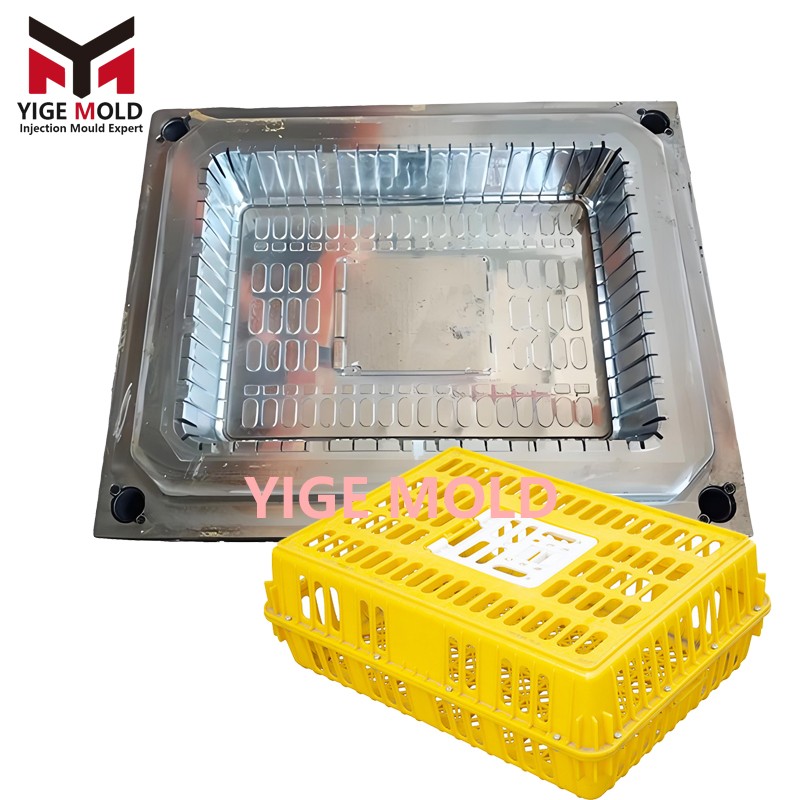
In-Depth Analysis of Poultry Turnover Box Mold Design and Manufacturing
The poultry turnover box mold, as a specialized injection mold, has its core design and manufacturing focus on translating animal welfare, biosafety, structural reliability, and process feasibility into quantifiable, achievable engineering specifications. Unlike general-purpose turnover box molds, its entire process must revolve around the special function of "live animal containment."
I. Key Technological Breakthroughs in Mold Design
1. Animal-Friendly Structural Design
-
Stress-Free Contact Surfaces: Employs fully contoured transition designs, with all internal corner radii ≥ R5mm and ventilation hole edges featuring radii ≥ R2mm. Sidewalls are designed with an 8-12° inward incline to create a natural shading area.
-
Biomimetic Ventilation System: Ventilation is optimized using Computational Fluid Dynamics (CFD), featuring staggered, specially shaped ventilation holes on sidewalls and the bottom to ensure ventilation efficiency ≥ 40% in any stacking configuration.
-
Anti-Injury Protective Structures: The top features an anti-escape inward lip, and the bottom incorporates an elastic buffer structure. The latching mechanism uses a progressive locking design to avoid impact noise during operation.
2. Biosafety Assurance Design
-
Zero Dead-Angle Structure: Utilizes a monolithic cavity design to avoid assembly seams. All reinforcing ribs employ rounded top structures with gradient connections to the main walls, ensuring a wash water contact angle ≤ 15°.
-
Self-Draining System: The bottom features radial drainage channels with a slope ≥ 3°, combined with a grid support structure, guaranteeing residual water < 5ml/m².
3. High Dynamic Load Structural Design
-
Biomimetic Reinforcement System: A honeycomb-like, variable-section reinforcing rib network is used. Wall thickness in key load-bearing areas graduates to 2.5-3.0mm, while non-load-bearing areas are thinned to 1.8-2.0mm, achieving the optimal strength-to-weight ratio.
-
Anti-Fatigue Connections: The stacking guide mechanism employs a multi-point elastic support design, combined with self-lubricating material inserts, ensuring a service life > 100,000 cycles.
4. Ergonomic Design
-
Integrated Handle Structure: Features a double-curved grip conforming to palm geometry, with anti-slip texturing in the grip area. Load points are evenly distributed on the main box structure.
-
Standardized Interfaces: Precisely matches forklift guide channels and automated conveyor system interfaces per EU EN ISO 17776 standard, with tolerances controlled within ±0.2mm.
II. Precision Engineering Implementation in Mold Manufacturing
1. Materials Science Application
-
Core components use premium German 1.2316 ESR stainless steel with PVD coating, achieving a surface hardness of HRC 52-54 and a corrosion resistance rating of 500h per ISO 9227 standard.
-
Moving parts use Japanese SKD61 hot-work tool steel, combined with a deep cryogenic treatment process, ensuring long-term operational precision.
2. Precision Machining Technology
-
Utilizes 5-axis simultaneous high-speed machining centers, achieving surface machining accuracy of ±0.02mm and surface roughness Ra ≤ 0.4μm.
-
Critical mating parts are processed using slow wire Electrical Discharge Machining (EDM) with accuracy up to ±0.005mm, controlling fit clearance to 0.03-0.05mm.
-
Ventilation hole arrays are processed using precision EDM, ensuring consistency across thousands of holes.
3. Cooling System Innovation
-
Employs 3D conformal cooling technology, with cooling channels maintaining a constant distance of 8-10mm from the cavity surface, ensuring a temperature gradient ≤ 3°C.
-
Implements zonal independent temperature control, with differentiated cooling circuits configured for areas of varying wall thickness.
4. Venting System Optimization
-
Nano-scale venting slots (depth 0.01-0.02mm) are set at the ends of reinforcing ribs and in deep cavity areas.
-
The main parting line uses a labyrinth venting structure, with the total venting area accounting for 8-10% of the parting line area.
5. Ejection System Design
-
A combined pneumatic + hydraulic ejection system is used, with programmable ejection speed for smooth demolding.
-
Ejector pin layout is optimized based on Finite Element Analysis (FEA) to prevent thin-wall part deformation.
III. Validation and Testing Standards
1. Mold Acceptance Standards
-
Cavity dimensional accuracy: Complies with ISO 8015 standard, Grade G6
-
Service life: Ensures key dimensional change < 0.1% over 1 million injection cycles
-
Production stability: CPK value ≥ 1.67
2. Product Validation System
-
Dynamic load test: Simulates a 1.5m drop test under full load conditions.
-
Fatigue test: 50,000 cycles of full-load stacking test.
-
Cleaning test: 5,000 cycles of high-pressure, high-temperature (85°C) washing.
-
Environmental test: Temperature shock test from -20°C to 60°C.
3. Production Efficiency Indicators
-
Cycle time: ≤ 45 seconds (including robotic part removal time).
-
Defect rate: < 0.3%.
-
Energy consumption indicator: ≤ 0.35 kWh/kg.
Conclusion
The design and manufacturing of modern poultry turnover box molds represent the transformation and upgrade of specialized injection molds from "shape-replicating tools" to "carriers of system solutions." Its technological core lies in translating life science requirements into precise engineering language and realizing industrial application through cutting-edge manufacturing technology, ultimately forming the technical cornerstone for ensuring food safety, enhancing animal welfare, and improving industrial efficiency. Each mold is a crystallization of interdisciplinary innovation spanning mechanical engineering, materials science, and bioengineering.