Fruit Crate Mold
Introduction to Fruit Crate Mold: The Standardized Forming Unit for the Agricultural Logistics Capillaries
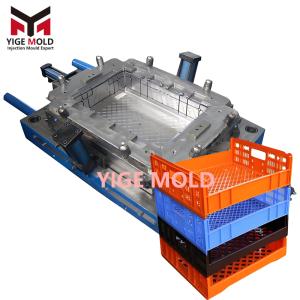
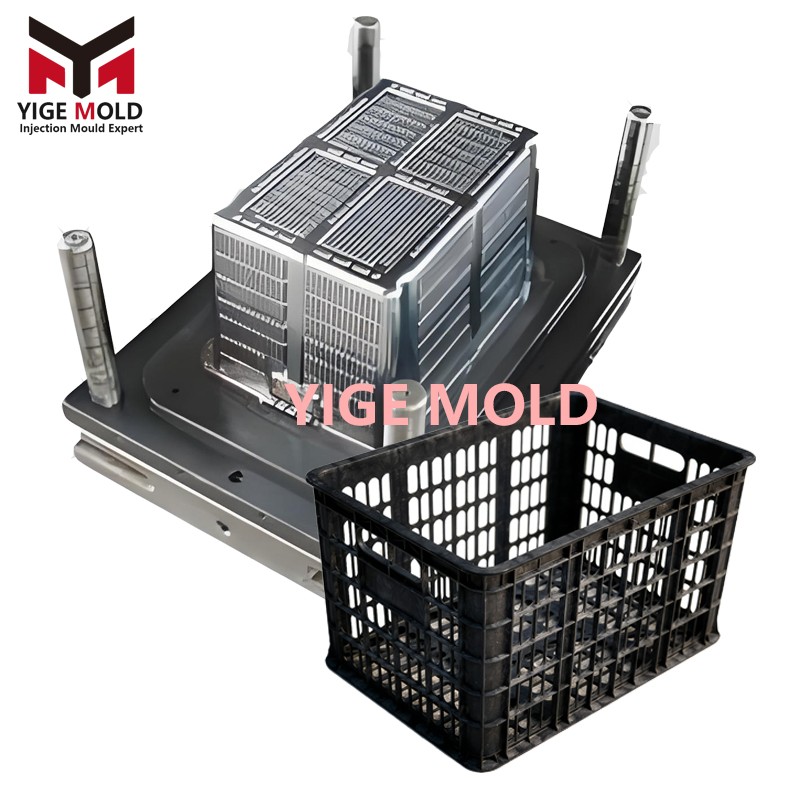
A Fruit Crate Mold is a core forming tool used for the industrial mass production of specialized plastic crates for fruit handling and transportation. Unlike general-purpose container molds, its design is deeply tied to the end-use scenario—from orchard harvesting and field collection to grading in wholesale markets and display at retail terminals. It represents a targeted solution that integrates agricultural practices, logistics efficiency optimization, and materials engineering.
I. Precise Industry Scenario Definition
The products of a Fruit Crate Mold primarily serve the first mile and intermediate distribution links of agricultural product circulation. Their main characteristics are:
-
Open Structure: Emphasizes ventilation and breathability to quickly dissipate field heat and respiratory heat, delaying fruit spoilage.
-
High Strength and Tolerance for Rough Handling: Adapts to rough logistics scenarios like forklift tine entry, high-altitude dumping, and multi-layer stacking.
-
Standardization and Modularity: Dimensions match pallets and racks, facilitating mechanized loading/unloading and space calculation.
The design philosophy is to achieve the optimal balance of strength, functionality, and durability under the extreme constraint of unit cost control. Its product is essentially a reusable "industrial consumable."
II. Targeted Engineering Implementation Path
To achieve the above goals, the engineering implementation of a Fruit Crate Mold focuses on several unique dimensions:
-
Synergistic Design of Structural Reinforcement and Lightweighting
-
3D Rib Network: The mold cavity must form a complex 3D reinforcing rib system, creating stable triangular or mesh support on the crate's bottom and sidewalls. This not only significantly enhances compression and impact resistance (capable of bearing hundreds of kilograms) but also achieves "optimal material distribution"—thickening at key stress points and thinning in non-load-bearing areas, accomplishing overall lightweighting.
-
Corner Reinforcement: Crate corners are stress concentration points and the most vulnerable to damage. The mold requires localized reinforcement design in these areas, such as gradual thickening and rounded transitions. The ejection system must be carefully arranged with ejector pins to ensure this thick-walled area cools evenly and ejects smoothly, preventing cracks.
-
-
Logistics-Adaptive Structure Molding
-
Forklift Pockets and Stacking Features: The mold must precisely form forklift entry pockets that meet logistics standards (typically front-to-back or side-to-side symmetrical). Their size, position, and reinforcement directly impact safety. Simultaneously, the stacking guide grooves on the crate's top rim and the anti-slip stacking feet on the bottom require millimeter-level fit, ensuring absolute stability in multi-layer stacks when full and efficient, tight nesting when empty.
-
Hand Holes and Grip Design: To accommodate manual handling, the hand holes on both sides of the crate must conform to ergonomics. The mold must form smooth, rolled edges around the hand holes, providing sufficient grip strength while avoiding burrs that could injure operators.
-
-
High-Efficiency Production and Durability Process
-
Multi-Cavity, High-Speed Configuration: To meet the massive seasonal demand of agricultural harvests, such molds often employ multi-cavity designs (e.g., 1x8, 1x12, or more) paired with hot runner systems to reduce waste and shorten cycle times, maximizing output per unit time.
-
Wear and Weather Resistance Assurance: The mold itself uses wear-resistant inserts in high-wear areas like gates and runners. The molded product must withstand sun, rain, temperature fluctuations, and minor impacts. This requires an evenly designed mold cooling system to ensure consistent plastic crystallinity, thereby giving the crate good toughness.
-
III. Manufacturing Process and Quality Validation
The creation of a mature Fruit Crate Mold follows a closed-loop verification from virtual to physical:
-
Working Condition Simulation Design: Based on inputs like fruit type (e.g., hardness of citrus, delicacy of grapes), stacking height, and estimated drop height, Finite Element Analysis is conducted to virtually test load-bearing and impact resistance.
-
Precision Machining and Surface Texturing: The cavity surface is often given a fine, leather-grain texture etching. This conceals flow marks and minor scratches, improving the product's appearance, while also increasing surface friction to prevent crates from slipping during stacking or transport.
-
Functional Load Testing: After trial production, physical crates must undergo full-load stacking tests, forklift handling tests, drop tests, and long-term outdoor exposure tests to ensure they meet the mechanical and weather resistance demands of actual use.
IV. Industry Value and Trends
The products shaped by Fruit Crate Molds are one of the cornerstones of the modern agricultural supply chain. Their value lies in:
-
Improving Circulation Efficiency: Standardized crates are a key step in transitioning agricultural products from non-standard bulk goods to unitized logistics carriers, greatly enhancing loading/unloading and transportation efficiency.
-
Reducing Post-Harvest Loss: Proper ventilation and robust protection directly reduce the rate of physical damage from field to market.
-
Promoting Circular Agriculture: Durable plastic crates can be reused hundreds of times, replacing disposable bamboo/wooden or cardboard packaging, aligning with green agricultural development.
Conclusion: The Fruit Crate Mold represents a systematic empowerment of traditional agricultural practices by industrial thinking. It consolidates the discrete, variable needs of agricultural product circulation into a standard, reliable, and efficient physical carrier. Every sturdy, neatly stacked fruit crate is a silent testament to the mold's precision in design and manufacturing. Its ultimate value is realized in lower logistics costs, fresher agricultural products, and a more sustainable agricultural circulation system.