Mop bucket strainer basket mold
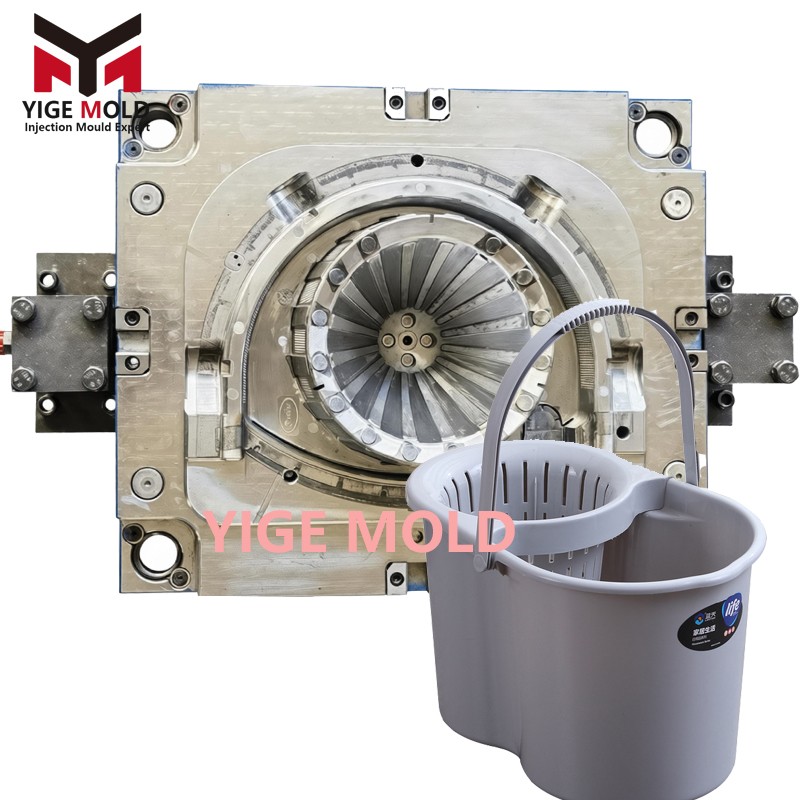
Mop Bucket Strainer Basket Mold: The Power Core Forming Equipment for the Spin-Dry System
Introduction
Within the spin mop system, the strainer basket (spinner basket) is the core moving component that holds the mop head and enables centrifugal water extraction. Its structural strength, kinematic precision, and dehydration efficiency directly dictate the overall product's performance. The mop bucket strainer basket mold is a quintessential example of precision injection molding technology applied to the manufacturing of dynamic functional parts. It transcends the realm of standard container molds, requiring the integration of complex kinematic structures, precise fluid channels, and high-strength mechanical designs within a compact space. It is a high-tech mold that embodies precision, efficiency, and durability.
I. Product Function and Mold Design Challenges
As a dynamic component integrating the three functions of "solid-liquid separation," "power transmission," and "structural load-bearing," the strainer basket presents unique challenges for mold design:
-
Balancing "Thin-Wall, Multi-Hole" Design with Structural Strength: For efficient dehydration, the basket body must be densely perforated with drainage holes (typically 3-5mm in diameter), with wall thickness often pushed to the limit of 1.2-1.8mm. This presents the dual challenge for the mold of ensuring both the rigidity and longevity of hundreds of slender cores (forming the drainage holes) and achieving complete filling and packing of the melt within the dense rib-and-web structure. The uniformity of hole distribution and the positioning accuracy of the cores (concentricity ≤0.03mm) directly affect the dynamic balance and noise control during spinning.
-
Precision Molding of Complex Helical Channels: The basket's inner wall commonly features guide spiral ribs (Archimedean spiral or involute profiles) designed to direct water flow upward and out during rotation. The cross-sectional shape, lead accuracy, and surface finish (requiring a mirror finish to reduce frictional resistance) of these spiral ribs must be directly guaranteed by the mold, imposing stringent demands on the core's complex surface machining, high-precision polishing, and uniform cooling.
-
High-Precision Molding of the Power Transmission Interface: The spline connection or square drive socket at the basket bottom, which interfaces with the drive shaft, is critical for torque transmission. Its fit clearance (typically 0.1-0.2mm per side), the symmetry and perpendicularity of the teeth/socket profile, must be precisely formed by the mold. Any minor deviation can lead to difficult assembly, transmission noise, or "jumping" failure under high-speed rotation.
-
Mechanical Design for Fatigue and Impact Resistance: The strainer basket withstands cyclical centrifugal forces, impact loads from the mop head, and user foot pressure during dehydration. The mold must ensure the product has an optimized rib layout (e.g., intersecting radial main ribs and circumferential auxiliary ribs) and uniform crystalline orientation, avoiding micro-defects in stress concentration areas like rib roots and corners, thereby enhancing the product's fatigue life.
II. Analysis of Core Mold Technology Systems
-
High-Precision, Long-Life Core System
-
"Honeycomb Matrix" Dense Core Design: To form the hundreds of drainage holes, the moving mold side requires a densely packed, honeycomb-like array of hundreds of slender core pins. These pins are typically made from high-hardness tool steel (e.g., ASSAB 88C) and undergo deep cryogenic treatment and surface PVD coating (e.g., TiN) to enhance bending and wear resistance. Their fixed ends feature a stepped, thickened design for enhanced support, and the working sections are high-precision guided to prevent deflection or breakage under injection pressure.
-
Conformal Spiral Cooling Technology: Inside the core forming the spiral ribs, 3D-printed conformal channels or embedded shaped copper tubes are employed, allowing cooling channels to closely follow the spiral contour. This ensures rapid, uniform cooling of this complex featured area, preventing deformation, sink marks, or increased ejection resistance due to uneven cooling.
-
-
Gating System Optimization for High Fill Resistance
-
Multi-Point Valve-Gated Hot Runner Balanced Filling: Due to the product's "cylindrical" shape and perforated structure, melt flow resistance is high. Typically, a 3 or 4-point valve-gated hot runner system is used, with gates evenly distributed around the circumference of the basket's upper rim to achieve radially symmetrical filling, minimizing weld lines and orientation stress caused by flow path differences. By sequencing the valve gates, key structural areas (like the bottom drive interface) can be filled preferentially.
-
Mold Flow Analysis-Assisted Design: In-depth mold flow analysis is essential to accurately predict the melt flow front within the dense rib and hole structure, optimizing gate location, size, and injection speed profiles to avoid short shots, air traps, or excessive shear heat.
-
-
Ejection System Ensuring Precision Demolding
-
Multiple-Ejector-Plate Two-Stage Ejection Mechanism: Given the product's depth and side spiral ribs, conventional ejection can cause damage. A two-stage ejection mechanism is often used: the first stage separates the part from the main core; the second stage uses a set of circumferentially spaced blade ejectors or pneumatic assistance to gently eject the part from the fixed plate densely populated with small ejector pins.
-
High-Pressure Spot Cooling and Vacuum Venting: A high-pressure spot cooling system is integrated into the dense core pin area, using high-velocity, low-temperature water to intensively cool the pin tips. Simultaneously, micro vacuum venting grooves are set at the core pin bases to ensure air trapped between the pin array is rapidly evacuated during high-speed filling, preventing burn marks.
-
-
Independent Temperature Control for the Transmission Interface Unit
-
The area forming the splines or drive socket requires an independent hot runner nozzle and cooling circuit. By precisely controlling the mold temperature in this zone 5-10°C higher than other areas, the melt crystallization process in this critical region is optimized, enhancing its dimensional stability and mechanical strength to ensure transmission accuracy.
-
III. The Pursuit of Ultimate Materials and Processes
-
Ultimate Performance Matching of Steels: The main core (forming the spiral surface) uses powder metallurgy steel with high mirror polishability and wear resistance (e.g., CPM 10V). The dense array of small hole core pins uses high-toughness, high-hardness tungsten carbide (hard alloy) inserts to withstand long-term alternating stress. The mold plates use pre-hardened, high-rigidity steel to minimize system deformation under immense injection pressure.
-
Micron-Level Machining and Inspection: The spiral surface requires 5-axis high-speed milling followed by nano-level diamond paste polishing. The spline tooth profile is machined by precision slow wire EDM. All critical dimensions are fully inspected using Coordinate Measuring Machines (CMM) and optical projectors, ensuring hole position accuracy and tooth profile errors are within micron-level tolerances.
Conclusion
The mop bucket strainer basket mold is a precision engineering apparatus that transforms a simple "basket" into the high-performance core of centrifugal dehydration. Its value lies not merely in shaping a plastic part, but in precisely constructing the channels of fluid dynamics, the interface for power transmission, and the skeletal framework that withstands alternating loads. Every strainer basket that spins smoothly, extracts water efficiently, and endures prolonged use validates the deep integration and innovation of its underlying mold in micro-hole molding technology, complex surface machining, precision motion control, and materials science. It represents a profound evolution of injection molds from static shaping to the bestowal of dynamic function, exemplifying modern precision manufacturing's excellence in the consumer goods domain.