Vegetable Turnover Box Mold
Comprehensive Technical Analysis of Vegetable Turnover Box Molds
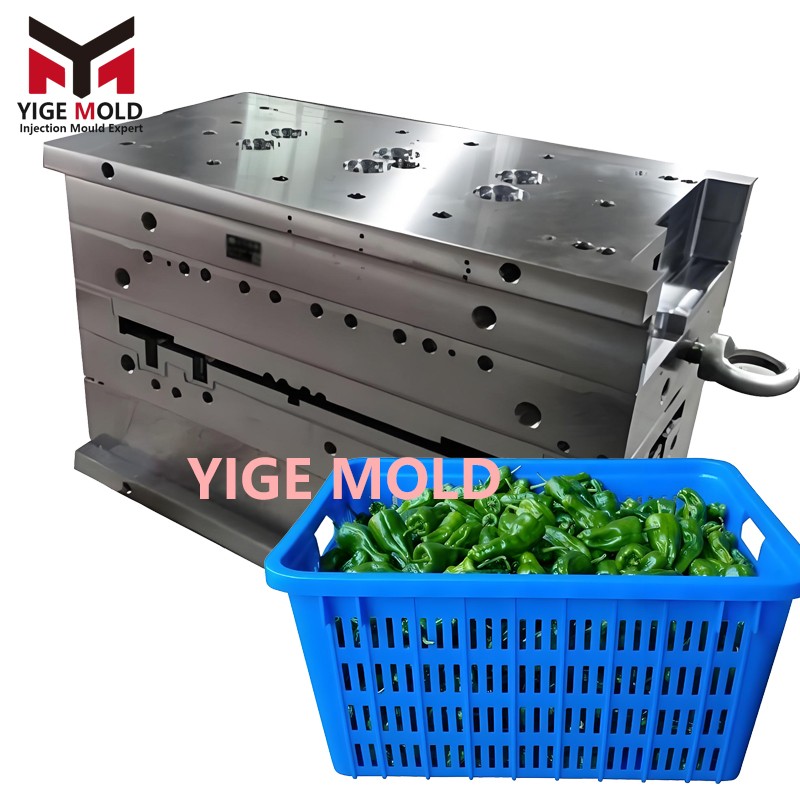
The vegetable turnover box mold is specialized injection molding equipment used to produce transportation carriers for agricultural products. Its core design focuses on meeting the basic functional requirements for the storage and transportation of fresh produce, including physical protection, ventilation, and hygiene. Through stable molding processes, this mold produces plastic containers with defined structural strength, standard dimensions, and applicable functionalities. It is a common packaging tool in the circulation of agricultural products from production areas to markets.
I. Product Function and Mold Design Positioning
As a standard container for circulating fresh agricultural products, the fundamental usage requirements of vegetable turnover boxes dictate the design standards of the mold:
-
Basic Structural Design:
-
The mold must form reinforcing rib structures that meet stacking requirements. The thickness of sidewall ribs is typically 2-3 mm, while the thickness in bottom load-bearing areas needs to reach 3-4 mm. The box is designed with standard ventilation holes on all sides, usually 10-20 mm in diameter, to ensure internal air circulation and prevent heat buildup from produce respiration.
-
-
Hygiene and Cleaning Requirements:
-
The inner and outer surfaces of the box must be smooth and even. All corners feature rounded transitions with a radius of no less than 5 mm, facilitating thorough cleaning and preventing residue buildup. The bottom is equipped with drainage holes, typically 5-8 mm in diameter and evenly distributed, to aid water drainage.
-
-
Standardization and Compatibility:
-
Product dimensions must comply with common industry standards to fit standardized shelves, pallets, and transport vehicles. The edges feature stacking/locating structures, such as flanges and grooves, ensuring stable alignment during multi-layer stacking and preventing slipping.
-
II. Core Mold Structure and Manufacturing Solutions
To produce structurally stable and efficiently manufactured products, the mold employs proven, mature design solutions:
-
Molding and Demolding System:
-
For the ventilation hole structures on the box sides, the mold uses side core-pulling mechanisms. Slides driven by angled leader pins enable the molding and demolding of the side holes. The ejection system employs evenly distributed ejector pins, typically placed at the base of ribs or on non-appearance surfaces, ensuring balanced force and no deformation during part ejection.
-
-
Temperature Control System:
-
The mold interior contains circulating cooling channels. The layout of these channels is denser in main wall-thickness areas like sidewalls and the base to accelerate heat dissipation. This ensures the product fully cools and sets, shortens the production cycle, and reduces warpage caused by uneven cooling.
-
-
Surface Treatment and Durability:
-
The mold cavity surface is typically polished to achieve the required surface finish on the product. High-wear areas may undergo surface hardening treatments, such as nitriding, to improve the mold's wear resistance and service life, meeting the demands of long-term, high-volume production.
-
III. Manufacturing Process and Quality Assurance
The mold manufacturing and production follow standardized operating procedures and quality control:
-
Standardized Machining Process:
-
The mold base is shaped by CNC milling. Complex rib areas or deep cavities may utilize Electrical Discharge Machining (EDM) to ensure shape accuracy. All moving components require precise bench fitting by mold makers to ensure smooth operation and clearances meeting design specifications.
-
-
Material and Process Compatibility:
-
Mold design must account for the shrinkage characteristics of commonly used materials like polypropylene, compensating in the cavity dimensions. The sprue and runner design must ensure the melt fills the cavity ends completely and balanced, paying particular attention to fill quality in ribs and thick-walled areas.
-
-
Systematic Testing and Validation:
-
Upon completion, the mold undergoes trial runs (mold testing) to determine suitable process parameters like injection pressure, speed, temperature, and cooling time. Samples from the trial run are subjected to dimensional inspection, stacking load tests, drop tests, etc., ensuring their load capacity, dimensional tolerances, and structural integrity meet usage standards.
-
IV. Application Value and Industry Significance
The products manufactured by vegetable turnover box molds play a fundamental yet crucial role in modern agricultural logistics:
-
Ensuring Logistics Efficiency and Product Quality:
-
Standardized, dimensionally consistent turnover boxes facilitate mechanized loading/unloading and stacking, improving space utilization and operational efficiency in warehousing and transportation. Reasonable structural design helps reduce impact damage to fruits and vegetables during transit. The ventilation properties of the box assist in heat dissipation, contributing positively to maintaining product freshness.
-
-
Promoting Reusability and Cost Control:
-
Durable plastic turnover boxes can be reused multiple times, replacing disposable cardboard or foam boxes, thereby reducing long-term packaging costs. Their ease of cleaning and disinfection meets the hygiene requirements for packaging containers of fresh produce.
-
-
Driving Standardization in Related Processes:
-
The standardization of turnover boxes promotes uniformity in carriers across the entire supply chain—from field harvesting, sorting, and packaging to warehousing, transportation, and market display—laying the foundation for improving overall logistics efficiency and management levels.
-
The technological focus of this type of mold continues to center on enhancing production stability and efficiency, optimizing product structure for increased durability and applicability, and strictly controlling costs to meet the needs of large-scale application. Vegetable turnover box molds and their products, as fundamental tools connecting agricultural production and market consumption, directly impact the smoothness of agricultural product circulation and loss control through their reliability and practicality. They are an indispensable component of modern agricultural supply chains.