Collapsible Logistics Box Mold
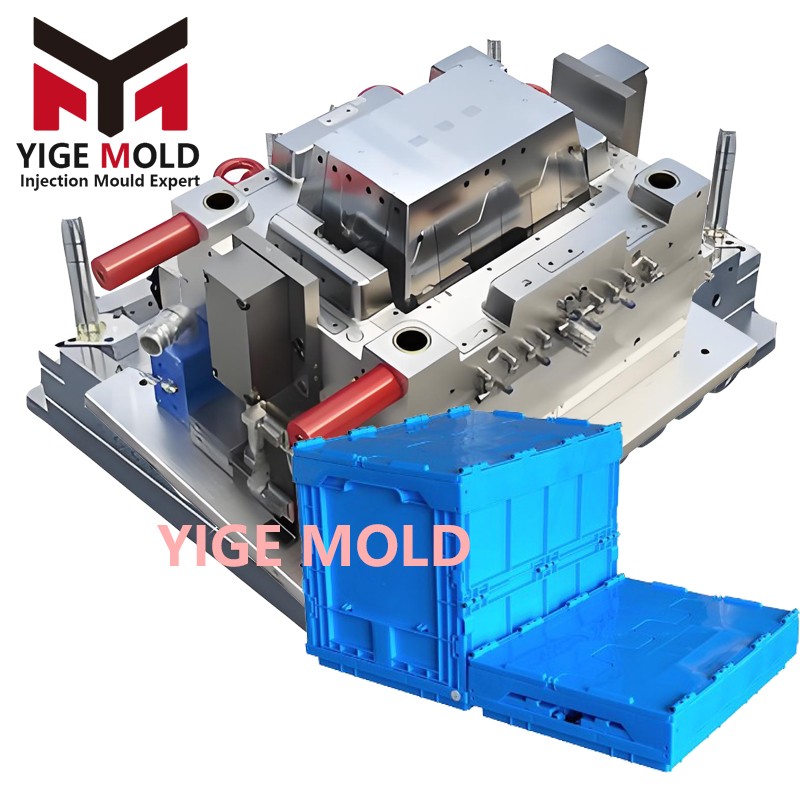
Collapsible Logistics Box Mold: Architect of Flexibility for Modern Supply Chains
The relentless pursuit of supply chain efficiency finds one of its most tangible expressions in the transformation of a fundamental unit: the logistics box. Evolving beyond a static container, the collapsible logistics box represents a dynamic solution for space and cost optimization. The genesis of its intelligent design and reliable performance is the Collapsible Logistics Box Mold. Far more than a tool, it is a synthesis of structural engineering, polymer science, and logistical strategy—a physical manifesto for leaner, greener, and more adaptive material flow.
I. Foundational Concept: Engineering a Product with Duality of Purpose
The mold's design philosophy represents a paradigm shift. It is engineered not to create a single, fixed form, but to define a product that seamlessly transitions between two distinct, optimized states within one manufacturing cycle.
-
The Deployed State: Engineered for Rigidity and Duty
In this state, the mold produces a load-bearing workhorse. Its precision-crafted cavity translates digital designs into physical strength.
-
Intelligent Reinforcement: A scientifically configured lattice of ribs is formed, providing maximum structural integrity with minimal material use. This internal architecture is calculated to manage compression from stacking, torsion during handling, and impact from transit.
-
Built for Integration: Critical interface features—standardized forklift pockets, secure stacking lugs, and pallet-compatible bases—are molded with exacting tolerances. This ensures flawless interoperability with automated warehouse systems, transport vehicles, and manual handling processes.
-
-
The Collapsed State: The Mastery of Controlled Transformation
This is the mold's defining innovation. It engineers transient but critical features that enable repeated, reliable transformation.
-
The Living Hinge: This is not a scored weakness but a precision-engineered polymer feature. Through meticulous control of local wall geometry and cooling, the mold creates a thin, flexible section that acts as a durable, integral hinge, designed for a lifespan of hundreds of thousands of folds.
-
Positive-Action Latching: Complementary to the hinge, the mold forms robust latch and release mechanisms. Their angles, clearances, and engagement surfaces are designed for intuitive, one-handed operation—delivering a confident lock when deployed and a simple release for collapse.
-
The output is a single object with dual identities: a high-volume carrier in use, and a compact, space-efficient asset in storage or return transit, achieving space savings of 70% or more.
II. Technical Realization: The Convergence of Disciplines
Creating this duality demands that the mold resolve inherent contradictions between strength and flexibility, durability and fatigue resistance.
-
Predictive Digital Prototyping:
The mold is first perfected in a virtual environment. Multi-physics simulations model the flow of molten plastic, predict cooling patterns and shrinkage, and analyze structural stresses under both operational and folded conditions. This allows designers to iterate the mold and part geometry concurrently, optimizing for performance and manufacturability.
-
Advanced Materials and Surface Engineering:
Areas subject to extreme wear, particularly the hinge and latch cores, are crafted from premium, high-polish tool steels. These are often enhanced with advanced surface treatments like Physical Vapor Deposition (PVD) coatings (e.g., TiN, CrN) or plasma nitriding. These ultra-hard, low-friction surfaces resist abrasion and adhesion, ensuring consistent part quality over the mold's multi-million-cycle lifespan.
-
Sophisticated Molding Process Control:
-
Sequential Valve Gating: For large parts, a system of computer-controlled valves opens and closes at different points in the injection sequence. This directs the flow of plastic to fill the cavity in the most optimal pattern, preventing defects like weld lines and minimizing internal stresses that could weaken the final product.
-
Conformal Cooling Technology: Cooling channels are machined (often via additive manufacturing) to follow the exact 3D contours of the mold cavity. This provides uniform, efficient heat extraction, drastically reducing cycle times and ensuring even cooling to prevent part warpage and ensure dimensional stability.
-
-
Complex Internal Actuation:
To form the box's functional details—recessed handles, internal dividers, bottom grids—the mold incorporates intricate systems of hydraulically or electrically driven lifters, sliders, and collapsible cores. These mechanisms perform a synchronized dance during mold opening, moving with precision to release the complex part without damage.
III. Systemic Impact: Catalyzing Efficiency Across the Network
The value proposition of this mold extends from the factory floor to the far ends of the supply chain, redefining cost structures.
-
Radical Optimization of Logistics Assets:
-
Transport: Collapsed boxes increase reverse logistics payload by 300-500%, turning empty truck space into revenue-generating capacity and slashing per-trip costs.
-
Storage: Warehouses gain effective cubic capacity, deferring capital expenditure on new facilities or liberating space for value-adding activities. Storage becomes a variable, not a fixed, overhead.
-
-
Enabler of Circular Material Flow:
The durable, standardized boxes produced are ideal for multi-party pooling systems. They move in closed loops between manufacturers, distributors, and retailers, eliminating single-trip packaging waste. The box transitions from a purchased commodity to a managed, reusable asset, embodying the principles of a circular economy.
-
Foundation for Process Standardization:
As a uniform, modular handling unit, the collapsible box enables true logistics unitization. Goods can move from origin to point-of-use without rehandling, simplifying processes, reducing damage, and increasing supply chain velocity and visibility.
IV. Path Forward: Evolving with Specialized Demand
Future development will be characterized by deeper specialization and integration:
-
Co-Engineering with Automation: Mold design will inherently support robotics, with features for easy gripping, scanning, and precise placement. The box becomes a cooperative element within fully automated fulfillment and sortation systems.
-
Application-Specific Engineering: Next-generation molds will be tailored for extreme environments: temperature-controlled versions for pharmaceuticals with integrated thermal mass; static-dissipative designs for electronics; and heavy-duty, high-impact configurations for automotive and industrial parts.
Conclusion
The Collapsible Logistics Box Mold is a pivotal innovation in industrial design. It masters the paradox of creating strength that can be neatly folded away. Its significance lies not in the steel from which it is made, but in the negative space it creates—the empty trailers and warehouse aisles that translate directly into competitive advantage. It is a tool that builds not just boxes, but a more responsive, economical, and sustainable framework for global commerce. Investing in this technology is an investment in the fundamental resilience and intelligence of the supply chain itself.