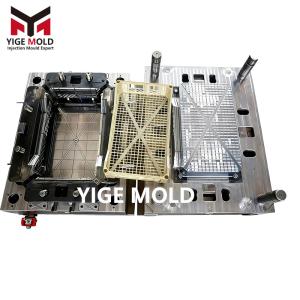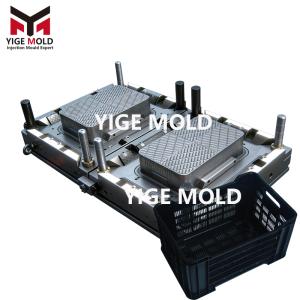
Folding Returnable Crate Mold
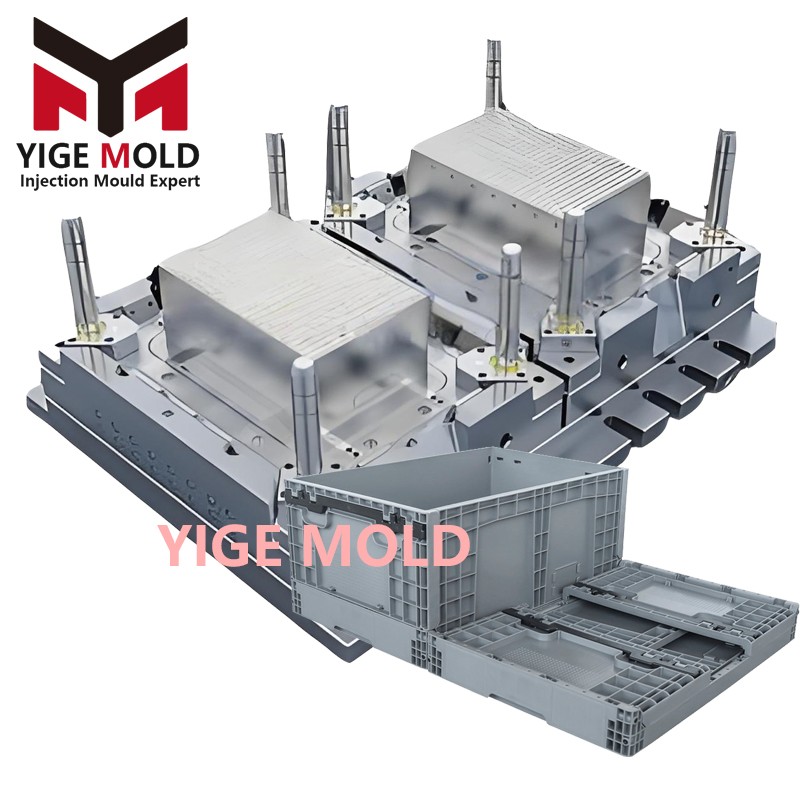
Folding Returnable Crate Mold: The Industrial Cornerstone Defining Circulation and Efficiency
In the modern industrial and logistics system, a product that integrates the two core concepts of "space efficiency" and "circulation" is born: the folding returnable crate. The very source of its creation and the determinant of its quality—the Folding Returnable Crate Mold—is a complex piece of equipment that crystallizes precision engineering, material dynamics, and circular economy thinking. It is not merely a production tool but the physical origin for constructing an efficient, green, and sustainable logistics infrastructure.
I. Integration of Dual Attributes: Single-Cycle Molding, Bestowing Dual Forms of Life
The core mission of this mold is to create, within a single injection molding cycle, a product that embodies a unity of opposites: it must be both a sturdy carrying unit and a flexible space-optimizing module.
-
Shaping "Sturdiness": The mold, through its high-precision cavity, endows the crate with outstanding structural performance. This includes:
-
Mechanical Architecture: A meticulously designed network of longitudinal and lateral reinforcing ribs, akin to the beams and columns of a building, ensures the crate possesses extremely high compression and bending resistance when fully loaded and stacked.
-
Stable Foundation: Precise anti-slip structures on the base and interlocking stacking lugs on the top/bottom ensure stability and safety during transportation and storage.
-
Built-in Durability: The mold's cooling system and venting design directly determine the uniformity of plastic crystallization, eliminating stress concentration points at the source and ensuring each crate possesses lasting structural integrity.
-
-
Presetting "Flexibility": This embodies the highest wisdom in mold design. Its core lies in integrally molding durable functional structures:
-
Living Hinges: At the junction of the crate's side walls and base, the mold does not create a simple crease. Instead, through precise wall thickness control and curved transitions, it forms a "living hinge" structure capable of withstanding hundreds of thousands of flexing cycles without fatigue failure.
-
Reliable Locking: The latches and release mechanisms, also directly formed by the mold, require appropriate opening/closing force, clear tactile feedback, and secure locking. This is key to ensuring the convenient and reliable functionality of the folding feature.
-
Through this mold, raw material is transformed in one cycle into an "intelligent" physical unit: when deployed, it is a rigid logistics carrier; when folded, its volume can be reduced by over 70%, becoming a highly efficient space-saver.
II. The Precise Symphony of Engineering Realization: Achieving Unity Amidst Contradictions
To realize the aforementioned dual attributes, the mold itself must solve a series of seemingly contradictory engineering challenges:
-
Collaborative Design of Structure and Motion:
-
Mold design begins with prospective finite element analysis. Simulating the stress distribution of the crate under extreme loads during the design phase allows for the optimization of rib layout in the mold, ensuring the best balance between strength and weight.
-
Simultaneously, kinematic and fatigue life simulations of hinges and latches are essential. This ensures every folding action is smooth and unobstructed, predicts performance after long-term use, and guarantees durability from the very source of the design.
-
-
"Extended Endurance" Treatment for Critical Areas:
-
Areas like the living hinges and latch sliders are the most susceptible to wear in the mold. Therefore, these core components are often manufactured from special wear-resistant steel and treated with processes like nitriding or PVD coating. This gives them an extremely hard surface, capable of resisting repeated friction from the plastic, ensuring the production of dimensionally precise products even after millions of cycles.
-
-
Guaranteeing Efficient and Homogeneous Production:
-
Large molds employ multi-point hot runner systems, ensuring molten plastic fills every corner quickly and uniformly. This reduces runner waste and improves material utilization and production efficiency.
-
A cooling system with independent temperature control for different zones is key to quality control. Intense cooling is applied to thick areas like hinges and ribs, while uniform cooling is used for large wall sections. This coordinates the shrinkage rates in different areas, minimizing product warpage and ensuring dimensional stability to the greatest extent.
-
-
The Complex Internal "Mechanical Dance":
-
To integrally form the crate's complex undercuts (such as recessed handles or bottom slots) in one cycle, the mold integrates a series of lifters, sliders, and hydraulically driven mechanisms. These mechanisms must act in perfect synchronization during mold opening and closing, with micron-level precision and a strict sequence. Their design and assembly quality directly determine the mold's reliability and lifespan.
-
III. Reshaping the Value Chain Beyond Production
The value of investing in such a precision mold extends far beyond the unit production cost of a single item; it reshapes the entire value chain from manufacturing to logistics:
-
Structural Reduction of Triple Costs:
-
Transportation Cost: The loading capacity for empty crate returns or redistribution increases 3 to 5 times, directly and significantly reducing unit logistics expenses.
-
Storage Cost: The minimal footprint when folded leads to a geometric increase in warehouse space utilization or a drastic reduction in required storage area.
-
Packaging Cost: Replacing vast quantities of disposable packaging, the crates themselves, with a service life spanning years, drive the per-use cost to a minimum.
-
-
Physical Fulcrum of the Circular Economy:
-
The standardized, high-quality crates it produces are the ideal carriers for building closed-loop logistics systems. Circulating between various nodes of the supply chain, they maximize the continued utility of resources, representing the most tangible embodiment of the "Reduce, Reuse" principle in industry.
-
-
Physical Carrier for Process Standardization:
-
Uniform, reliably performing folding crates are the foundation for achieving logistics unitization and modularization. Their perfect compatibility with standard pallets, racks, and transport vehicles enables "seamless" handling from the production line to the end point without changing carriers, greatly enhancing supply chain fluidity and resilience.
-
IV. Future Evolution: Deeper Integration and Greater Specialization
Its future development will deepen along two main trajectories:
-
Deeper Coupling with Specific Processes: Mold design will more closely align with the interface requirements of automated sorting lines, automated storage/retrieval systems (AS/RS), and AGVs. Details like forklift pockets and guide ramps on the crate base will be optimized, transforming the crate into a standardized, "communicative" mobile unit within intelligent logistics systems.
-
Specialization for Vertical Applications: For specialized needs like fresh food cold chains, electronic components (ESD protection), or automotive heavy loads, dedicated molds will evolve. These will produce crates with features like insulated structures, compatibility with conductive materials, or ultra-high-strength designs, creating value in more specialized fields.
Conclusion
The Folding Returnable Crate Mold is a silent value creator. With the precision and stability of steel, it presets the flexibility and resilience of plastic. It does not directly partake in the bustle of logistics, yet it fundamentally defines its density, cost, and sustainability. What this mold produces is not merely crates, but "foldable space" and "circulating assets." It represents a profound wisdom in modern industry: through high complexity and forward-looking investment at the manufacturing end, it secures lasting simplification, efficiency, and green benefits for the entire societal system throughout the product's lifecycle. This is the foundational power hidden behind every efficiently circulating folding crate.