Plastic clip mold
Introduction to Plastic Clip Molds
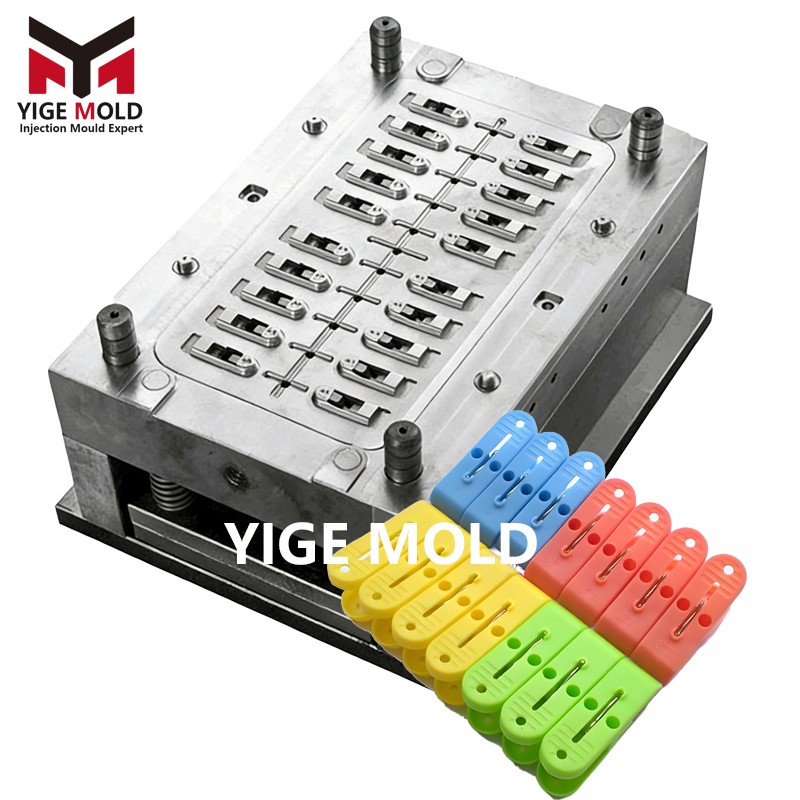
Plastic clip molds are a critical and widely used category of technical equipment in the plastics molding industry, particularly within the production of daily-use plastic goods and stationery. They are specifically designed for the efficient, precise, and high-volume manufacturing of various types and sizes of plastic clips (such as clothespins, binder clips, foldback clips, food bag clips, etc.). The design and manufacturing standards of these molds directly determine the quality, production efficiency, and cost of the final plastic clip products, serving as the core bridge connecting plastic raw materials to the final functional goods. This article will provide a systematic overview covering their core functions, classifications, key structural design points, manufacturing processes, material selection, and application areas.
I. Core Functions and Importance
The core function of a plastic clip mold is to receive molten plastic material (such as Polypropylene PP, Acrylonitrile Butadiene Styrene ABS, Polyoxymethylene POM, etc.) under the high temperature and pressure of an injection molding machine, fill its cavity, and, after cooling and solidification, produce plastic clip parts or assemblies with specific geometries, dimensions, functions, and fit accuracies.
Its importance is reflected in:
-
Mass Production and High Efficiency: A single high-precision multi-cavity mold can produce dozens or even hundreds of plastic clips in one injection cycle, achieving extremely high production efficiency and very low unit cost, meeting the massive market demand for such small commodities.
-
High Precision and Consistency: Molds ensure uniformity in the dimensions and shape of every single product. This is crucial for plastic clips that require good elasticity and clamping force (e.g., clothespins with spring-hinge structures, foldback clips relying on elastic arms), guaranteeing product performance and reliability.
-
Realization of Complex Structures: Modern plastic clips often integrate complex functional features like spring mechanisms, hinges, snap-fits, and anti-slip grips. Through ingenious mold design (e.g., slider core-pulling, angled-lifter ejection, split-block parting), these complex features can be molded in one piece, reducing subsequent assembly steps.
-
Determinant of Surface Quality: The surface finish of the mold cavity is directly transferred to the product's appearance. Highly polished, textured, or laser-etched cavities can produce clips with glossy, matte, or various textured surfaces, enhancing product added value.
II. Main Classifications
Based on the structure, function, and molding characteristics of the plastic clips produced, molds are primarily categorized as follows:
-
Classification by Product Structure:
-
Single-Component Clip Molds: Produce structurally simple, single parts, such as some basic food bag clips.
-
Assembled Clip Molds: Produce plastic clips composed of multiple parts requiring assembly, like traditional spring-type clothespins (typically requiring separate molds for the clamp head, spring, and pivot pin, followed by assembly). Multiple mold sets may be used for different components.
-
Integrated Functional Clip Molds: Produce functional clips with built-in elastic mechanisms, requiring no additional assembly, the most classic example being the "one-piece molded clothespin." These molds have the most complex structures, often employing advanced mechanisms like "inner lifters" or "tunnel sliders" to form and release the undercuts of the elastic arms within the mold itself.
-
-
Classification by Mold Structure:
-
Two-Plate Molds: The most basic structure with a single parting plane, suitable for simple clips without side-actions or undercuts.
-
Three-Plate Molds: Suitable for clips where the gate needs to be located in the center of the product or where automatic degating of pinpoint gates is desired. Common for some small, precision clips.
-
Molds with Side-Action Core Pulling: When a plastic clip has side holes, undercuts, or features not in the main mold opening direction (e.g., the inner side of a foldback clip's lever, hanging holes on some clips), slider (side-action) mechanisms are essential for forming and ejection. This is one of the most common complex structures in plastic clip molds.
-
Split-Cavity (Hob) Molds: For round or oval clips with circumferential grooves or flanges (e.g., some cap-style clips), split-cavity blocks are often used. Upon mold opening, the blocks separate radially to allow part ejection.
-
-
Classification by Number of Cavities:
-
Single-Cavity Molds: Used for mold trials, low-volume production, or large clips.
-
Multi-Cavity Molds: The vast majority of plastic clip production uses multi-cavity molds (e.g., 1x16, 1x32, 1x64, or even more) to maximize production efficiency. Balanced runner layout design for multi-cavities is key.
-
III. Key Structural Design Points
The design of an excellent plastic clip mold must comprehensively consider multiple factors:
-
Parting Line Design: The parting line location should ensure smooth part ejection, ideally be placed in an inconspicuous area to hide the parting line flash, and must consider machining feasibility. For clips with elastic arms, the parting line often runs through the symmetrical plane of the arm.
-
Gating System Design: Includes sprue, runners, and gates. Plastic clips are typically small, often using a "hot sprue bush to cold runner with pinpoint gates" or full cold runner with edge/pinpoint gates scheme. The design aims for fast, balanced filling, reduced flow resistance, and a clean, aesthetically acceptable gate vestige after removal.
-
Molding Component Design: Refers to the core and cavity inserts that directly form the product shape. High-quality mold steel must be selected, with precise dimensional calculations (accounting for material shrinkage). Critical mating areas (like the clamping jaws, hinge points) require fine polishing or special treatment to ensure smooth action and clamping force.
-
Side-Action Core-Pulling Mechanism Design: This is the technical core of many plastic clip molds. Design requires precise calculation of core-pull stroke, slider angles, and locking force. For integrated elastic clips, the "inner lifter" mechanism must, through the mold's own movement during opening, first allow the core pins forming the undercuts of the elastic arms to move sideways (creating deformation space) before the part is ejected. The timing and reliability of this mechanism are extremely demanding.
-
Ejection System Design: Plastic clips often have irregular shapes, requiring rational placement of ejector pins, sleeves, or stripper plates to ensure uniform force distribution during ejection, preventing deformation or surface defects ("ejector pin blush"). Special attention is needed for thin-walled clip arm areas.
-
Cooling System Design: Efficient and uniform cooling channels are crucial for shortening cycle times and reducing part warpage. Cooling lines should be placed as close as possible to the cavity surface, follow the part contour, and avoid dead spots.
IV. Manufacturing Processes and Materials
-
Key Materials:
-
Molding Components: Commonly use high-wear-resistance, high-polishability steels like Swedish ASSAB 718 (P20+Ni), S136 (corrosion-resistant mirror polish steel). For high-volume production molds, steels with higher hardness and wear resistance like H13 or powder metallurgy high-speed steels may be chosen.
-
Structural Components: Mold plates often use medium carbon steel (e.g., S50C). Sliders and angled lifters may use high-toughness alloy tool steels.
-
-
Key Manufacturing Processes:
-
Precision Machining: Extensive use of CNC milling machines and machining centers for roughing and finishing cavity shapes. High-Speed Machining (HSM) is used for complex surfaces.
-
Electrical Discharge Machining (EDM): Widely used for deep slots, narrow gaps, sharp corners, and slider mating surfaces difficult for CNC machining, employing both Sinker EDM and Wire EDM (especially Slow Wire-Cut).
-
Precision Grinding: Used to ensure plate flatness and slider fitting accuracy.
-
Heat Treatment and Surface Treatment: Core molding components undergo quenching and tempering to increase hardness and lifespan. Nitriding treatments are sometimes applied to enhance surface wear resistance.
-
Polishing and Texturing: Cavity surfaces undergo progressive fine polishing from stone to diamond paste to achieve the desired gloss. For matte or special grain finishes, chemical etching or laser texturing is performed.
-
V. Application Areas
Products from plastic clip molds permeate various industries:
-
Household & Daily Use: Clothespins, curtain clips, snack bag clips, kitchen utensil clips, etc.
-
Office Stationery: Foldback clips (bulldog clips), file folders, document clips, clipboard clips, etc.
-
Industrial Packaging: Cable ties, plastic bag seals, light packaging fastener clips, etc.
-
Specialized Applications: Medical IV line regulator clips, laboratory equipment clips, etc.
Conclusion
Although serving seemingly simple everyday items, plastic clip molds integrate multidisciplinary knowledge including mechanical design, materials science, precision machining, and fluid dynamics, representing a quintessential example of precision manufacturing technology. As the cornerstone enabling the mass production of plastic clip products with high quality and low cost, plastic clip molds play an indispensable and critical role in modern manufacturing.