Plastic clothes peg mold
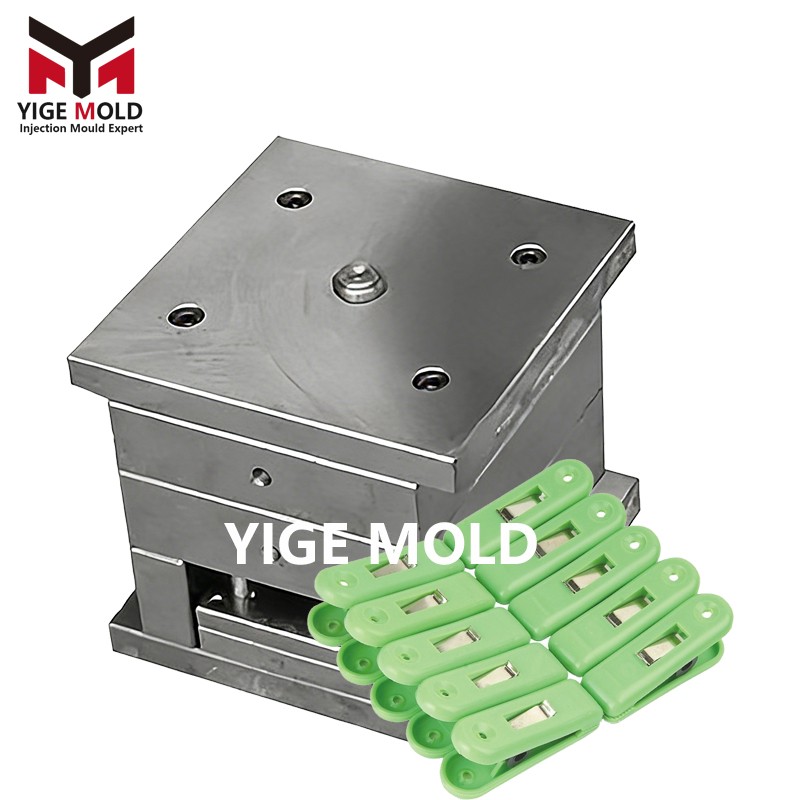
Technical Analysis of Plastic Clothespin Molds
Plastic clothespin molds are a representative and technically demanding category of specialized molds within the field of plastic injection molding. Their core function is to enable the large-scale, high-precision, and high-efficiency production of clothespins, a common household item. The design and manufacturing of these molds directly impact the functionality, durability, aesthetics, and cost-effectiveness of the final clothespin product, representing a classic case of "small commodity, sophisticated technology."
I. Product Overview and Core Mold Functions
A typical clothespin consists of a pair of clamping arms, one or two springs (or a built-in elastic structure), and a connecting pin (or an integrated hinge). Its basic functional requirements are: smooth opening and closing, appropriate and lasting clamping force, aging resistance, and resistance to sunlight and rain. Therefore, the mold must precisely form the following key features:
-
Clamping Surfaces: Must have anti-slip teeth or textures to prevent clothes from slipping.
-
Elasticity/Reset Mechanism:
-
External Spring Type: The mold is primarily responsible for precisely forming the two clamping arms and pin holes; the spring is a purchased standard part or separately stamped component. The mold structure is relatively simple, but dimensional accuracy for the fit between the arms and the spring is critical.
-
Integrated Spring Structure: This is the mainstream design for modern clothespins. The mold directly forms a thin-walled elastic structure (like a V-shaped or arched spring) on the clamping arms, enabling self-resetting. This imposes the highest demands on the mold, requiring complex internal side-core pulling or lifter actions within the mold itself, which is the core challenge in mold design.
-
-
Hinge/Pivot Structure: Ensures smooth and wear-resistant rotation of the clamping arms. This could be an integrated "living hinge" design (requiring high material toughness and careful gate placement) or involve assembly with a separate pivot pin.
II. Mold Classification and Typical Structural Designs
Based on clothespin structure and production process, molds are mainly divided into two categories:
-
Disassembled/Assembly-Type Clothespin Molds:
-
Product Composition: Two symmetrical clamping arms + a metal spring + a pivot pin (plastic or metal).
-
Mold Solution: Typically requires two sets of molds. The first is a "multi-cavity" mold for the clamping arms, producing both left and right arms simultaneously (often symmetrically arranged). This mold may include simple side-cores (for forming hook holes) and an ejection system. A second mold may be used for molding plastic pivot pins (if needed). Springs are usually produced with stamping dies.
-
Characteristics: The mold structure is relatively conventional, but the production process involves more steps, requiring subsequent manual or automated assembly. The clamping force primarily depends on the performance of the external spring.
-
-
Integrated (Self-Spring) Clothespin Molds:
-
Product Composition: A complete clothespin with a built-in elastic structure; the part ejected from the mold is the final product, requiring no spring assembly.
-
Mold Solution: This represents the most technologically advanced clothespin mold, often employing a "three-plate mold" or "hot runner + cold runner" structure for automatic part drop-off. Its core technology lies in the inward-collapsing core-pulling mechanism:
-
Functional Need: The elastic part of an integrated clothespin (e.g., the base of a V-spring) often has an internal undercut, allowing the arms to lock and generate spring force when closed. The mold must first retract the core that forms this internal undercut (the "internal core") from the part before the arms can open and be ejected.
-
Implementation: Commonly achieved using an "Inner Lifter" or "Tunnel Slider" mechanism. This mechanism is typically linked to the mold's ejection system. After mold opening, as the ejector plate advances, it drives the inner lifter to first move inward via angled surfaces or T-slots, releasing the part's internal undercut. Then, ejector pins continue to advance to fully eject the part. This entire process requires precise timing, smooth movement, and minimal wear.
-
-
III. Key Points in Mold Design and Manufacturing
-
Gating System Design: Gate location is critical, typically placed on non-working surfaces of the clamping arms (e.g., the inner side) or near the hinge to ensure balanced melt flow and avoid weld lines in elastic areas that could weaken the part. Multi-point pinpoint gates are commonly used.
-
Cooling System Design: As clothespins are often slender, uneven cooling can cause warpage. Sufficient cooling channels must be designed around the arm contours to ensure rapid, uniform cooling and shorter cycle times.
-
Venting Design: Areas like arm tips and elastic structures are prone to trapped air during mold closing. Proper venting channels are essential to prevent burn marks or short shots.
-
Material and Heat Treatment: Critical components like cavities, cores, and inner lifters must be made from high-wear-resistance, high-toughness mold steels (e.g., S136, 718H, NAK80) and undergo appropriate heat and surface treatments (like hardening, nitriding) to withstand frequent friction and impact, extending mold life.
-
Surface Treatment: Anti-slip textures on clamping surfaces are created through texturing (etching) of the mold cavity. Texture depth and pattern must be carefully designed based on clamping force requirements. Other mold areas usually require high-polish finishes to ensure a glossy, defect-free part appearance.
IV. Manufacturing Process and Quality Control
Mold manufacturing involves precision CNC milling of cavities, EDM for fine details and complex surfaces, slow wire EDM for high-precision inner lifters, and high-skill bench work for assembly and debugging. During trial runs, the focus is on verifying:
-
Smoothness and force of the clamping arm opening/closing action.
-
Uniformity and durability of clamping force.
-
Reliability of automatic part ejection from the mold.
-
Absence of defects like flash, sink marks, or warpage.
V. Application and Value
High-quality plastic clothespin molds are the foundation of modern, automated clothespin production lines. One high-output, high-stability mold set, combined with robotics, can enable unmanned continuous production, transforming plastic pellets directly into thousands of fully functional finished products, dramatically increasing labor productivity and reducing overall costs.
Conclusion
A plastic clothespin mold is far from a simple combination of "two metal plates"; it is a comprehensive technological product integrating mechanical design, material mechanics, precision manufacturing, and plastics processing. Its technological evolution—from disassembled assembly to integrated self-spring designs—clearly reflects the industry trend towards integration, automation, and high efficiency. Understanding its design principles and manufacturing challenges is fundamental to improving the quality and market competitiveness of such everyday products.