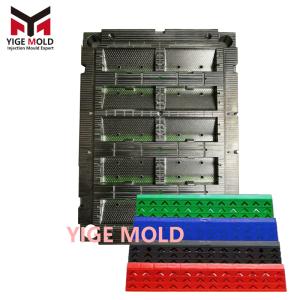
Road reflective strip mold
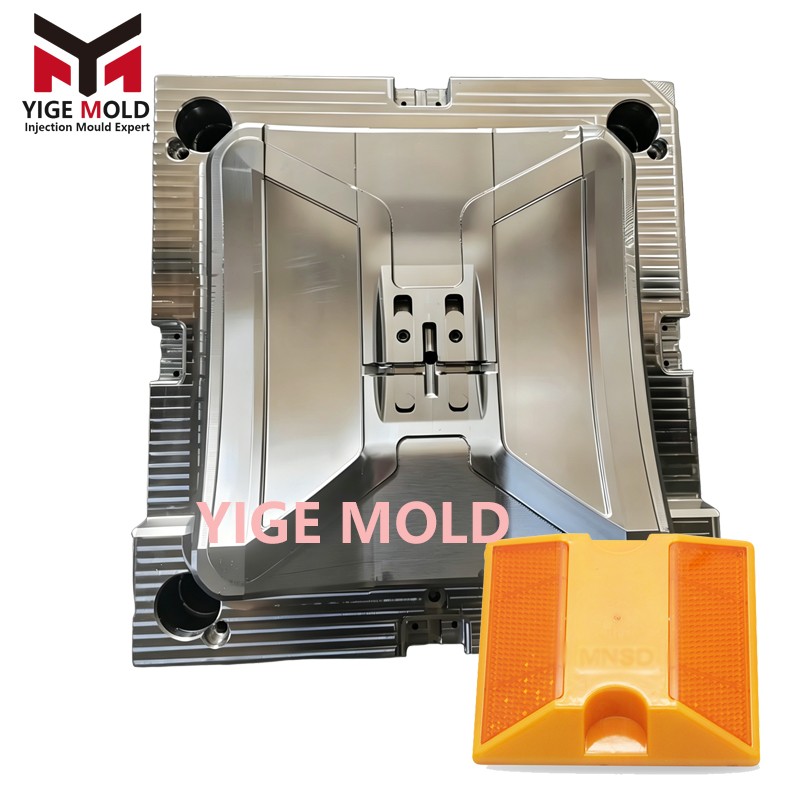
Road Reflective Strip Injection Molds: The Fusion of Precision Optics and Structural Engineering
In the modern road traffic safety system, road reflective strips serve as the core element of passive illumination. Widely applied to highway guardrails, municipal isolation piles, vehicle rears, and various traffic warning facilities, these seemingly simple red-white or yellow-black stripes are actually a key defense line ensuring night driving safety. The unsung hero supporting the high-precision, large-scale production of these reflective strips is the road reflective strip injection mold. As a highly specialized piece of industrial equipment, the injection mold not only determines the physical form of the reflective strip but also directly impacts its reflective efficiency, weather resistance, and bonding strength with the substrate. Unlike traditional adhesive reflective films or simple extrusion processes, injection molds deeply fuse thermoplastic materials with reflective units through high temperature and high pressure. Its technical connotation encompasses a deep intersection of optical design, rheological analysis, and precision mechanical manufacturing.
Precision Control of Insert Molding and IMD Technology
The core of road reflective strip injection mold design lies in solving the challenge of integrated molding of "optical elements" and "structural housings." Unlike ordinary plastic parts, reflective strips usually embed high-refractive-index glass beads or micro-prism structures inside, posing extremely high requirements for the precision of insert molding in the mold. The mold design must ensure that during the high-speed filling of molten plastic, the reflective sheet or crystal lattice does not shift, deform, or suffer from flash.
To this end, engineers typically employ In-Mold Decoration (IMD) technology or two-color (double-shot) injection molding processes. In the IMD process, pre-printed reflective films are precisely placed into the mold cavity by robotic arms. During injection, the plastic melt flows behind the film, cooling to form a tight bond with the film surface, creating an integrated reflective strip. This design requires the mold to possess extremely high sealing capability to prevent plastic from seeping into the reflective surface and destroying the optical effect. In two-color injection molding, the mold usually consists of two independent stations; the transparent or translucent substrate is injected first, followed by the colored housing in the second station. This complex rotary or slide-core mold structure ensures that the reflective strip possesses both a vibrant appearance and unobstructed internal light paths.
Optimization of Gating Systems and Venting Design
The design of the gating system is the lifeline determining the quality of reflective strips. Since reflective strips typically present a long, thin shape with thin cross-sections, the melt(is prone to) experiencing pressure loss and temperature drop when flowing through the long runners, leading to short shots or weld lines. To solve this problem, road reflective strip injection molds universally adopt hot runner systems, specifically valve-gate hot runners. This system can precisely control the opening and closing time of the gates. Coupled with multi-point gating design, it ensures that the plastic melt fills the cavity steadily in a laminar flow state, avoiding shifts in the reflective sheet caused by turbulence.
Simultaneously, the runner layout must undergo strict rheological simulation to ensure filling balance across all cavities, which is crucial for high-efficiency production with multi-cavity molds. For reflective strips with complex prism structures, the mold also requires a special venting system, utilizing porous steel inserts or micron-level venting slots to rapidly exhaust air from the cavity. This prevents gas compression from generating high heat that could burn the reflective film or form bubbles, ensuring product surface smoothness and uniform optical performance.
Conformal Cooling and Thermal Management
The optimization of the cooling system is key to improving the production efficiency and dimensional stability of reflective strips. As slender products, reflective strips are extremely prone to warping and deformation during the cooling process, which would directly prevent them from fitting flatly onto guardrails or vehicle bodies. Therefore, conformal cooling water channels are typically designed inside the mold. These channels wind and arrange closely along the cavity surface, capable of uniformly removing heat and eliminating internal stresses caused by uneven wall thickness.
For reflective strips made of high-transparency materials, the control of mold temperature is even more rigorous. High-temperature mold temperature controllers are usually required to maintain a constant surface temperature, preventing flow marks or fogging on the product. This ensures the transparent housing is as clear as crystal, maximizing light transmittance and reflectivity.
Material Selection and Surface Treatment
In terms of material selection, road reflective strip injection molds face severe challenges regarding wear and corrosion resistance. The production of reflective strips often uses engineering plastics such as Polymethyl Methacrylate (PMMA), Polycarbonate (PC), or Acrylonitrile Butadiene Styrene (ABS), often with added glass fibers for strength. These materials possess (extremely strong) abrasiveness towards mold steel under high temperature and pressure. Coupled with the requirements for weather resistance in outdoor environments, the mold steel must possess excellent hardness and corrosion resistance.
Typically, the mold cores and cavities are made of corrosion-resistant mirror mold steels like S136 or 2316. After vacuum heat treatment and cryogenic treatment, the hardness can reach above HRC 50. The mold surface also requires Diamond-Like Carbon (DLC) coating or nitriding treatment. This not only reduces the flow resistance of the plastic melt, preventing sticking, but also significantly extends the mold's service life, ensuring that after hundreds of thousands of injection cycles, the dimensional accuracy of the reflective strips remains within micron-level tolerances.
Precision Ejection Mechanisms
The design of the ejection mechanism also tests the wisdom of mold engineers. Reflective strip surfaces usually feature anti-slip textures or buckle structures, and due to the insertion of reflective sheets, the product has a high clamping force on the core. To ensure the product does not suffer from stress whitening, deformation, or damage to the reflective surface during ejection, molds typically adopt a combination of air-assisted ejection and stripper plate ejection. Air poppets can instantly break the vacuum adhesion, allowing the product to detach evenly from the core, while the stripper plate provides steady support. For automated production lines, the mold must also reserve space and positioning points for robotic arm grasping, achieving a seamless connection from injection molding to assembly.
In summary, the road reflective strip injection mold is a system engineering project integrating optical protection, precision molding, and efficient production. From the precise positioning of inserts to the balanced control of hot runners, from the thermal management of conformal cooling to the (ultimate) polishing of mirror steel, every step embodies the ingenuity of manufacturing craftsmanship. It is these molds, meticulously carved in steel, that transform ordinary plastic granules and optical materials into a "luminous defense line" guarding night safety, outlining clear traffic veins on dark roads.