Office Chair Mold
Structural Features and Technical Requirements of Office Chair Molds
I. Scope and Functional Positioning
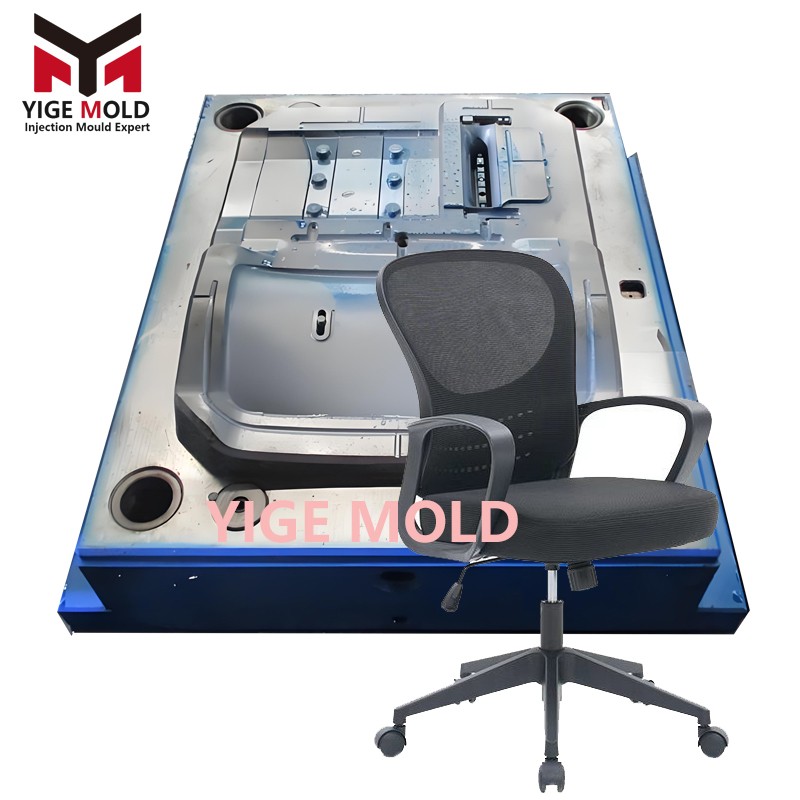
Office chair molds are specialized forming tools used for mass-producing plastic components and metal load-bearing parts for office chairs, including seats, back frames, armrests, chassis, star bases, gas lift covers, and various connectors. Unlike household chairs, office chairs operate under frequent height adjustment, rotation, and sliding conditions, demanding higher structural strength, assembly interchangeability, and durability. Mold design must simultaneously meet three key indicators: surface flatness, dimensional stability, and dynamic load safety, making them a technology-intensive category within medium-to-large furniture molds.
II. Classification Framework
(A) Injection Molds: Main Tooling for Plastic Parts
Plastic parts for office chairs primarily use PP, ABS, PA+GF, etc. Due to ergonomic curves, dense assembly interfaces, and varying wall thicknesses, injection molds exhibit distinct features:
-
Seat and Backrest Molds: Deep-cavity thin-shell structures with irregular surfaces like lumbar supports and shoulder transition zones. Multi-point submarine gates or hot-runner zoned gating ensure uniform long-flow filling; ejection systems integrate lifters, sliders, and hydraulic core pulls to address undercuts at armrest roots and mesh-side recesses. High-end molds may add auxiliary ejection mechanisms to reduce demolding stress.
-
Mechanical Component Molds: Load-bearing parts like chassis and lift seats often use glass-filled materials. Steel selection combines P20 and S136 grades, with quick-change inserts in high-wear areas; threaded bosses and insert slots adopt independent split structures for easier maintenance and adjustment, while optimized cooling circuits control shrinkage.
-
Appearance Part Molds: Armrest covers and decorative caps require high-gloss or textured finishes. Cavities undergo mirror polishing or etching; multi-level venting minimizes flow marks and burn, with cold slug wells capturing flow-front residue.
(B) Die-Casting Molds: Support for Metal Load-Bearing Frames
Aluminum die-castings focus on key load-bearing units like star bases and reinforced chassis. Design priorities include:
-
Sprue systems using fan or tangential gates for stable metal flow, reducing turbulence-induced porosity;
-
H13-series hot-work steel cores/sliders with nitriding to withstand aluminum erosion and thermal shock, extending service life;
-
0.5–1 mm machining allowance reserved, with locating datums aligned to the parting plane for consistent drilling/tapping coaxiality.
III. Core Design Considerations
-
Strength Adaptation Under Dynamic Loading
Daily operation involves hundreds of height adjustments and rotations. CAE-assisted optimization of gate locations and packing curves directs weld lines away from high-stress pivot points (e.g., armrest hinges, chassis locks). Wave-gradient ribs improve bending stiffness while reducing stress concentration, ensuring ≥120,000-cycle fatigue performance.
-
Mapping Ergonomics to Manufacturing Precision
Seat and back-support surfaces require multi-axis CNC machining and EDM finishing to maintain curvature continuity. Contour errors in lumbar depth and seat-depth transitions are tightly controlled within 0.08 mm to prevent discomfort or inadequate support in mass-produced parts.
-
Tolerance Chain Control in Multi-Level Assembly
Cumulative tolerance across components (gas lift bore to chassis mount) must remain below 0.4 mm. A common-datum strategy aligns all related parts to the same parting-plane origin; anisotropic shrinkage compensation minimizes post-mold fitting.
-
Balancing Service Life and Economics
Wear-prone zones (e.g., glass-filled flow paths, slide rails) use powder metallurgy steel or bimetal cladding, targeting ≥1 million-shot lifespan. Modular insert libraries enable shared mold bases and slider sets across chair series, reducing development costs and changeover time.
IV. Manufacturing Execution and Quality Anchors
-
Integrated Machining Chain: Five-axis high-speed milling forms main cavities, supplemented by slow-wire EDM and precision spark erosion for narrow corners. Guide pin/bushing clearances are held within 0.015 mm for consistent mold-open/close repeatability.
-
Targeted Heat Treatment: Customized tempering based on material abrasion; carburizing high-glass-content contact surfaces slows wear propagation.
-
Closed-Loop Trial Validation: Three-phase trials iteratively optimize injection speed, multi-stage packing, and cooling time; 3D scanning compares physical parts to CAD models for micro-corrections.
-
Multi-Tier Inspection: Products undergo dimensional sampling, static load testing (≥1100 N), tilt stability checks, and 100,000-cycle endurance tests; molds are logged per shot count, with guide wear and sealing-face inspections every 50,000 shots.
V. Industry Evolution Trends
-
Expanded Material Compatibility: Adapting to recycled PP/ABS and high-fill engineering plastics by refining vent layouts and coating adhesion to resolve sticking and orange-peel defects.
-
Lightweight-Strong Integration: Topology-optimized rib grids and wall-thickness gradients reduce total weight by ~15% while maintaining rated load capacity, aligning with low-carbon logistics and user-experience goals.
-
Efficiency-Driven Design: Optimized runner cross-sections and conformal cooling channels cut cycle times by ~15%; large-scale quick-change interfaces enable multi-model line switching without downtime.
VI. Conclusion
Office chair molds form the foundation of industrialized seating production; their maturity directly determines product yield and brand reputation. As competition shifts from pure output to “precision + longevity + responsiveness,” deep integration of materials, structure, and process is essential to building sustainable advantages. Moving forward, flexible tooling and targeted performance upgrades will be key to addressing increasingly segmented ergonomic needs.