Gaming Chair Mold
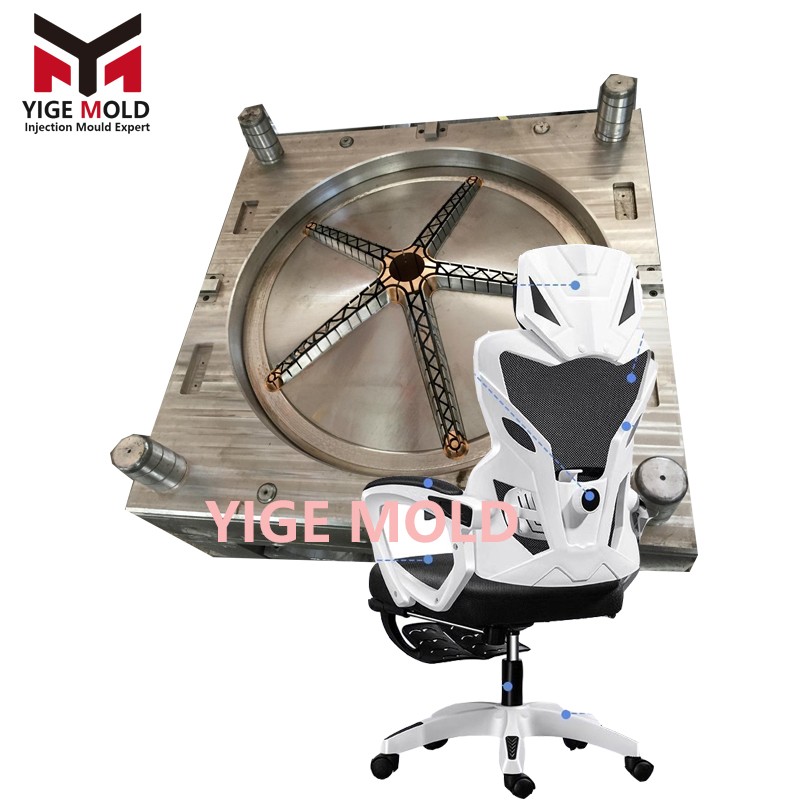
Specialized Technical Analysis of Gaming Chair Injection Molds
I. Scope and Positioning
Gaming chair injection molds refer specifically to dedicated molding tools for producing all plastic components of gaming chairs, including bucket seats, high-backrests, multi-directional adjustable armrests, chassis covers, lumbar/headrest clips, and decorative parts. Compared to office chairs, gaming chairs feature more aggressive styling: deeper side wings, larger surface undulations, and denser decorative textures. Thus, the mold must realize complex aesthetic features while ensuring structural reliability under high-frequency reclining impacts, prolonged sitting pressure, and multi-joint adjustments—making it a typical category of injection molds subject to dual constraints of high appearance requirements + high mechanical performance.
II. Differentiated Structure Architecture
(A) Bucket Seat and High-Back Molds: Technical Challenges of Deep Cavities and Steep Walls
Gaming seats typically adopt racing bucket forms with side wing heights reaching 120–180 mm; the seat and back form a continuous C-shaped wrap-around curve, posing three core challenges:
-
Deep Undercut Release: Both inner and outer sides of the wings have significant undercuts beyond conventional lifter coverage. Long-stroke sliders (stroke ≥150 mm) combined with hydraulic cylinder assistance are required; slide rails receive tungsten carbide coatings for frequent friction resistance. The parting line follows the non-uniform curve along the wing root, with seal-off widths precisely controlled at 6–8 mm to prevent flashing.
-
Complete Curved Surface Filling: Due to high length-to-thickness ratios (L/T often >200), multi-point hot runners with sequential valve control are used. Gates are prioritized in non-appearance areas like the seat bottom; auxiliary venting inserts at the top back eliminate weld lines caused by trapped air.
-
Stress Control in Thick-Thin Transitions: Wall thickness varies from 3 mm at wing roots to 5 mm at seat junctions. Conformal cooling channels loop around thick sections, coupled with sloping packing curves, to restrict volumetric shrinkage differences below 1.5% and avoid warping.
(B) Multi-Function Armrest Molds: Forming Precision Motion Pairs
Armrests often support height, fore-aft, and angle adjustments, containing hidden rail grooves, gear racks, and limit holes. Mold design focuses on:
-
Modular Functional Inserts: Rail slots, hinge holes, and spring detents are made as separate inserts using 1.2344 (H13) or higher-hardness powder steel, polished to Ra ≤0.025 to ensure burr-free motion surfaces.
-
Micro-Feature Venting: Gear rack and slot areas have 0.003–0.006 mm micro-vents, paired with main parting-line vents (depth 0.03 mm), preventing short shots or burns from gas entrapment.
-
Wear Resistance for Glass-Filled Materials: Armrest frames commonly use 30% glass-fiber PA or PP; runner and gate areas undergo local nitriding (case depth ~0.15 mm), extending high-wear zone life beyond 800k shots.
(C) Appearance Component Molds: Realizing Visual Impact
Emphasizing racing DNA, common elements include faux stitching, honeycomb grids, carbon-texture patterns, and high-gloss black surfaces, requiring special processes:
-
Texture Replication Accuracy: Faux stitches are electrode-machined to 0.25±0.03 mm width, 0.18±0.02 mm height, with 1.5° draft balancing release and dimensionality. Honeycomb arrays use embedded electroformed nickel inserts, hole consistency within ±0.06 mm.
-
High-Gloss Surface Control: Gloss-black parts (e.g., armrest end caps) require cavity polish to Ra ≤0.012. Pin-valve hot tips feed through pinpoint gates; cold slug well volume increased to 1.2× sprue size to fully trap cold material; vent spacing tightened (<20 mm end-to-end) to eliminate haze-like flow marks.
-
Multi-Material Adaptation: Soft-touch TPU/TPE parts (e.g., lumbar wraps) use S136 or higher-purity stainless steel with DLC coating (2–3 μm) against sticking; ejector pins enlarged to ≥∅8 mm to reduce deflection.
III. Core Design Logic: Mapping User Experience to Process
-
Balancing Wrapped Surfaces vs. Demoldability
Side wing angles exceeding 60° exponentially increase release force. CAD simulations determine critical draft angles; wing inner surfaces are adjusted by 0.7°–1° increments to retain styling while ensuring release. Slide lock angles are inversely compensated for shrinkage to prevent part tearing during opening.
-
Misaligning Dynamic Stresses and Weld Lines
Reclining impacts concentrate on the lower backrest edge and chassis ears. Flow analysis positions gates away from load-bearing zones, keeping weld lines ≥5 mm from bolt holes/pivot points. Ribs follow “tree-branch” patterns with root R ≥1.5T, dispersing impact stress to the overall frame.
-
Closing Tolerance Chains for Adjustment Precision
Multi-stage fits between armrests and chassis must hold ≤0.35 mm cumulative tolerance. A common-datum approach aligns all related parts to the chassis mounting plane; anisotropic shrinkage compensation accounts for fiber orientation (1.1× flow direction, 0.9× transverse), achieving >95% direct assembly rate after paired trial tuning.
-
Engineering Life-Cycle Cost Balance
High-wear zones use bimetal overlay/hard alloy inserts for ≥1M-shot targets; non-critical parts simplify to cold-runner conversions, cutting cost ~30%; sharing mold bases/slide sets across series reduces new development to ~12 weeks.
IV. Precision Manufacturing Execution
-
Five-Axis Surface Machining: Bucket-seat cavities are milled with five-axis high-speed machining (≥18k rpm), cutter radius compensation ±0.008 mm; wing-root corners cleared with ∅1 mm ball tools, residual <0.035 mm.
-
Special Process Enhancement: EDM finishes fillets/texture transitions with pulse widths ~3 μs to minimize recast layers; guide pin/bushing clearance ≤0.018 mm; slide wedge faces ground to flatness ≤0.004 mm.
-
Three-Stage Trial Loop: Phase I establishes filling/ejection; Phase II validates assembly interference/adjustment feel; Phase III uses 3D scanning to compare part-to-CAD deviation, applying 0.022 mm stepwise surface compensations to keep contour error within ±0.28 mm.
-
Scenario-Based Inspection: Parts undergo static crush (≥1500 N), 100k recline cycles, 6000 armrest adjustments; molds track slide wear (max 0.075 mm loss per 40k shots) and cooling flow drop (threshold -15%).
V. Industry Evolution Directions
-
Material Boundary Expansion: Adapting to recycled PC/ABS and high-fill flame-retardant grades by optimizing vent density/coating adhesion to solve degradation sticking and silver streaks.
-
Lightweight-Strong Integration: Variable wall thickness plus microcellular foaming cuts weight 18–22%; molds integrate high-pressure clamping and rapid venting structures to maintain rigidity.
-
Flexible Changeover Upgrade: Quick-change interfaces for large modules (seat/armrest swaps) enable core component changes within 24h, supporting seasonal skin updates.
VI. Conclusion
Gaming chair injection molds are the nexus translating player experience into mass-production capability. Their technical essence lies in balancing “styling extremes” with “manufacturing limits.” Future competitiveness extends beyond single-mold precision to rapid response across material innovation, aesthetics iteration, and cost control—requiring designers to deeply integrate rheology, structural mechanics, and process simulation into a short-loop capability from concept to batch production.