High-back chair mould
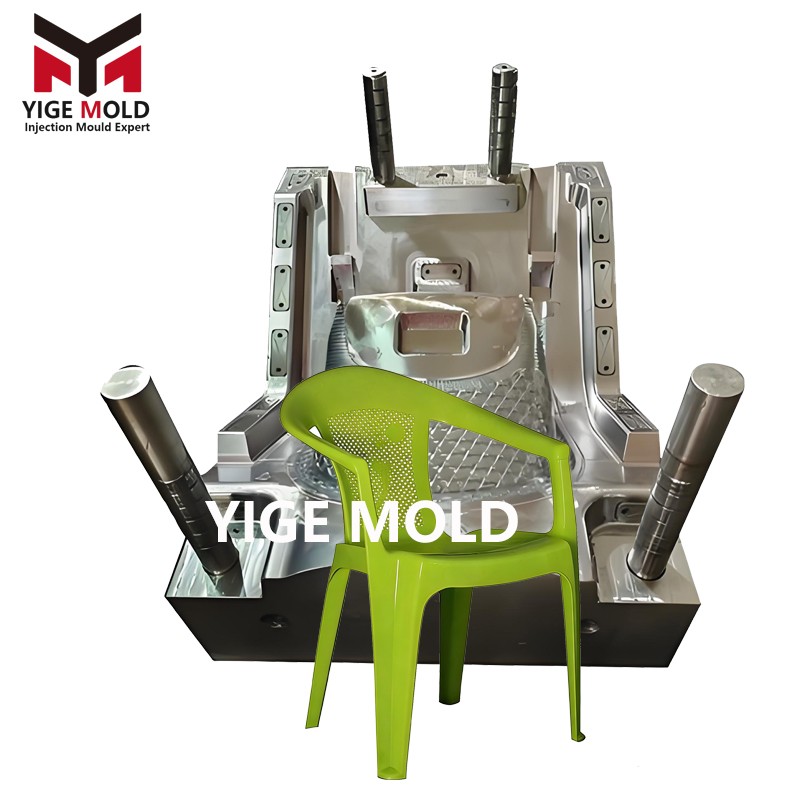
High-Back Chair Mold: A Precision Vessel for Ergonomics and Advanced Manufacturing
I. Core Purpose: High-Fidelity Realization of Ergonomic Curves
The primary distinction and challenge of a high-back chair mold lies in its mission: to precisely and stably form complex, contoured structures that provide comprehensive body support, adhere to ergonomic principles, and possess aesthetic appeal. Its technical complexity and value are directly proportional to the product's positioning, functional integration, and design sophistication, making it a critical link between industrial design and mass production.
-
Precision Reproduction of Complex 3D Surfaces: The seat back and pan of a high-back chair are typically complex, three-dimensional free-form surfaces designed around the spine's natural curvature and pressure distribution. The mold's cavity and core must reproduce the digital 3D model of these surfaces with 100% accuracy. This demands micron-level precision across every manufacturing step—from CNC milling and EDM to hand polishing—to ensure the final product's fit, comfort, and visual fluidity.
-
Balancing Structural Integrity with Lightweighting: The tall, continuous backrest acts like a cantilever, creating significant leverage under load (e.g., reclining, twisting). The mold must form a scientifically designed internal reinforcement structure beneath the seemingly simple shell. This includes:
-
Rigidity Across Large Spans: Internally, the mold forms longitudinal primary load-bearing ribs and multiple transverse anti-twist ribs, creating a stable "I-beam" or grid-like skeleton. The height, thickness, and root radii of these ribs require rigorous stress analysis to prevent fatigue failure.
-
Integrating Ribs with Contours: Unlike flat surfaces, placing ribs on complex curves requires ensuring smooth plastic flow within the rib channels and reliable ejection, placing higher demands on mold machining and ejection system design.
-
II. Functional Integration: From Static Support to Dynamic Interaction
High-end high-back chairs often integrate multiple functions, requiring the mold to form complex mechanical features in a single shot.
-
Embedding Tilt and Lumbar Mechanisms: Many office high-back chairs feature tilt locks, height adjusters, and lumbar support. The mold must form internal gear racks, spring clip slots, damper sleeves, and guide channels. This necessitates numerous intricate angled lifters, sliders, and hydraulically/pneumatically actuated side-cores within the mold to ensure these internal features can immediately and precisely interface with gas lifts and base mechanisms after ejection.
-
Reinforced Armrest Integration: Armrests are common stress concentration points. The mold forms the connection points between the armrests and the main body, often utilizing metal inserts (e.g., nuts, threaded sleeves) or special self-locking snap-fit designs for strength. The mold must precisely position these inserts and ensure the plastic fully encapsulates them during injection, creating ultra-strong connection nodes.
III. Dual Challenges: Manufacturing Process and Material
-
Process Challenges from Large Size and Deep Draw:
-
Fill and Warpage Control: The large projected area and depth of a high-back chair mean the melt must travel a long flow path from the gate to the top of the back, risking flow hesitation, visible weld lines, and uneven shrinkage. Molds typically employ multi-point sequential valve-gated hot runner systems to precisely control the fill path and speed, coupled with a zoned temperature-controlled cooling system to ensure uniform cooling and prevent large-scale warpage.
-
Deep Cavity Venting: Deep sections of the tall cavity easily trap air, causing burns or short shots. Efficient venting is essential via parting lines, core inserts, and ejector pins. In some cases, vacuum-assisted venting is designed to completely evacuate air.
-
-
Stringent Material Requirements: High-back chairs often use high-strength, high-flow engineering plastics like modified PP, nylon (PA), or ABS. These materials place greater demands on the mold's wear resistance, corrosion resistance, and thermal stability. Mold steels are typically high-polish, high-wear-resistant pre-hardened steels or premium stainless steels to ensure long-term production stability and surface finish quality.
-
Achieving Premium Surface Finishes: Whether aiming for a premium matte feel, leather grain, or high-gloss piano finish, it is achieved through mold surface treatment. For instance, the "soft-touch" texture common on high-end office chairs is created via precise chemical texturing (etching), where the depth and uniformity of the texture directly impact the user's tactile experience.
IV. The Eternal Pursuit: Precision and Stability
The value of a high-back chair mold is reflected in its consistency and stability. A top-tier mold should guarantee that the 1st and the 100,000th part produced are virtually identical in critical dimensions, assembly tolerances, ergonomic curves, and surface quality—with deviations kept within an exceptionally narrow range. This requires not only precise design but also manufacturing with high-precision equipment, rigorous inspection standards (e.g., CMM), and extensive assembly expertise.
Conclusion
The high-back chair mold represents the technical crystallization of the seating industry's advancement towards premium, human-centric design. It transcends the mere manufacture of an object; it uses metal (the mold) to shape plastic, which in turn shapes the comfort and health of the human body during prolonged sitting. Its technical complexity is vividly embodied in the final chair that perfectly supports the user's spine and tilts seamlessly with their posture. The mold behind it is, therefore, an industrial artifact of both scientific and aesthetic value—a fusion of structural engineering, materials science, precision machining, and ergonomics.