32-cavity spoon mold
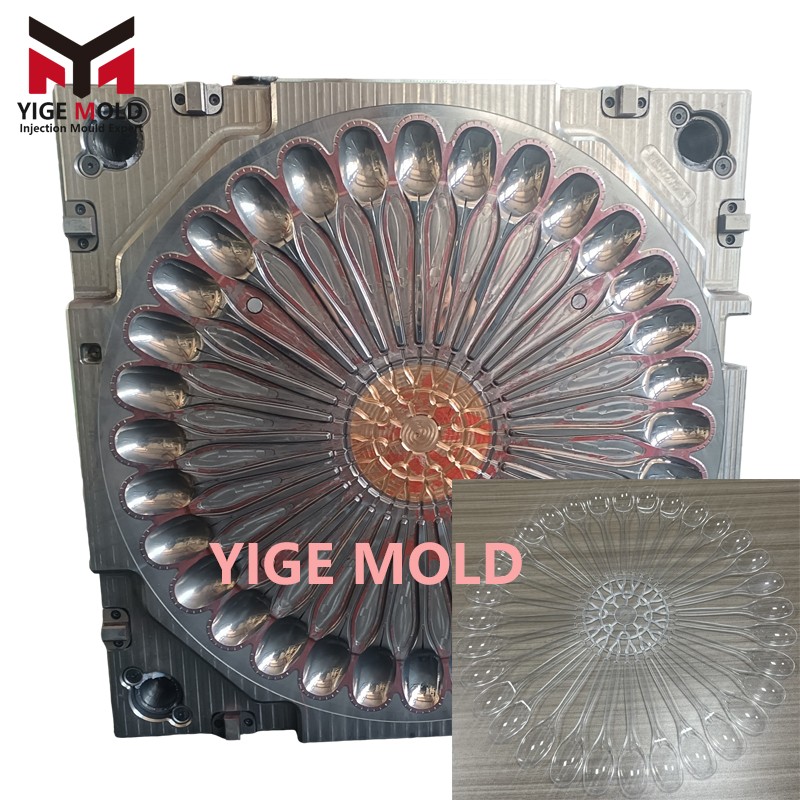
32-Cavity Spoon Mold: The Art of Precision Metering in the Era of Mass Production
In the modern catering and food industry, the plastic spoon is the most ubiquitous yet seemingly insignificant consumable item. The core supporting its massive production is the multi-cavity mold. Among these, the 32-cavity spoon mold is a concentrated embodiment of efficiency and precision, aptly described as an "engineering paradigm that amplifies the value of a single action to its extreme."
I. Core Logic: The Geometric Evolution of Efficiency
The number of cavities in a mold directly correlates to a multiplicative increase in production efficiency. Compared to common 4- or 8-cavity molds, the 32-cavity mold achieves a leap in output per production cycle. However, this is far from a simple matter of numerical addition. Its essence is finding the "optimal solution for cost-per-unit-time"—maximizing the output of a single injection molding action through ingenious runner and layout design, within the limits of the molding machine's clamping force and shot volume. This means that to produce the same quantity of spoons, the required machine running time, energy consumption, and labor supervision costs are drastically reduced. It is a key production tool for sectors like food packaging and fast food, which are extremely sensitive to costs.
II. Design Core: Balance is the Soul
In a 32-cavity mold, balance is the overriding core principle. This balance manifests in three dimensions:
-
Flow Balance: This is the lifeline of a multi-cavity mold. It must ensure that molten plastic, starting from the main sprue and passing through the runners, reaches the end of all 32 cavities simultaneously, at equal speed, equal pressure, and equal temperature. Any slight imbalance can cause "flow leaders"—cavities near the gate being over-packed while distant ones are under-filled, leading to inconsistent product weight, dimensional deviations, or even scrap. This relies on an extremely complex balanced runner system (often in an H-pattern or radial layout) and precise runner dimension calculations.
-
Thermal Balance: The uniformity of cooling across all 32 cavities is critical. The cooling channel design must ensure each cavity dissipates heat at the same rate. Uneven cooling causes spoon warpage and inconsistent shrinkage, affecting usability (e.g., poor stacking) and appearance. Conformal cooling channels or precisely designed parallel cooling networks are typically employed to ensure a highly consistent thermal environment for each cavity.
-
Mechanical Balance: The mold opens and closes under high pressure. The pressure center of the 32 cavities must be highly aligned with the clamping force center of the injection molding machine. Otherwise, it leads to uneven mold loading, accelerated wear, or even damage. This requires the cavity layout to undergo rigorous mechanical analysis to ensure balanced force distribution.
III. Structural Challenges: Creating a Universe of Precision Within a Confined Space
-
Miniaturization and High Precision: A single spoon cavity is already small. Arranging 32 within a limited mold size demands extremely high machining accuracy. Dimensional tolerances and surface finish for each cavity must be controlled at the micron level to ensure every one of the 32 spoons has identical weight, thickness, and capacity. Faithfully replicating details like anti-slip patterns on the handle and the bowl's curvature presents a stern challenge.
-
The Miniature Symphony of the Ejection System: The 32 sets of ejection mechanisms (ejector pins or stripper plates) must actuate instantaneously and synchronously to cleanly strip the 32 thin, easily deformable spoons from the cores without leaving ejector marks or causing deformation. This requires an extremely rational ejector layout and exceptionally high actuation synchronization—a masterpiece of precision mechanical design.
-
The Pursuit of "Zero Waste" in Runners: Traditional cold runners generate a significant amount of sprue material that requires recycling and grinding. In 32-cavity molds, full hot runner systems or valve-gated hot runners have become standard for high-end applications. They keep the plastic molten within the runners, generating no waste, thereby saving material and eliminating downstream processing steps. They represent efficient, clean production.
IV. Manufacturing and Maintenance: The Sum of Precision
-
Manufacturing: Its core components (e.g., cavity inserts, hot runner nozzles) require ultra-precision machining technologies like mirror-finish EDM (Electrical Discharge Machining) and Slow Wire-Cut EDM. A high-quality 32-cavity mold is itself a precision instrument meticulously crafted from premium tool steel.
-
Maintenance: A high cavity count implies higher maintenance complexity and downtime cost. A single clogged or damaged cavity can halt the entire mold. Therefore, modular design (for quick replacement of individual cavities or runner components) and preventive maintenance (regular cleaning and servicing of hot tips) are essential for its stable operation.
V. Economics: The Perfect Vehicle for Economies of Scale
The 32-cavity mold is the physical embodiment of "economies of scale." Its high design and manufacturing costs are amortized over an astronomical production volume, driving the mold depreciation cost per spoon close to zero. It enables disposable cutlery to exist for a few cents or less, profoundly shaping the cost structure and consumption habits of modern fast-moving consumer goods society.
Conclusion
The 32-cavity spoon mold is far more than a simple replication tool. It is the perfect practice of precise control of fluid dynamics, uniform conduction of thermodynamics, coordinated operation of precision mechanics, and the economics of scale. In the rhythm of its rapid opening and closing, we witness how industrial civilization transforms the most ordinary everyday object into a grand narrative about efficiency, precision, and cost control. Every spoon that falls uniformly from the assembly line is silent testament to the concept of "precision at scale" within modern manufacturing systems.