Plastic laundry basket injection mould
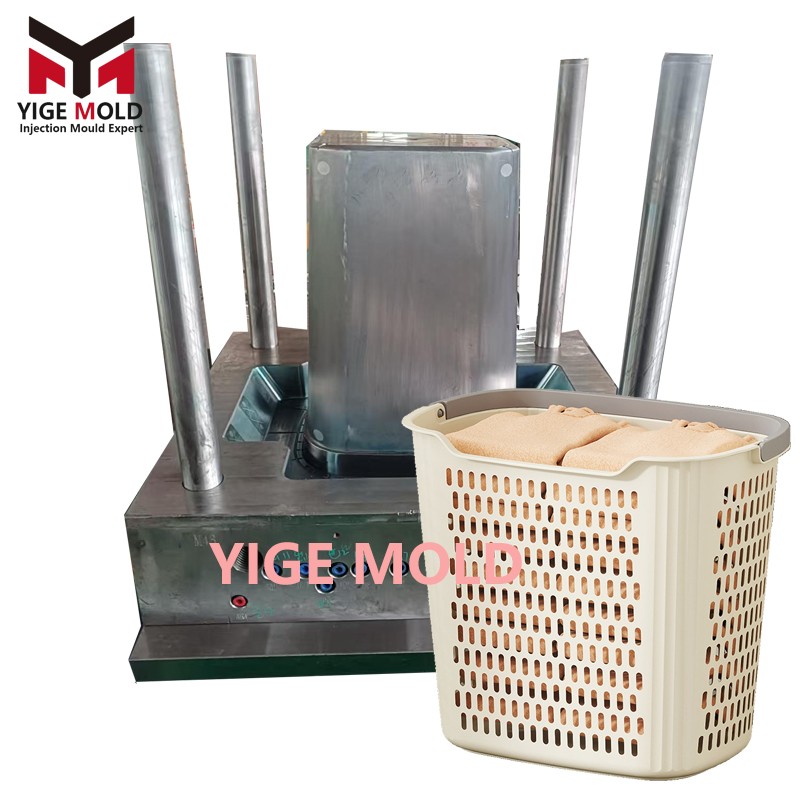
Plastic Laundry Basket Injection Mold: The Precision Engineering Behind Modern Household Essentials
In contemporary home life, the plastic laundry basket is practically a standard item in every household. It is lightweight, durable, and inexpensive, perfectly meeting daily storage needs. Yet, few ponder how such a seemingly simple product is mass-produced with such high efficiency and low cost. The answer lies concealed within the "plastic laundry basket injection mold," a piece of precision industrial equipment. It is not only the "mother" of the product but also a concentrated embodiment of modern injection molding aesthetics and efficiency. The technological logic and engineering wisdom behind it form the material foundation of our everyday goods.
I. The Mold: The Creator of the "Negative" from Concept to Object
The essence of a plastic laundry basket injection mold is an "internal cavity system" designed with extreme precision. Its core function is to shape molten plastic material (typically polypropylene PP or polyethylene PE) into the predetermined laundry basket form under high temperature and pressure. This process follows a profound "negative form philosophy": to obtain thousands of identical "positive" products, one must first create a perfect, complementary "negative" space—the mold cavity.
A typical laundry basket injection mold is not a simple block of iron with a groove. It is a functional system comprising dozens or even hundreds of parts assembled with precision. Its core structure typically includes:
-
Fixed and Moving Halves (Plates): The two main sections of the mold. The fixed half is secured to the injection side of the molding machine, while the moving half is mounted on the moving platen. When closed, they form a sealed molding cavity.
-
Molding System: Consists of the cavity (shaping the product's outer surface) and the core (shaping the product's inner surface). It directly determines all the details of the basket's shape, wall thickness, texture (e.g., anti-skid grids, reinforcing ribs), etc.
-
Gating System: Acts as the mold's "circulatory system"—the channels through which molten plastic flows from the molding machine nozzle into the cavity. The design of the sprue, runners, and gates is critical, directly affecting the fill speed, pressure transfer, and final product quality. For large, thin-walled parts like laundry baskets, multi-point hot runner technology is often employed to ensure the plastic fills the entire large, complex cavity rapidly and uniformly, minimizing weld lines and saving material.
-
Ejection System: After the product cools and solidifies, it must be cleanly released from the core. Ejector pins, ejector plates, etc., actuate after mold opening to ensure the finished product detaches undamaged. For products with deep cavities, side holes, or undercuts like laundry baskets, complex angled lifters or slide (side-action) cores are often necessary to achieve lateral parting and ejection.
-
Cooling System: A network of cooling channels precisely arranged within the mold. Circulating coolant efficiently removes the heat released as the plastic solidifies, significantly shortening the molding cycle (cooling time often accounts for over 70% of the total cycle time) and is key to boosting production efficiency.
-
Venting System: Tiny channels for air to escape from the cavity. Inadequate venting can cause trapped, compressed air to lead to defects like burning, short shots, or bubbles in the product.
II. Design Intelligence: Seeking the Optimal Balance Between Function, Aesthetics, and Cost
The design of a laundry basket mold goes far beyond replicating a basket shape. It is a complex game of precise trade-offs between functionality, aesthetics, structural strength, production efficiency, and material cost.
-
The Structural Reinforcement vs. Lightweighting Balance: A laundry basket must bear the weight of clothes, requiring structural strength. Designers achieve this by scientifically arranging grid-like or radial reinforcing ribs on the product's backside (determined by the core), significantly enhancing the product's compressive, impact, and deformation resistance with almost no increase in wall thickness (thus avoiding a significant increase in weight and material cost). This requires the mold core surface to be precisely machined with corresponding rib channels.
-
Detail Handling and Ergonomic Considerations: Handle holes must be smooth and burr-free, requiring the corresponding mold areas to be perfectly smooth, gap-free, and designed with appropriate draft angles. The side walls of the basket are often designed as ventilated grids, which means the mold cavity and core have numerous slender protrusions and depressions, placing extremely high demands on the steel's strength, polishing techniques, and cooling uniformity.
-
The Efficiency Magic of "Multi-Cavity" Design: To maximize production efficiency, modern molds often employ "family" or "multi-cavity" designs, where a single mold contains 2, 4, 8, or even more identical cavities. Each injection cycle can simultaneously produce multiple baskets. This requires excellent runner balance within the mold to ensure fill pressure, speed, and time are completely consistent for each cavity, guaranteeing uniform product quality.
III. Manufacturing: The Art of Steel with Micron-Level Precision
Mold manufacturing is the process of translating a design blueprint into a steel reality, representing the pinnacle of precision machining.
-
Material Selection: Core mold components (cavity, core) are typically made from high-grade tool steels like P20, H13, S136, etc. These offer high hardness, excellent wear resistance, superior corrosion resistance, and good thermal conductivity to withstand millions of cycles of high pressure, temperature, and abrasion.
-
Precision Machining: Computer Numerical Control (CNC) milling is used for roughing and semi-finishing to create the basic shape. Subsequently, Electrical Discharge Machining (EDM) is employed to handle deep ribs, narrow slots, and complex contours inaccessible to CNC cutters. For surfaces requiring high gloss, Slow Wire-Cut EDM and precision grinding are used.
-
Surface Finishing: After machining, the cavity surface undergoes a series of polishing steps—from stone polishing, diamond compound polishing to mirror polishing—to achieve the desired finish (matte, texture, high gloss, etc.) on the final product. This directly affects the basket's final appearance and ease of demolding.
-
Heat Treatment: To enhance the hardness and service life of the tool steel, critical components undergo processes like quenching and tempering, giving them the necessary internal "toughness" to resist long-term fatigue.
IV. Lifecycle: The Engine of Efficiency and a Vessel of Value
Once the mold is debugged and mounted on an injection molding machine with clamping forces measuring in the hundreds or thousands of tons, its efficient and stable production journey begins. A high-quality laundry basket injection mold can produce over a million parts within its lifecycle. Its cost is amortized across this vast quantity of products, driving the manufacturing cost of a single basket to a very low level—this is the economic foundation enabling the widespread adoption of plastic goods.
However, the mold itself is a high-value asset. Its design and manufacturing cycle is long (several weeks to months), and the upfront investment is significant (ranging from hundreds of thousands to over a million RMB), making it a typical technology- and capital-intensive product. Therefore, meticulous mold maintenance is crucial. Regular cleaning, rust prevention, lubrication, and inspection of key components for wear are essential to ensure its long-term, stable operation and extend its service life.
Conclusion: The Invisible Industrial Cornerstone
When we casually pick up a lightweight plastic laundry basket, we are holding not just a household item but the crystallization of an entire modern industrial system. Behind it stands that injection mold—crafted from premium steel through cutting-edge processes, embodying immense engineering wisdom. The mold is the true "unsung hero" of this era of standardized, scaled manufacturing. It operates silently in the depths of factories, transforming intangible plastic pellets into the tangible, fully functional objects within our reach, with astonishing precision and efficiency. The story of the plastic laundry basket injection mold is a tale of how creativity, materials, mechanics, and ultimate craftsmanship converge to serve the most common daily needs. It reminds us that behind the most ordinary conveniences often stands the most remarkable monument to engineering.