Rattan backrest armless chair mold
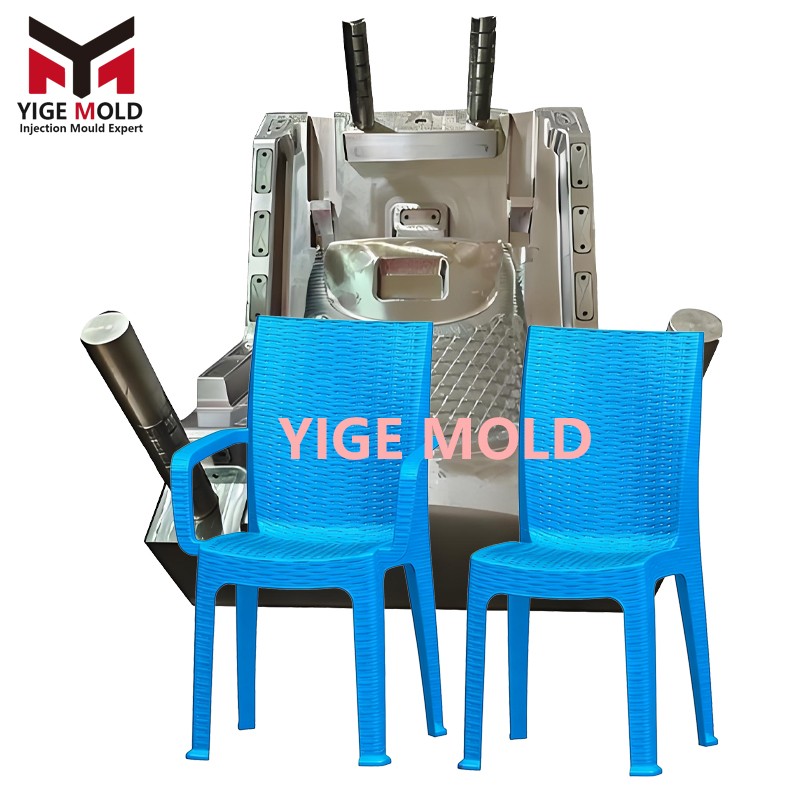
Woven Rattan Texture Backrest Armless Chair Mold: A Precision Molding System Integrating Natural Aesthetics and Composite Structures
I. Product Function Definition
This mold is specifically designed for manufacturing modern armless chairs featuring a backrest that replicates woven rattan texture. It must achieve the following in a single injection cycle:
-
Three-dimensional replication of woven texture (texture depth: 0.8-1.2 mm).
-
Ergonomic curved support (backrest curvature radius: R450±10 mm).
-
Thin-wall reinforced structure (main body wall thickness: 2.5 mm; reinforcement rib network thickness: 1.2 mm).
-
Quick-release demolding design (draft angle in textured areas: ≤0.5°).
II. Texture Replication Technology System
-
Digital Scanning and Texture Reconstruction
-
A white-light 3D scanner is used to capture the surface of natural rattan (accuracy: 0.02 mm).
-
Point cloud data is processed to generate an aperiodic texture matrix.
-
Texture unit size: 8-12 mm in the warp direction, 6-9 mm in the weft direction.
-
A gradual fusion algorithm is applied at texture intersections to avoid stress concentration.
-
-
Mold Surface Microstructure Machining
-
Textured areas are processed using a combined process of 5-axis precision engraving/milling and laser micro-texturing.
-
Warp texture: Depth 1.0±0.1 mm, angle 15°±2°.
-
Weft texture: Depth 0.8±0.1 mm, angle 20°±2°.
-
Surface roughness control: Ra 1.6-3.2 μm (simulating the tactile feel of natural rattan).
-
-
Demolding Guidance System
-
12 sets of texture-guiding inserts are installed, which translate 0.3 mm synchronously during demolding.
-
Textured areas undergo micro-sandblasting (glass bead size: 50-80 μm).
-
An automatic mold release agent spraying system operates for 0.5 seconds every 10 cycles.
-
III. Structural Design Innovations
-
Bionic Reinforcement Network
-
The backrest utilizes a hexagonal honeycomb bionic structure with a unit size of 25 mm.
-
The seat area employs a fractal support structure, achieving a load capacity of ≥150 kg.
-
Stress diffusion design at leg joints, with transition fillets of R8-R12.
-
-
Composite Wall Thickness Control
-
Aesthetic surfaces: Uniform thickness of 2.5±0.1 mm.
-
Reinforcement ribs: Height 8-12 mm, root thickness 1.5 mm, top thickness 0.8 mm.
-
Edge reinforcement: Perimeters thickened to 3.2 mm, with a C1.5 chamfer.
-
-
Assembly Positioning System
-
4 tapered locating pillars (taper 1:50, fit clearance 0.1 mm).
-
16 ultrasonic welding ribs (height 1.2 mm, width 1.0 mm).
-
8 bosses for screws (M6 pilot hole, wall thickness 3.0 mm).
-
IV. Mold System Configuration
|
System Module |
Technical Solution |
Performance Parameters |
|---|---|---|
|
Hot Runner System |
8-point valve gate system |
Gate diameter Φ1.8 mm, sequential control accuracy 0.01s |
|
Cooling System |
3D conformal channels + Beryllium copper inserts |
Mold temp. control accuracy ±2°C, cooling time reduced by 25% |
|
Ejection System |
Nitrogen springs + Stripper plate + 236 ejector pins |
Ejection synchronization error ≤0.05 mm |
|
Venting System |
3D venting network + Vacuum assist |
Vent depth in textured areas: 0.015 mm |
V. Molding Process Control
-
Material Selection
-
Main material: Reinforced Polypropylene (PP + 20% glass fiber).
-
Masterbatch: Rattan color + UV stabilizer.
-
Melt Flow Index: 18 g/10 min (230°C, 2.16 kg).
-
-
Process Window
-
Injection temperature: 210-230°C.
-
Mold temperature: 40-60°C.
-
Injection pressure: 80-100 MPa.
-
Holding pressure: 60-70 MPa (three-stage reduction).
-
Cooling time: 45-50 s.
-
-
Quality Control Points
-
Texture completeness: ≥98% (visual inspection system).
-
Warpage deformation: Flatness ≤1.2 mm/600 mm.
-
Shrinkage control: Dimensional stability ±0.15%.
-
VI. Mold Manufacturing Precision
-
Core Component Machining
-
Cavity texture: 5-axis high-speed milling (20,000 rpm, feed rate 3000 mm/min).
-
Core structure: Deep hole drilling + EDM for corners.
-
Insert fit: Jig grinding, fit clearance 0.01-0.02 mm.
-
-
Surface Treatment Processes
-
Textured areas: Nano-ceramic coating (thickness 3-5 μm, hardness HV1200).
-
Sliding components: PVD coating (TiAlN, friction coefficient ≤0.15).
-
Aesthetic surfaces: Multi-stage polishing (#600 → #1500 → diamond paste).
-
-
Inspection Standards
-
CMM inspection: Critical dimensions Cpk ≥1.67.
-
Blue light scanning: Surface profile tolerance ≤0.1 mm.
-
Texture comparison: Similarity to natural rattan ≥92%.
-
VII. Mass Production Performance Indicators
-
Production Efficiency
-
Cycle time: 70±3 s.
-
Daily capacity: 1200 pieces/24h (single-cavity mold).
-
First-pass yield: ≥98.5%.
-
-
Mold Life
-
Texture retention: ≥300,000 cycles (texture depth attenuation ≤10%).
-
Dimensional stability: ≥500,000 cycles.
-
Moving components: ≥800,000 cycles.
-
-
Energy Consumption Indicators
-
Electricity per ton of product: ≤850 kWh/t.
-
Cooling water circulation: 25 m³/h.
-
Compressed air consumption: 0.8 m³/cycle.
-
VIII. Application Value
This mold achieves the following through technological innovation:
-
Combines the aesthetic of traditional hand-woven rattan with industrial mass production.
-
Improves texture replication accuracy by 300% compared to traditional texturing/etching processes.
-
Increases product fatigue resistance by 50% (100,000 cycle sitting pressure test).
-
Reduces mold maintenance costs by 40% (modular design).
This technical solution provides a cost-effective option for replicating natural textures in outdoor furniture, leisure, and home furnishing sectors, meeting aesthetic demands while ensuring industrial-grade product reliability and economic feasibility.