Rice bucket mold
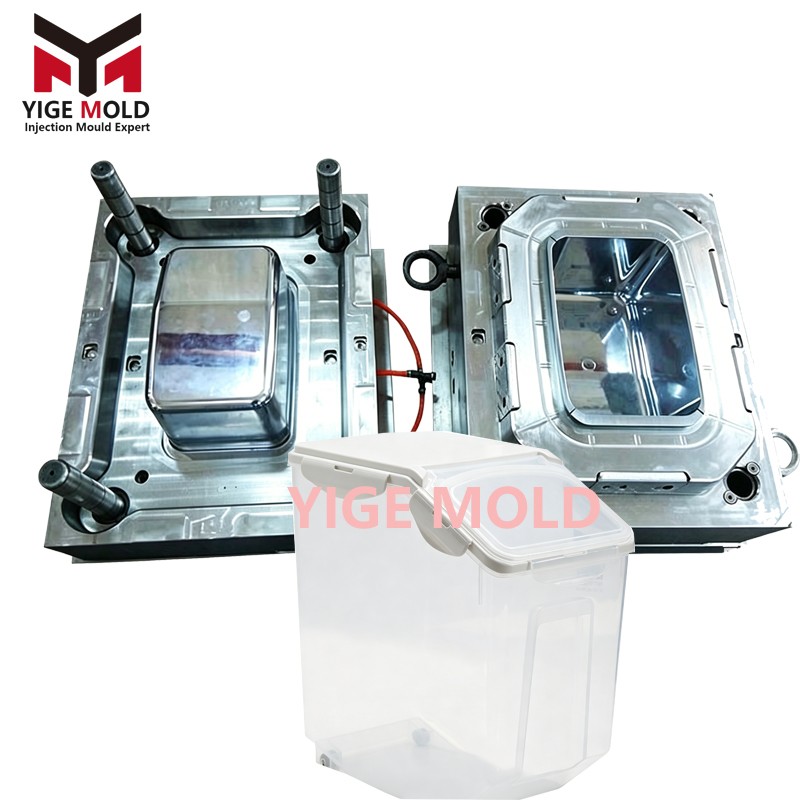
 Plastic Rice Bucket Injection Mold – Professional Introduction & Technical Overview
What Is a Rice Bucket Injection Mold?
A Plastic Rice Bucket Injection Mold (also known as a rice storage container mold, grain bin mold, or food-grade cereal bucket mold) is a precision-engineered injection tool used to mass-produce airtight, food-safe plastic containers designed for storing rice, grains, flour, beans, and dry foods. Unlike ordinary pails, rice buckets are typically deep-cavity, thin-to-medium wall-thickness products that demand excellent sealing performance, smooth inner surfaces for hygiene, integrated measuring cup/lid compatibility, and often transparent or translucent body sections.
Most household rice buckets range from 5 L to 20 L (small kitchen models) up to 25 L–50 L for bulk storage, and are injection-molded from Polypropylene (PP) or occasionally HDPE/ABS, which are odorless, impact-resistant, and compliant with FDA/EU food-contact regulations.
Typical Applications of Rice Bucket Molds
-
Household Kitchen Use – Airtight rice & grain canisters with snap-fit or screw-on lids, often with a built-in small measuring cup insert.
-
Retail Packaging – Branded rice storage boxes with IML (In-Mold Labeling) decoration for supermarket display.
-
Agricultural / Bulk Dry Food Storage – Larger-capacity PP buckets for warehouse or shop grain keeping.
-
Multi-purpose Dry Goods Containers – Flour bins, pet kibble jars, noodle & pasta holders—same mold family with minor customization.
Standard Technical Specifications of a Rice Bucket Mold
|
Parameter |
Typical Value / Option |
|---|---|
|
Mold Type |
Injection Mold (Fixed Half + Moving Half) |
|
Cavity Layout |
Single Cavity (1×1) or Multi-Cavity (2×1, 2×2) per customer output |
|
Mold Base |
LKM / DME / HASCO Standard or Custom |
|
Mold Steel (Core/Cavity) |
P20 (pre-hardened), 718H, 2738, NAK80, S136 (for high-gloss or anti-corrosion) |
|
Mold Base Plate Steel |
45# / S50C |
|
Runner System |
Cold Runner (sub-gate / edge gate) or Hot Runner (YUDO / Master / HASCO brand) |
|
Suggested Product Material |
PP (most common), HDPE, ABS |
|
Shot Life Expectancy |
300,000 – 1,000,000+ shots (depending on steel grade & maintenance) |
|
Recommended Injection Machine |
160T – 450T (based on bucket volume & cavity number) |
|
Design Software |
UG NX, Pro/E (Creo), CATIA, SolidWorks, AutoCAD |
|
Cooling Method |
Water channel cooling; beryllium copper inserts for deep-core zones |
|
Ejection System |
Stripper plate + ejector pins / air-assist ejection |
|
Surface Finish |
High-gloss polish (mirror finish) for food-contact interior; textured exterior optional |
|
Lead Time |
35–60 working days after drawing approval |
|
Certification |
ISO 9001, SGS (on request) |
Key Design Challenges & Engineering Solutions
1. Deep Cavity & Uniform Wall Thickness
Rice buckets are classic deep-draw thin-wall containers. Uneven wall thickness leads to sink marks or warping. Experienced mold designers run Mold Flow Analysis (MFA) to optimize gate location—commonly side-edge gates, fan gates, or hot-runner valve gates for large-volume buckets—to balance melt filling and minimize weld lines.
2. Advanced Cooling System for Cycle Time Reduction
The core (forming the inner bucket cavity) is bulky and slow to dissipate heat. Conformal or spiral water lines are machined into the core; beryllium copper (BeCu) inserts may be added at the deepest section to accelerate heat transfer, shortening cycle time to approx. 30–50 seconds per shot.
3. Reliable Ejection Without Deformation
Cooling shrinkage causes the PP part to grip the core tightly. A stripper plate (push-ring) combined with evenly distributed ejector pins is widely adopted. For extra-large buckets, air-poppet valves assist in breaking the vacuum. Draft angles of 1°–3° on vertical walls and mirror-polished core surfaces further reduce demolding stress and prevent white stress marks.
4. Sealing & Lid Matching
Rice buckets require a precision lip/flange for an airtight silicone or PP gasket lid. Mold parting lines are carefully placed to avoid flash on the sealing bead. Optional features—measuring cup nests, date indicator windows, transparent strip windows—can be integrated via insert molding or secondary assembly design.
5. Venting Design
Deep cavities trap air. Vents (0.01–0.03 mm deep) are cut along parting faces, ejector pin gaps, and sometimes core-top breather plugs to prevent burn marks and short shots.
Mold Steel Selection Guide
|
Application Level |
Recommended Core/Cavity Steel |
Characteristics |
|---|---|---|
|
Economy / Medium Run |
P20 (HRC 28–33) |
Cost-effective, good machinability, pre-hardened |
|
Standard Production |
718H / 2738 (HRC 33–38) |
Better polishability, higher toughness & wear resistance |
|
High Gloss / Food-Safe Mirror Finish |
NAK80 (pre-hardened HRC ~40) |
Excellent polish & etching, no heat treatment needed |
|
Corrosive Environment / Long Life |
S136 / 2316 (stainless mold steel) |
Corrosion-resistant, suitable for humid climates & long storage |
Proper nitriding or quenching & tempering heat treatment enhances surface hardness (up to HRC 48–52 on sliding components) and extends mold service life.
Manufacturing Workflow of a Custom Rice Bucket Mold
-
Product & Mold Feasibility Analysis – Review 3D product data, propose wall thickness optimization, draft angle check, and gate position suggestion.
-
Full 3D Mold Design – Create cavity layout, parting surface, slider/insert design, cooling circuit, ejection scheme; perform mold-flow simulation.
-
Precision CNC Machining – High-speed milling of cavity/core, gun-drilling of deep cooling holes, EDM for fine details.
-
Fitting & Assembly – Hand-fitting of slides, inserts, ejection plates; surface polishing per specification.
-
Mold Trial (T1) – Install in injection machine, adjust process parameters, check part dimensions & cosmetic quality.
-
Correction & Final Approval – Modify if needed, then final polish/paint protection, package in wooden crate with rust inhibitor.
-
Delivery & After-Sales Support – Provide mold running video, inspection report, spare wear parts, and 12-month warranty under normal use.
Advantages of a Well-Designed Rice Bucket Mold
High Production Consistency – Tight tolerances (±0.05–0.10 mm) ensure every bucket stacks and seals identically.
Short Cycle Time – Optimized cooling & balanced gating reduce cost-per-part.
Food-Grade Surface Quality – Mirror-polished cavity meets hygiene standards, easy to clean.
Long Service Life – Premium steel + proper heat treatment = millions of shots.
Customizable Features – Transparent window, measuring cup insert, IML capability, lockable lid, anti-insect seal ring groove.
How to Choose the Right Rice Bucket Mold Supplier
When sourcing a rice bucket injection mold, consider:
-
Proven portfolio of similar-sized bucket molds (photos/videos of trial runs).
-
In-house Mold Flow Analysis & UG/Creo design team.
-
Use of branded hot runners & standard mold bases (LKM/DME/HASCO).
-
Clear warranty terms and provision of spare parts (ejector pins, sprue bushing, seals).
-
Ability to supply matching lid mold & measuring cup mold in the same project.