Washing machine cabinet mold
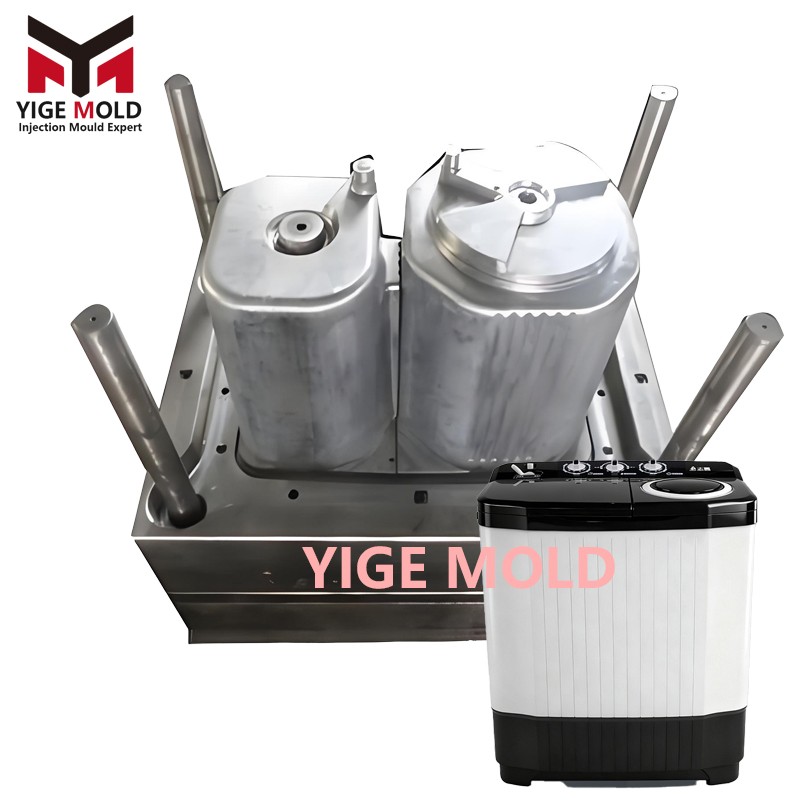
Comprehensive Technical Analysis of Washing Machine Casing Injection Mold
Chapter 1: Product Definition and Technological Positioning
A washing machine casing injection mold is a high-precision, large, complex injection mold used for the integrated molding of external structural components of washing machines, such as all-plastic bases, front panel frames, top covers, and decorative panels. Compared to traditional sheet metal stamping processes, all-plastic casings offer significant advantages in lightweighting, design freedom, corrosion resistance, electrical insulation, noise reduction, and overall cost reduction. It has become the mainstream technical path for high-end washing machines. The mold must achieve complex structural integration, aesthetic decoration, and functional assembly features in a single injection cycle, imposing extremely high demands on dimensional stability, surface quality, mechanical strength, and assembly accuracy.
Chapter 2: Core Architecture of the Mold System
2.1 Large, Complex Mold Base Structure
-
Mold Base Dimensions and Load Capacity: Mold dimensions generally exceed 1500mm x 1200mm, with a total weight of 15-30 tons. It utilizes heavy-duty pre-hardened mold plates (e.g., S50C) optimized by Finite Element Analysis (FEA) to ensure deformation of less than 0.1mm/m under long-term, high clamping forces (typically matching 1600-3500 ton injection molding machines).
-
Guiding and Locating System: Employs oversized ball-bearing guide pillars and bushings (Φ80mm and above) and four-corner tapered interlocks to ensure precise alignment and smooth movement between the moving and fixed halves under massive opening/closing forces, with positioning repeatability ≤ 0.02mm.
2.2 High-Balance Gating System Design
Washing machine casings are typically large, thin-walled parts with asymmetric structures, making them highly prone to warpage and weld lines. Their gating system design is a core technical challenge.
-
Multi-Level Hot Runner and Sequential Control: A multi-point valve-gated hot runner system (typically 8-16 points) is essential. The runner dimensions and layout are precisely designed using CAE Mold Flow Analysis. Sequential Valve Gate (SVG) Control technology is employed to precisely control the opening sequence of each gate, guiding the melt flow front along a predetermined path. This "chases" weld lines to non-visible surfaces or behind structural ribs, potentially eliminating visible weld lines altogether.
-
Gate Location Strategy: Gates are often located on the back, bottom, or other non-visible mating areas of the casing. For parts with high aesthetic requirements like front panels, submarine gates or pin-point gates are used for automatic shearing and minimal gate vestige.
2.3 Efficient and Uniform Cooling System
Uniform cooling is key to controlling product warpage, ensuring dimensional stability, and shortening cycle time.
-
Conformal Cooling Technology: For large, flat areas and deep draws of the casing body, metal 3D-printed (SLM) mold cores with internal cooling channels that perfectly follow the product contour are prioritized. Compared to traditional drilled channels, cooling efficiency can be improved by over 30%, with temperature variation controlled within ±2°C.
-
Zoned Differential Cooling:
-
Aesthetic Surface Zones: Use multi-circuit, parallel, dense straight-through channels combined with high-gloss surface finishing to ensure rapid setting and a high-gloss finish.
-
Thick-Wall Rib and Boss Areas: Embed high thermal conductivity beryllium copper alloy inserts or use baffle-cooled wells and bubbler tubes for focused, enhanced cooling to prevent sink marks.
-
Hot Runner Area: Equip with independent cooling circuits to prevent heat transfer from the hot runner manifold to the cavity.
-
2.4 Complex Demolding and Functional Structure Molding System
Washing machine casings integrate numerous functional features, placing extremely high demands on the mold's side-core pulling and ejection systems.
-
Multi-Directional Composite Core-Pulling Mechanisms: The casing perimeter typically features water inlet/outlet ports, cable holes, decorative strip slots, ventilation grilles, etc., requiring side-core pulling in multiple directions. The mold employs a composite synchronous core-pulling system combining "hydraulic cylinder actuation" and "angled pin + slider" mechanisms. All slider movements must be synchronized mechanically via linkages or rack-and-pinion gears, or electronically via PLC-controlled hydraulics, ensuring smooth action, correct sequence, and precise positioning.
-
Insert Molding: Used to directly embed metal parts like nuts, metal frames, grounding terminals, and wire harness clips during injection. The mold is equipped with a precise automatic insert feeding, positioning, and detection system, ensuring insert positional accuracy within ±0.1mm.
-
High-Reliability Ejection System: Due to the product's large surface area and high holding force, nitrogen springs and hydraulic cylinders provide powerful, smooth ejection force. Ejector pin layout is optimized via mechanical simulation, combining large-diameter round pins, blade ejectors, and sleeve ejectors. Gas-assisted ejection channels are also set in deep-draw areas to aid part release, preventing ejection marks or distortion.
2.5 High-Standard Surface Finishing and Texturing
-
High-Gloss Mirror Effect: For aesthetic parts like front panels, cavities undergo multi-stage manual diamond paste polishing to a #A1 mirror finish (Ra ≤ 0.01μm) and may receive an Electroless Nickel (Ni-P) coating to enhance surface hardness, corrosion resistance, and release properties.
-
Precision Texturing: For effects like brushed metal, fine leather grain, or matte sandstone, precision chemical etching (Photo Etching) or laser texturing is used. Texture depth and uniformity must be strictly controlled at the micron level.
Chapter 3: Materials, Process, and Quality Control
3.1 Specialized Engineering Plastics
-
Primary Materials: High-flow, high-stiffness Polypropylene (PP), typically filled with 20-40% talc or glass fiber to improve rigidity, heat resistance, and dimensional stability. Some high-end models use ABS/PC blends for better aesthetics and impact resistance.
-
Material Preprocessing: Must be thoroughly dried (e.g., 3-4 hours at 80-90°C), with moisture content strictly controlled (≤0.02%) to prevent splay marks and bubbles.
3.2 Precision Injection Molding Process Window
-
Injection Control: Employs a "Slow-Fast-Slow" multi-stage injection speed profile. Initial low speed to penetrate the gate, medium-high speed for filling to reduce melt front temperature difference, and final speed reduction to prevent over-packing and molecular orientation. Injection pressure is precisely calculated based on flow length.
-
Packing and Cooling: Uses a multi-stage, decreasing packing pressure strategy, applying very low pressure for a long duration to compensate for shrinkage and minimize internal stress. Cooling time is proportional to the square of the wall thickness and is controlled in a closed loop via mold temperature sensors.
-
Mold Temperature Control: The front half (aesthetic side) temperature is typically set between 60-80°C, and the rear half (structural side) between 40-60°C, to facilitate part ejection and control warpage.
3.3 Full-Process Quality Monitoring
-
In-Mold Monitoring: Integrates cavity pressure sensors and fiber optic temperature sensors to monitor the filling status, packing effectiveness, and cooling condition of every cycle in real-time, enabling closed-loop process control and SPC statistics.
-
Automated Visual Inspection: After ejection, a machine vision system automatically detects product appearance defects (scratches, sink marks, weld lines), key dimensions, and presence/absence of inserts.
-
Functional Testing: Regular samples undergo assembly testing (fit with inner tub, motor, control panel), drop testing, long-term load testing, and high/low temperature cycle testing to verify structural reliability and environmental adaptability.
Chapter 4: Manufacturing, Maintenance, and Economic Benefits
4.1 Ultra-High Precision Manufacturing
Mold manufacturing precision is fundamental. It requires equipment like large 5-axis gantry machining centers, precision EDM machines, deep-hole drills, and jig grinders. Key mating surface machining accuracy must reach the 0.005mm level, with cavity profile error ≤ 0.05mm/1000mm.
4.2 Systematic Maintenance and Long Service Life
-
Preventive Maintenance: Establishes strict maintenance schedules, including daily cleaning/lubrication, periodic replacement of seals and springs, and regular polishing/maintenance of cavity surfaces.
-
Mold Life: With proper use and maintenance, the core cavity life can reach 800,000 to 1.2 million cycles. The hot runner system, hydraulic components, etc., require periodic maintenance and part replacement.
4.3 Techno-Economic Analysis
-
Mold Investment: A high-end, fully automated washing machine casing injection mold can cost between 1.5 and 4 million RMB, depending on complexity, size, and automation level.
-
Per-Unit Cost Advantage: Although mold investment is high, injection molding achieves a high degree of integration, eliminating subsequent stamping, welding, painting, and other processes. In mass production, the comprehensive per-unit cost is competitive, with superior product consistency and reliability.
-
Design Value: Grants product designers greater freedom to achieve complex curves, integrated structures, and special surface effects difficult to realize with traditional metals, thereby enhancing product added value.
Conclusion
The washing machine casing injection mold is one of the most technically complex, integrated, and precise categories within the home appliance mold sector. It is not merely a plastic forming tool but a systems engineering project that integrates materials science, precision mechanics, fluid thermodynamics, automation control, and digital simulation. Its successful development and application signify a profound shift in the washing machine industry from traditional manufacturing towards an advanced manufacturing model characterized by high performance, high integration, and high design freedom. It stands as a quintessential example of the perfect fusion of modern industrial design philosophy and cutting-edge manufacturing capability.