Plastic Dining Chair Injection Mold with Long Service Life
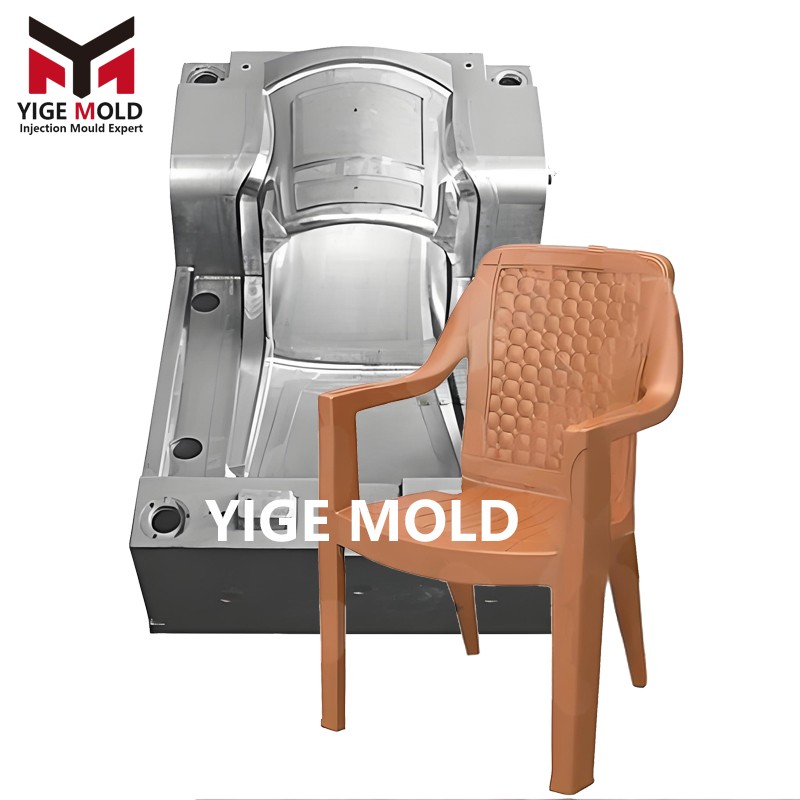
Injection Mold for Long-Life Plastic Dining Chairs: A Technical Monument Defining Industrial Durability Through Repetition
The plastic dining chair, an indispensable fixture in modern living and commercial spaces, is supported by the stable, round-the-clock production of millions of units. At the core of this immense scale and enduring stability lies the Injection Mold for Long-Life Plastic Dining Chairs. It is far more than a mere production tool; it is a systems engineering challenge centered on time, stress, and material limits. Its design philosophy is anchored from the outset in "full-lifecycle reliability," engineered to counteract the inevitable forces of physical wear, thermal fatigue, and chemical degradation. Its ultimate goal is to reproduce the ten-thousandth chair with the same precision as the first, enduring well over a million cycles.
I. Core Definition: "Precision Durability" Beyond Mere Endurance
Here, "long service life" is not a vague marketing term but a quantifiable target, decomposed and embedded into every aspect of the mold's design. It typically refers to the mold's ability—under maintenance—to stably produce 1 to 2 million parts without requiring major overhauls or replacement of its core forming components. This goal rests on three pillars:
-
Structural Endurance: The ability to withstand continuous, cyclical clamping and injection forces measuring thousands of tons without suffering plastic deformation or fretting wear.
-
Surface Resistance: Resistance to erosion, corrosion, and adhesion from high-temperature plastic melt, especially when reinforced or filled with materials like glass fibers or minerals.
-
Kinematic Reliability: Ensuring that hundreds of thousands of ejection and core-pulling actions remain smooth, precise, and free from jamming, abnormal noise, or cumulative error.
II. Full-Lifecycle Design Philosophy: Engineering for "Time"
The design of a long-life mold begins with a profound understanding and proactive avoidance of failure modes. Its logic is comprehensive and systemic.
1. Structural Design: Dissipating Stress
As large, thin-walled parts, dining chairs present molds with challenges of non-uniform stress from "long spans and dense rib networks." Long-life design employs:
-
A Hybrid of Global Rigidity and Local Compliance: The mold structure itself is built on a "bedrock" foundation using thickened plates, densely arranged support pillars, and a monocoque box-frame design to ensure the parting surface resists deformation and misalignment under sustained high pressure. Locally, at stress concentration points like dense rib areas and corners, Finite Element Analysis (FEA) guides topology optimization. Stress is "channeled" and "released" through increased fillet radii, gradual transitions, and embedded stress-dispersing blocks, preventing the initiation and growth of micro-cracks.
-
"Overtravel" and Redundancy in Moving Mechanisms: All movements for sliders and lifters incorporate a 20-30% safety margin beyond their theoretical calculated stroke. This ensures that even after minor wear on guide components from prolonged use, the critical forming areas remain fully and accurately protected and released. Key guiding components use four-corner, eight-face locating systems instead of simple two-sided engagement, eliminating the risk of bias wear caused by lateral forces.
2. Material Science: Building Defenses at the Micro-Scale
Mold life is fundamentally determined by a material's resistance to degradation at its surface and within. A long-life mold is a battlefield of material science at the microscopic level:
-
Strategic Selection of Base Materials: Moving beyond a single steel grade. Core cavity and core inserts use pre-hardened mold steels with high toughness and thermal fatigue resistance, such as premium-grade 1.2738 modified steel, which resists internal cracking under high pressure and thermal cycling. For areas subject to extreme shear, like runners and gates, powder metallurgy high-speed steel inserts are used, their exceptional red-hardness and wear resistance specifically combating high-velocity melt flow.
-
Layered "Armor" via Surface Engineering: Base hardness is achieved through through-hardening, while the surface receives multi-layered defenses. First, deep-layer ion nitriding creates a dense nitride layer exceeding 0.2mm, providing excellent anti-galling and wear resistance. On top of this, critical high-friction, corrosion-prone areas (e.g., slider angles, ejector pins) receive Physical Vapor Deposition (PVD) coatings like CrN or DLC (Diamond-Like Carbon). This micron-thick "ceramic armor" drastically reduces the coefficient of friction and provides a complete barrier against chemical corrosion from plastic additives (e.g., flame retardants, pigments).
3. Thermal Management: The Pursuit of Ultimate Stability
Thermal fatigue is a primary agent of mold aging. Thermal management in long-life molds evolves from mere "cooling" to achieving a state of "thermal equilibrium."
-
Zoned Pulse Cooling and Isothermal Field Control: The mold is divided into dozens of independently controlled cooling circuits. Each circuit allows for precise, independent control of flow rate and temperature and can be programmed for "pulse mode," dynamically adjusting during fill, pack, and cool phases to counteract exothermic peaks from plastic crystallization. The objective is to limit temperature fluctuation across the entire cavity surface to less than ±3°C per cycle, creating a near-"isothermal" environment that fundamentally suppresses crack formation due to thermal stress.
-
Minimizing Thermal Inertia in the Runner System: The hot runner system employs fully closed-loop, multi-zone independent PID temperature control. Thermocouple placement within each nozzle is precisely calculated for instantaneous feedback. Heating elements use high-stability alloys with ample power headroom to prevent performance decay and temperature drift from sustained operation at full load. The manifold is crafted from a single forging, with internally polished channels to eliminate material stagnation points, preventing localized overheating and carbon buildup from degraded material.
III. Manufacturing and Validation: Launching with "Zero Defects"
The foundation for long life is laid during manufacturing. Precision standards here exceed the entering the realm of "preventive accuracy."
-
Stress Relief Pervading the Process: Multiple stress relief annealing cycles are interspersed between roughing, semi-finishing, and finishing operations. Following each significant material removal, internal stresses are allowed to re-balance and dissipate. This ensures the final mold operates from its most "relaxed" and stable state, preventing gradual deformation under long-term cyclic stress.
-
"Pre-loading" and "Hand-Fitting" in Assembly: Critical kinematic pairs are not merely assembled flush; they are assembled with micrometer-level pre-load, positioning them in their most stable mechanical state from the start. Guide components and plates undergo precision hand-fitting, requiring a contact area greater than 85% to ensure even stress distribution and avoid early failure from "point contact."
Accelerated Life Testing: Before leaving the factory, the mold undergoes simulated accelerated life testing on a dedicated test bench. A program controls thousands of "dry cycles" (with simulated heating and cooling) at a frequency higher than normal operation, monitoring temperature, vibration, and current profiles of all moving components. This "stress test" exposes potential design or assembly flaws in advance, ensuring the mold begins its service life in optimal "health."
IV. Intelligent Operation and Maintenance: From "Repair" to "Prediction"
True longevity depends on intelligent, systematic maintenance, evolving from a traditional "fix-on-fail" model to a "predictive health management" paradigm.
-
Digital Twin and Lifecycle Logging: Each mold possesses a unique digital twin file, comprehensively documenting its design, manufacturing history, process parameters from every production run, maintenance records, and periodic measurements of key dimensions. Big data analytics are used to build predictive wear models.
-
Condition Monitoring and Early Warning: Miniature sensors embedded at critical mold locations provide real-time data on temperature, vibration, and strain. Processed by edge devices, this data triggers alerts upon detecting anomalous patterns (e.g., a gradual increase in slider friction coefficient, a trend of declining cooling efficiency), prompting targeted maintenance before a failure occurs.
-
Modular Repair and Dimensional Chain Compensation: When predictable wear occurs in a local area (e.g., the gate region), rapid repair is possible by replacing a standardized, pre-fabricated insert module. More advanced systems, based on wear data analysis, can apply micrometer-level dimensional compensation during the reverse engineering of new inserts. This allows a repaired mold not only to be "restored" but also to actively "compensate" for systemic errors accrued over time, keeping product dimensions consistently centered within the tolerance band.
Conclusion
The Injection Mold for Long-Life Plastic Dining Chairs is an industrial monument seeking permanence within dynamic repetition. It transmutes the destructive force of time into measurable, manageable technical parameters through multiple barriers of material science, structural mechanics, thermodynamics, and intelligent algorithms. It represents an evolution in industrial values: from pursuing "perfection in a single cycle" to ensuring "decades of unwavering reliability and stability." In every open-and-close cycle of this mold, it shapes not only plastic but also the modern manufacturing industry's ultimate understanding of "durability," "reliability," and "sustainability"—the guardianship of a precise, sub-millimeter promise across infinite repetitions.