Mold for PVC Right angle Tee Joint
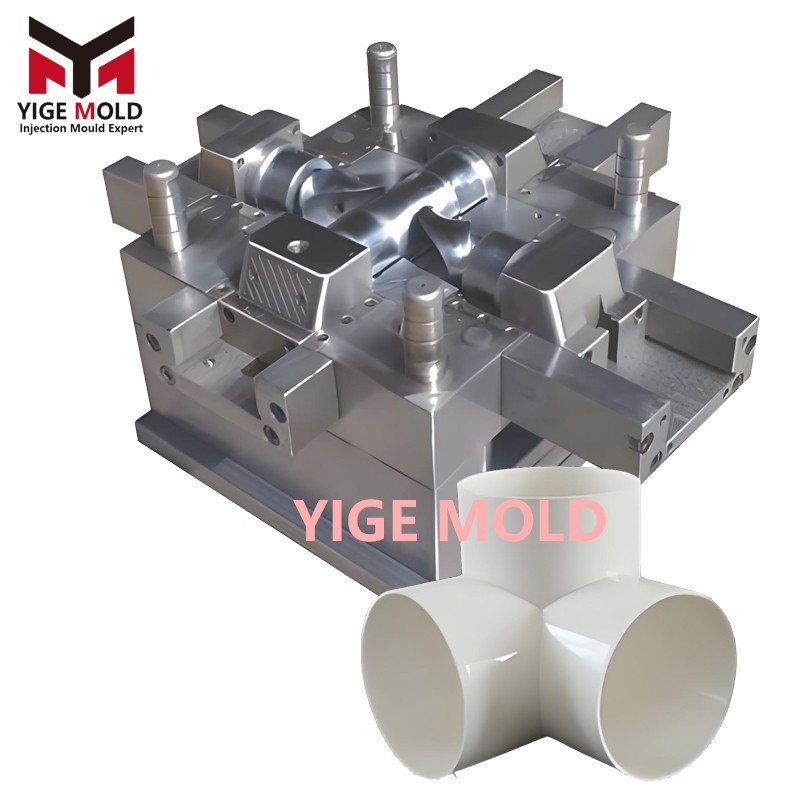
Mold for PVC Right Angle Tee Joint
Product Overview:
A PVC right angle tee joint is a pipe fitting with a 90-degree branching structure, widely used in low-pressure fluid transport systems such as building drainage, electrical conduit wiring, and agricultural irrigation. It consists of a main vertical pipeline and a branch pipeline that diverges at a 90-degree angle, forming a standard "T"-shaped orthogonal connection.
Mold Type:
This product is typically produced using injection molds. For some large-diameter models, extrusion molding with specialized calibration molds may be used. Injection molds are primarily classified into:
-
Two-plate mold structure
-
Three-plate mold structure
-
Multi-plate molds with side core-pulling mechanisms
Key Mold Design Points:
-
Runner System Design
-
Uses a three-point balanced hot runner or valve gate system
-
Gate locations are typically set at both end faces of the main pipeline
-
Runner layout must ensure uniform convergence of the melt flow fronts
-
-
Cooling System Configuration
-
Core incorporates a spiral cooling water channel
-
Cavity is equipped with multi-layer circulating cooling circuits
-
High thermal conductivity inserts are added at the pipe junction areas
-
Achieves zoned temperature differential control overall (temperature difference ≤ 3℃)
-
-
Ejection Mechanism
-
Hydraulically driven sliders perform 90-degree side core-pulling
-
Main pipeline uses sleeve ejectors
-
Draft angle is designed at 1-1.5°
-
Includes an early return mechanism to prevent ejector pin interference
-
-
Venting System
-
Vents with a depth of 0.03-0.05mm are machined on the parting surface
-
Vent inserts are placed at the last fill positions of the melt
-
Employs a multi-stage venting structure
-
Total venting area is not less than 30% of the runner cross-sectional area
-
Materials and Manufacturing:
-
Mold Steel Selection
-
Cavity/Core: P20 (pre-hardened) or S136 (high-gloss texture finish)
-
Sliders/Lifters: H13 (hardened to HRC 48-52)
-
Sprue Bushing: SKD61 (surface nitrided)
-
-
Machining Accuracy Requirements
-
Cavity dimensional tolerance: ±0.02mm
-
Slider fit clearance: 0.015-0.025mm
-
Surface roughness: Ra 0.2μm (runner area)
-
Perpendicularity: ≤0.01/100mm
-
Molding Process Parameters:
-
Melt temperature: 185-200℃
-
Mold temperature: 35-50℃
-
Injection pressure: 60-100 MPa
-
Holding pressure: 40-60 MPa
-
Cooling time: 25-40 seconds (depending on wall thickness)
Key Quality Control Points:
-
Conduct a 0.05 MPa pressure test using an airtightness tester
-
Measure critical dimensions with a profile projector:
-
Main pipeline inner diameter tolerance: ±0.15mm
-
Branch pipeline perpendicularity: ≤0.3°
-
End face flatness: ≤0.1mm
-
-
Perform a falling weight impact test (1kg weight dropped freely from 1m height at -10℃ environment)
-
Perform a hydraulic burst pressure test (≥4 times the working pressure)
Technological Innovation Trends:
-
Adoption of conformal cooling technology to optimize cooling efficiency in thick-walled areas
-
Integration of in-mold vision inspection systems
-
Development of multi-material co-injection processes (rigid PVC body + elastic sealing layer)
-
Application of mold IoT systems for real-time production status monitoring
Maintenance and Service Regulations:
-
Perform lubrication maintenance on slider guides every 50,000 cycles
-
Replace hot runner seal components every 100,000 cycles
-
Regularly clean runner residue using ultrasonic cleaning
-
Establish a mold usage file to record maintenance history
This type of mold has an average lifespan of 800,000 to 1.2 million cycles. Through optimization of the cooling system and ejection mechanism, the production cycle time can be controlled between 35 and 50 seconds. It is a technologically mature and widely used key tooling equipment in PVC pipe fitting production.