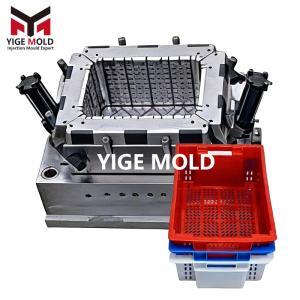
Fish Tote Mold
Fish Tote Mold: The Engineering Foundation of Modern Fishery Cold Chain Logistics
Professional Positioning: Specialized Tooling System for Aquatic Product Logistics
The Fish Tote Mold is distinct from general-purpose logistics container molds; it is an engineering equipment system specifically designed for the unique logistics requirements of aquatic products. The design philosophy of this mold is built upon the biological characteristics of seafood and the physical demands of cold chain logistics. Its core mission is to achieve seamless connectivity of seafood products from catch to sale within a fully temperature-controlled environment.
Design Principles: Engineering Solutions Customized for Aquatic Products
Structural Design for Temperature Management is the primary consideration. Mold design must ensure that the molded container possesses an efficient balance of heat exchange and thermal insulation. The container walls feature a unique built-in hollow structure, with wall thickness controlled between 2.5-3.0 mm, forming a micro air insulation layer. Simultaneously, a three-dimensional drainage channel system is specially designed in the container base. The channels are 5-8 mm wide, 3-5 mm deep, and arranged in a radial pattern, ensuring meltwater drains quickly without soaking the product.
Structural Strength and Weight Balance require precise calculation. As aquatic product transport often involves significant amounts of ice, the full load weight can reach 1.5-2 times that of general cargo. The mold employs Topology Optimization with Variable Thickness. Rib density is increased in stress concentration areas: rib spacing is 15 mm with a height of 8 mm in maximum load-bearing zones; in non-load-bearing areas, spacing expands to 35 mm and height reduces to 5 mm. This differential design reduces empty container weight by 25% while increasing maximum load capacity to 80 kg, allowing stacking up to 8 layers high.
Chemical Resistance Design addresses the actual working environment. Seafood transport involves corrosive mediums like seawater, fish blood, and digestive enzymes. The molded surface must achieve a Food-Grade Mirror Polish Standard (Ra ≤ 0.1 μm), and the mold itself is constructed from corrosion-resistant steel. All interior corners of the container feature large-radius transitions of R10 mm or more, completely eliminating cleaning dead spots. Edge sealing structures utilize a triple labyrinth design, effectively preventing liquid leakage.
Manufacturing Process: Precision Machining for Specialized Needs
The manufacturing process for Fish Tote Molds exhibits distinct professional characteristics, with each stage specifically optimized for the harsh environment of seafood transport.
Material Science Application Reaches New Heights. The mold cavity is made from Marine-Grade Corrosion-Resistant Mold Steel with a chromium content no less than 16%, and elements like copper and molybdenum are added to enhance pitting resistance. Critical moving components, such as ejector pins and sliders, use Duplex Stainless Steel, combining high strength with high corrosion resistance. Surface treatment employs Composite Coating Technology: first, ion nitriding creates a 0.2 mm hardened layer, followed by a Diamond-Like Carbon (DLC) coating. This achieves a surface hardness up to HV3500 and a friction coefficient below 0.1.
Precision Molding of the Drainage System is a technical challenge. The mold must accurately form Self-Cleaning Drainage Channels. The channel cross-section features an inverted trapezoid design: top width 8 mm, bottom width 5 mm, depth 4 mm, with an inclination angle of 3°-5°. This design allows for rapid drainage while minimizing clogging from fish scales or crushed ice. To achieve this structure, the mold utilizes a Multi-Point Hot Runner System with Sequential Valve Control, ensuring uniform melt filling within the narrow channels.
Integrated Design of Anti-Slip and Stacking Structures. The container base is designed with 3D Anti-Slip Patterns. The pattern depth is 1.2-1.5 mm with a spacing of 6-8 mm, providing sufficient friction while remaining easy to clean. The stacking structure employs a Dual Guidance System: the lower part consists of guiding tapered surfaces with a 5° taper, and the upper part features elastic snap-fits with an interference fit of 0.3-0.5 mm. This ensures automatic alignment during empty stacking and provides stable locking force when stacked under full load.
Specialized Optimization of the Cooling System. Due to significant wall thickness variations and complex drainage structures, traditional cooling methods are insufficient. The mold adopts a Zoned Independent Cooling System, dividing the cavity into 8-12 independent temperature control zones, each with its own cooling circuit. In high-heat areas, such as dense rib sections, Beryllium Copper Inserts with Micro Cooling Channels are used. The channel diameter is only φ3 mm and located just 5 mm from the surface, improving cooling efficiency by over 40% compared to traditional designs.
Quality Control: Inspection Standards Adapted to Harsh Environments
Fish Tote Molds must pass stricter testing protocols than standard molds to ensure long-term, stable performance in demanding conditions.
Chemical Resistance Testing simulates the actual use environment. Molded samples are immersed in simulated seawater (3.5% NaCl solution), diluted fish blood, cleaning agents, etc., for a 1000-hour accelerated aging test at three temperatures: 4°C, 25°C, and 40°C. Requirements: mass change rate ≤ 0.5%, dimensional change rate ≤ 0.3%, with no significant discoloration or corrosion on the surface.
Low-Temperature Impact Testing evaluates material toughness. A drop-weight impact test is conducted at -25°C with an impact energy of 50 J. The container must show no cracks or breakage. Additionally, a Low-Temperature Stacking Test is performed: stacking 8 layers high at -18°C under continuous load for 72 hours, with a deformation requirement of ≤ 2 mm.
Fatigue Life Validation simulates long-term use. A continuous opening/closing test simulates long-term lid operation in low temperatures. Test conditions: -5°C environment, 2 cycles per minute, for 100,000 consecutive cycles. Requirements: hinge structure remains intact, and sealing performance degradation does not exceed 20%.
Cleaning Efficiency Evaluation reflects practical value. Standardized contaminants simulate fish blood, mucus, etc. Cleaning effectiveness is tested under defined washing procedures. Requirements: after one wash, residual surface contamination ≤ 2 g/m², with no visible residue upon visual inspection. The self-cleaning capability of the drainage system is also assessed, testing blockage from crushed ice and fish scales.
Economic Benefits: A Key Investment for the Transformation of the Fishery Industry
The return on investment for Fish Tote Molds is evident not only in direct cost savings but also in the enhanced efficiency of the entire supply chain and the protection of product value.
Direct Economic Gains are clear. Taking a medium-sized aquatic enterprise processing 5 tons of fish daily as an example, after adopting a specialized tote system: product loss rate decreases from an industry average of 8-12% to below 2%, reducing annual losses by approximately 1.2 to 1.8 million currency units; packaging costs (foam boxes + plastic bags) are reduced by 70%, saving about 800,000 currency units annually; loading/unloading efficiency increases by 40%, cold storage space utilization improves by 35%, and labor costs are reduced by 30%.
Quality Assurance Value, though difficult to quantify, is crucial. Specialized totes ensure zero crushing and zero abrasion of fish during transport, increasing the intact appearance rate from 85% to over 98%. Temperature fluctuation inside the container is controlled within ±2°C, and the product's core temperature change does not exceed 1°C per hour, effectively extending shelf life by 2-3 days. Standardized packaging enhances brand image, and the proportion of premium-grade products increases from 75% to 92%.
Operational Convenience Improvements enhance the working environment. Container weight is 15-20% lighter than traditional plastic containers, reducing handling labor intensity by 25% for the same load. Ergonomic handle design ensures a stable grip even with gloves in low-temperature environments. The drainage system makes unloading operations cleaner and more efficient, significantly improving the working environment.
Environmental Benefits align with sustainable development requirements. A single container can be reused over 500 times, with a service life of 3-5 years, reducing solid waste by over 95% compared to disposable foam boxes. Made from food-grade, recyclable polypropylene material, the containers are 100% recyclable at end-of-life, enabling a true circular economy.
Industry Applications: Building a Modern Aquatic Supply Chain
The application of Fish Tote Molds is driving modernization in the fishery industry, demonstrating unique value across multiple stages.
In Marine Fishing Operations, specialized totes can be used directly on vessels. Containers are designed with interfaces for vessel mounting fixtures, allowing quick locking to the ship's deck to withstand rough seas. Corrosion resistance ensures long-term use in harsh marine environments, with a service life up to 3 times that of traditional containers.
During Dock Transshipment, standardized containers enable rapid mechanized operations. The container base is designed with standard forklift pockets and lifting interfaces, compatible with various handling equipment. Stacking stability ensures pile safety during dock operations; even stacks 6 layers high will not collapse on a deck tilted up to 5°.
Processing Plant Applications enhance operational efficiency. Containers can go directly into washing lines, perfectly interfacing with automated cleaning equipment. The internally designed product layering structure facilitates mechanical sorting, increasing processing efficiency by over 25%. Standardized dimensions allow for more rational production line layouts, improving space utilization by 40%.
In Cold Chain Distribution, product quality is ensured for the "last mile." Containers have good insulation properties, maintaining low temperatures for 4-6 hours without an external power source. They perfectly match standard shelving in refrigerated trucks and cold storage, achieving seamless temperature continuity and controlling temperature fluctuations within acceptable limits throughout the journey.
Retail Display enhances the consumer experience. Transparent container designs (e.g., using GPPS material) can serve directly as display units, reducing secondary packaging. Professional appearance design elevates product grade. Consumers can visually inspect the product's condition, increasing purchase confidence by over 30%.
The Fish Tote Mold represents the direction of specialization in aquatic logistics equipment. Its value lies not merely in producing a container but in constructing a complete cold chain logistics solution. From design philosophy and manufacturing processes to quality control and practical application, this system is propelling the fishery industry toward greater efficiency, professionalism, and sustainability. For aquatic enterprises committed to enhancing competitiveness, investing in such specialized equipment is not an expense but a strategic investment in future development. When seafood products can travel from fishing vessels to dining tables in optimal condition, the technological and commercial value embedded in the mold is fully realized.