Plastic Drink Crate Mold
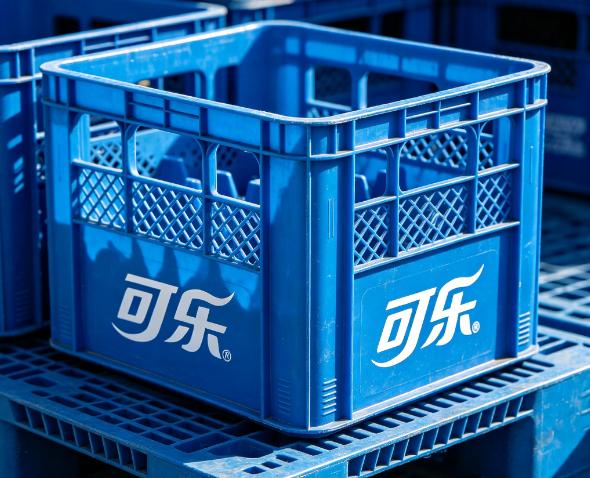
Introduction to Plastic Beverage Crate Molds
I. Overview of Plastic Beverage Crate Molds
1.1 Definition of Plastic Beverage Crate Molds
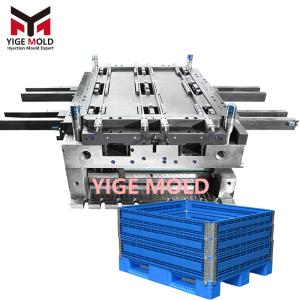
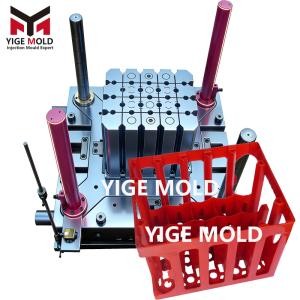
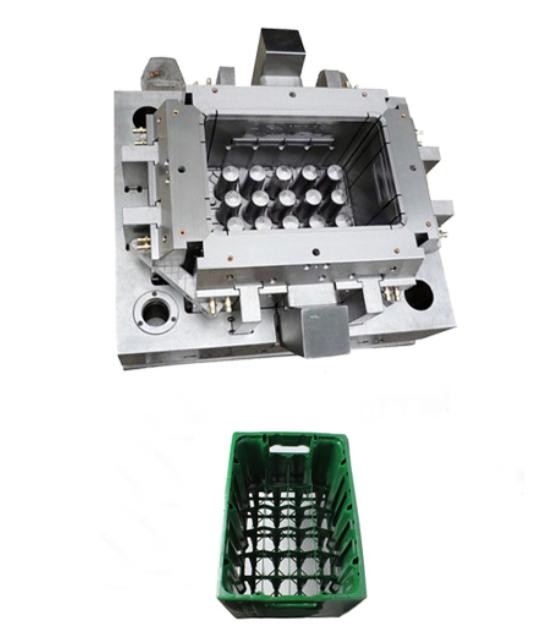
Plastic beverage crate molds are specialized tools designed explicitly for manufacturing plastic beverage crates. They play a vital role in the production process. Working in conjunction with plastic molding machines, these molds inject molten plastic into the mold cavity. Upon cooling and solidification, the plastic takes on the specific shape, dimensions, and structural features of a beverage crate. Typically constructed from plastic mold steel, these molds comprise forming components, gating systems, guiding mechanisms, and ejection systems. They enable the efficient and stable mass production of high-quality beverage crates to meet market demand, making them indispensable equipment in the industry.
1.2 Importance of Plastic Beverage Crate Molds
These molds hold a critical position in production, profoundly impacting both product quality and manufacturing efficiency.
-
Product Quality: High-quality molds ensure dimensional accuracy and surface finish, resulting in crates that are structurally robust and durable. This reduces defect rates and enhances the overall quality of the final product.
-
Production Efficiency: Advanced mold designs shorten cycle times and increase output. Long mold lifespan reduces the frequency of changeovers, lowering production costs. Furthermore, rational design optimizes melt flow, minimizing raw material waste, which is irreplaceable in the production of beverage crates.
II. Classification of Plastic Beverage Crate Molds
2.1 Classification by Molding Process
-
Injection Molds: Widely used for beverage crates, these molds inject molten plastic into the cavity where it cools and solidifies. They offer short cycle times, high efficiency, and the ability to form complex structures with high precision.
-
Blow Molds: Primarily used for large, hollow crates. This process involves extruding a tubular parison, placing it in the mold, and inflating it with compressed air until it conforms to the cavity shape, resulting in uniformly thick, hollow containers.
2.2 Classification by Structural Features
-
Two-Plate Molds: Featuring a simple structure and lower cost, these molds are reliable and have short cycle times. They are suitable for producing standard, small-to-medium-sized crates with simpler geometries.
-
Three-Plate Molds: More complex, incorporating an additional stripper plate. They facilitate pinpoint gating, resulting in better aesthetics and automatic degating. These are ideal for high-precision crates or those with complex shapes, side holes, or undercuts.
III. Design Key Points of Plastic Beverage Crate Molds
3.1 Product Structure Design
Designing the crate structure requires balancing functionality with manufacturability.
-
Shape & Dimensions: Must align with usage scenarios (handling, transport) and standard bottle sizes, ensuring compatibility with stacking and storage systems.
-
Strength: Structural optimization, such as strategically placing reinforcing ribs, is necessary to prevent deformation or damage under load.
-
Demolding: The design must facilitate easy ejection to avoid production difficulties and increased costs.
3.2 Mold Material Selection
Key considerations include:
-
Wear Resistance: Essential for withstanding high-pressure melt impact and friction.
-
Corrosion Resistance: Necessary to combat corrosive gases generated during plastic processing.
-
Common Materials:
-
Pre-hardened Steels (e.g., P20, 718): Offer good comprehensive mechanical properties for standard crates.
-
Aging Hardening Steels (e.g., NAK80, S136): Provide high hardness and excellent polishability for high-precision, high-surface-quality crates.
-
3.3 Cooling System Design
The cooling system is crucial for efficiency and quality.
-
Uniformity: Water lines must be rationally laid out according to the mold geometry to ensure even cooling and prevent warpage or surface defects.
-
Optimization: Areas with thicker walls require enhanced cooling (more lines or larger diameters).
-
Calculation: Parameters such as channel diameter, spacing, and distance from the cavity must be precisely calculated to ensure effective heat transfer and sufficient cooling before ejection.
IV. Manufacturing Process of Plastic Beverage Crate Molds
4.1 Processing Flow
The manufacturing process is rigorous and systematic:
-
Material Preparation: Selecting appropriate mold steel, followed by cutting, forging, and heat treatment to achieve required mechanical properties.
-
Rough Machining: Using milling and planing machines to remove excess material and establish the basic shape.
-
Semi-Finish Machining: Employing CNC machining centers for more precise shaping in preparation for finishing.
-
Finish Machining: Utilizing high-precision equipment (grinders, EDM) to refine cavities and cores to exact dimensional and surface finish specifications.
-
Inspection & Trial Run: Verifying dimensions and conducting trial runs on an injection machine to test performance. Adjustments are made until the mold meets all production requirements.
4.2 Key Processing Technologies
-
CNC Machining: Automates cutting operations with high precision, ensuring accuracy and efficiency.
-
EDM (Electrical Discharge Machining): Uses electrical sparks to erode material, ideal for complex cavities, narrow slots, and hardened steel that is difficult to machine conventionally.
-
Wire Cutting: Employs a thin wire electrode to cut intricate shapes and holes with high precision.
V. Application and Market Prospects of Plastic Beverage Crate Molds
5.1 Application Fields
-
Beverage Packaging: Core application for bottling, canning, storage, and transport.
-
Logistics: Used for cargo handling and turnover, improving transport efficiency and reducing damage.
-
Retail: Utilized for merchandise display, keeping products organized.
-
Catering: Assists in organizing and transporting tableware and beverages.
5.2 Market Prospects
Driven by the continuous growth of the beverage industry and related sectors, demand for these molds is rising. The trend toward environmentally friendly, recyclable crates further expands the market. Future developments point toward smarter, more automated, and more efficient mold technologies, presenting significant opportunities alongside challenges for manufacturers.
VI. Maintenance and Care of Plastic Beverage Crate Molds
6.1 Daily Maintenance Measures
-
Cleaning: After production, wipe the mold surface with a dry cloth to remove dust and residue. Use neutral solvents (e.g., Trichloroethylene or Acetone) for stubborn stains, avoiding hard tools that could scratch the surface.
-
Lubrication: Regularly apply grease or oil to moving parts (guide pillars, ejector pins) to reduce friction and wear, ensuring smooth operation and longevity.
6.2 Troubleshooting Methods
-
Blocked Gates: Often caused by small gate diameters or improper cutting angles. Solution: Enlarge the gate or adjust the cutting profile.
-
Uneven Edges/Flashing: May result from misalignment or incorrect feeding. Solution: Adjust positioning, increase clamping force, or recalculate step pitch.
-
Broken Ejector Pins: Can be caused by excessive clamping force or poor material positioning. Solution: Adjust the mold height and verify material alignment. Accurate diagnosis is key to resolving issues and maintaining production.