Washing machine pulsator mold
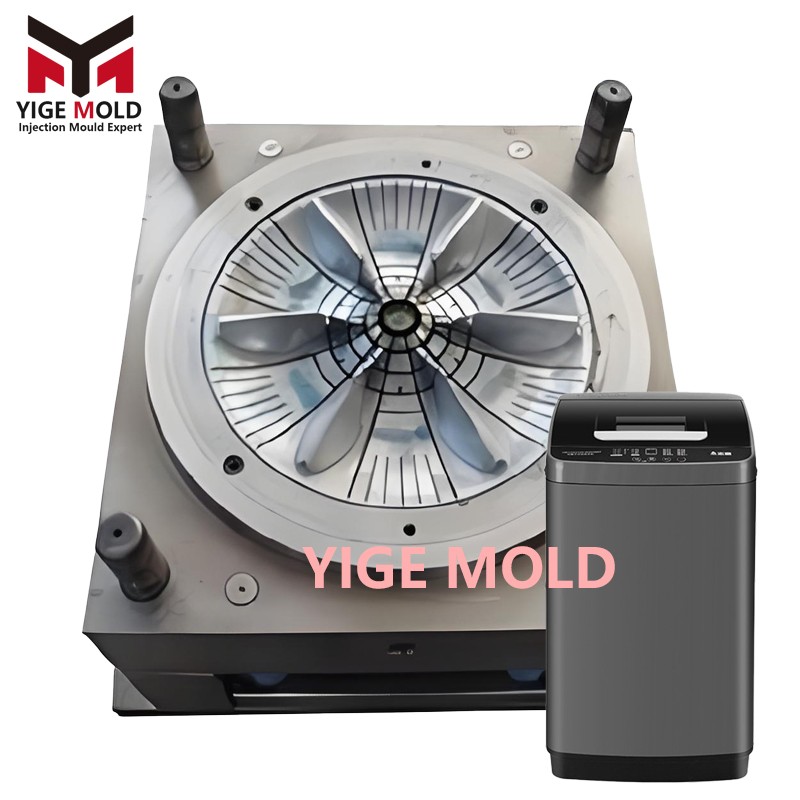
Washing Machine Pulsator Mold
Product Definition:
A washing machine pulsator mold is a specialized injection molding tool used to manufacture the pulsator – the core agitating component of a pulsator-type washing machine. The final product must maintain stable performance under harsh operating conditions including high-speed rotation (≥800 rpm), high temperature and humidity, long-term load, and exposure to chemical detergents. It imposes extremely high requirements for dynamic balance accuracy, structural strength, wear resistance, hydrolysis resistance, and hydrodynamic performance. Materials typically used are glass-fiber-reinforced polypropylene (PP+GF) or special engineering plastics.
Mold Technology System:
1. High Dynamic Balance Structure Design
-
Asymmetric Blade Molding Technology:
-
Employs 3-6 unevenly distributed, three-dimensionally twisted blades to optimize water flow.
-
The mold requires 5-axis simultaneous machining to ensure the geometric accuracy and consistency of each blade's curved surface and flow channel.
-
The weight deviation of each blade must be controlled within ±0.5 grams to ensure initial dynamic balance.
-
-
Precision Balancing Weight System Integration:
Dynamic Balance Compensation Solution:
├── Design Phase: Pre-calculates mass distribution via CAE analysis.
├── Mold Implementation: Pre-sets balancing weight mounting posts on the pulsator back.
├── Molding Compensation: Fine-tunes shrinkage by adjusting local packing time.
└── Post-Process Adjustment: Reserves slots for adding balancing weights.
2. High-Performance Material Molding System
-
Glass Fiber Orientation Control Technology:
-
Uses a sequential valve hot runner combined with specific gate design (e.g., film gate).
-
Controls melt flow direction and shear field to orient glass fibers along the main stress direction.
-
Achieves 40-60% increase in axial tensile strength and 3x improvement in creep resistance.
-
-
Hydrolysis Resistance Treatment:
-
The mold cavity surface undergoes nanocrystalline treatment (forming a Cr₂O₃ layer).
-
Reduces hydrolysis catalytic reactions between the melt and cavity surface.
-
Extends product service life in high-temperature washing environments.
-
3. Ultra-Precision Cooling and Venting
-
Topology-Optimized Conformal Cooling:
Cooling System Layout: ├── Blade Area: Spiral conformal channels (3D printed). │ ├── Channel-to-surface distance: 3 ± 0.5 mm. │ └── Cooling efficiency: 45% improvement vs. traditional channels. ├── Hub Area: Fountain cooling matrix. │ ├── 8-point symmetrically arranged cooling wells. │ └── Temperature differential control: ≤ 2°C. └── Edge Area: Ring-series connected channels. └── Flow control: Precise regulation via proportional valves. -
Micro-Vortex Venting Technology:
-
Sets vortex venting slots (depth 0.015-0.025 mm) at blade tips.
-
Utilizes centrifugal venting principle to guide gas towards the parting line.
-
4. Wear-Resistant Enhanced Surface Treatment
-
Micro-Texture Friction Reduction Design:
-
Designs shark-skin inspired micro-grooves (width 50-100 μm) on the pulsator blade surface.
-
Achieved on the mold cavity via micro-EDM machining.
-
Reduces water flow friction resistance by 15-20%, improving washing efficiency.
-
-
Gradient Hardening Treatment:
-
The cavity surface undergoes composite treatment of plasma nitriding + PCVD coating.
-
Surface hardness reaches HV1800-2200.
-
Wear life is 5-8 times higher than conventional molds.
-
Manufacturing Precision Control Standards:
|
Inspection Item |
Precision Requirement |
Inspection Method |
Control Significance |
|---|---|---|---|
|
Blade Profile Contour |
≤ 0.05 mm |
3D Blue Light Scanning |
Ensures hydrodynamic performance. |
|
Shaft Hole Concentricity |
≤ Φ0.02 mm |
Roundness Tester + CMM |
Ensures smooth rotation. |
|
Dynamic Unbalance |
≤ 1.5 g·cm |
Dynamic Balancing Tester |
Reduces vibration and noise. |
|
Surface Roughness |
Ra 0.2-0.4 μm |
Profilometer |
Optimizes water flow boundary layer. |
Molding Process Window:
1. Special Parameters for Glass-Fiber Reinforced Material
Process Parameter Matrix:
├── Material Temperature
│   ├── Barrel: 190°C / 200°C / 210°C / 215°C (Nozzle)
│   └── Mold: 60-80°C (Front mold 5-8°C higher)
├── Injection Control
│   ├── Speed: Medium-low speed filling (prevents glass fiber disorientation)
│   ├── Pressure: 90-120 MPa
│   └── V/P Switch Point: 98-99%
└── Post-Processing
    ├── Annealing: 100°C × 2h (Relieves internal stress)
    └── Dynamic Balance Calibration: 100% online inspection
2. Defect Prevention Strategy
-
Glass Fiber Exposure (Fiber Read-Out): Increase mold temperature to upper limit, reduce injection speed.
-
Warpage: Use differential mold temperature control (Front: 80°C / Rear: 60°C).
-
Weld Line Strength: Apply local heating to 100°C in the weld line area.
Mold Maintenance and Life:
1. Preventive Maintenance Nodes
-
Every 50k cycles: Clean venting slots in blade areas, check flow in conformal channels.
-
Every 150k cycles: Repair wear on blade tips, recalibrate dynamic balance features.
-
Every 300k cycles: Complete disassembly inspection, replace all guiding components.
2. Life and Economics
-
Mold Life: 1.0 - 1.5 million cycles (up to 2.0 million with carbide inserts).
-
Rejection Rate: ≤ 0.3% (including products failing dynamic balance).
-
Investment Payback Period: 8-12 months (based on annual production of 500k units).