Collapsible Container Mold
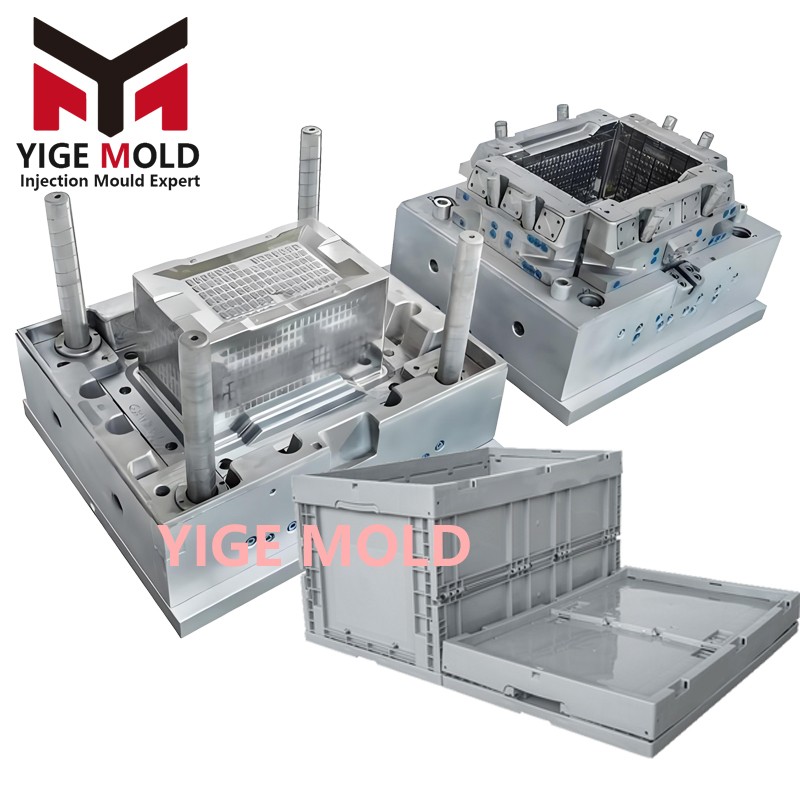
Collapsible Container Mold: The Art and Engineering of Space Efficiency
In the vast landscape of modern industry and logistics, where competition for efficiency permeates every detail, the collapsible returnable container—a seemingly simple logistics vessel—holds its core secret and superior performance in its creator: the Collapsible Container Mold. It is not merely a precision tool but the materialized solution of a set of physical principles, silently reshaping the way goods are moved and stored.
I. Core Philosophy: One Structure, Dual Mission
The fundamental breakthrough in the design of a collapsible container mold lies in its rejection of the pursuit of a "fixed form" in favor of the wisdom of "controlled deformation." The product it shapes is endowed with a dual state of existence:
-
Load-Bearing State: In this state, it must be a sturdy fortress. Through meticulously calculated networks of reinforcing ribs, interlocking stacking lugs, and reinforced corners, the mold ensures the container can withstand the pressure of multi-layer stacking when fully loaded and resist shocks and vibrations during transport. The design of the mold's cooling channels plays a crucial role here, ensuring the plastic solidifies uniformly, eliminating weak points, and creating lasting, reliable rigidity.
-
Collapsed State: In this state, it transforms into a space-saving panel. The true essence of the mold lies in integrally forming durable living hinges at the connection points between the container's side walls and base. This requires the mold to achieve precise wall thickness control and specific fillet designs in the hinge areas, allowing the material to retain its flexibility without becoming brittle after hundreds of thousands of flexing cycles. Working in precise concert are the latches and release mechanisms, also directly formed by the mold, which must engage and disengage cleanly and lock securely. The transition from a three-dimensional structure to a flat one typically reduces volume by over two-thirds, achieving a revolutionary optimization of space occupancy.
Therefore, the essence of this mold is using static steel to define dynamic deformation. It produces not a fixed container, but a "spatial unit with pre-programmed transformational capability."
II. Engineering Core: Reliability and Durability Achieved in Silence
Translating the above concept into a physical object involves overcoming a series of complex engineering challenges, centered on balancing strength, lifespan, and production efficiency.
-
Structural Design: The Foresighted Layout of Mechanics
-
At the design stage, the mold's structure is deeply integrated with the stress analysis of the container. By simulating scenarios like full-load stacking, forklift handling, and accidental drops, the optimal layout and dimensions for reinforcing ribs are pre-determined in the mold, placing material exactly where it is needed most.
-
Kinematic simulation of moving mechanisms is crucial. The rotation center of hinges and the sliding trajectory of latches must be calculated with precision during mold design to ensure all actions are smooth and unobstructed, preventing early-life failure due to friction or interference.
-
-
Material and Surface: The Armor Against Millions of Cycles
-
The mold base employs high-toughness tool steel to ensure the overall structure resists deformation under long-term, high-pressure cycles.
-
Reinforcement of key moving parts is the guarantee of longevity. Core inserts in hinge areas, latch sliders, and other such components commonly undergo treatments like nitriding, hard chrome plating, or specialized coatings. This hard surface layer effectively resists long-term abrasion from plastic particles, ensuring that the hinges and latches formed remain dimensionally accurate and fully functional even after an ultra-long service life.
-
-
Hot Runner and Temperature Control: The Unsung Heroes of Efficiency and Consistency
-
Large container molds widely employ multi-point hot runner systems. This not only eliminates massive cold runner waste, saving raw material, but more importantly, allows molten plastic to be injected into the cavity synchronously and uniformly from multiple points. This results in a product with minimal internal stress and uniform shrinkage.
-
Complex zoned cooling circuits are the key to controlling production rhythm and quality. Powerful cooling is applied to thick areas like reinforcing ribs and hinges, while gentler cooling is used for large thin-walled sections. This coordinates the solidification speed of the entire product, shortens the molding cycle, and minimizes warpage to the greatest extent.
-
-
Internal Actuation Mechanisms: The Precise "Skeleton" of the Mold
-
To form the container's complex undercut features (such as recessed handles, anti-skid patterns on the base, or internal slots), the mold integrates numerous lifters, sliders, and hydraulically driven mechanisms. These mechanisms must actuate with strict sequence and precise travel during mold opening and closing, with flawless synchronization. Their machining and assembly accuracy directly determine whether the mold can run stably for hundreds of thousands, or even millions, of cycles.
-
III. Value Created: From Production Tool to Engine of Systemic Efficiency
The value of a collapsible container mold extends far beyond the injection molding shop floor; it is an engine driving cost reduction and efficiency gains across the entire logistics system.
-
Direct Transformation of Logistics and Storage Costs
-
Transportation Link: The efficiency of reverse logistics or cross-regional redistribution of empty containers is multiplied by collapsing. The number of empty containers a single truck can transport increases exponentially, directly and significantly reducing unit transportation costs.
-
Storage Link: Collapsed containers require only a fraction of the storage space needed in their expanded state. This means the effective storage capacity of a warehouse can be multiplied, or the warehouse space required for the same volume of goods can be drastically reduced. Its economic value is profound in an era of increasingly expensive land and storage resources.
-
Handling Link: Standardized, collapsible containers greatly simplify loading/unloading, counting, and palletizing processes, facilitating manual operations and laying the groundwork for more efficient, centralized logistics management.
-
-
Tangible Contribution to Resource Circulation and Sustainability
-
High-quality containers produced by precision molds can have a service life of ten years or more, capable of being reused thousands of times. This substantially replaces vast quantities of disposable packaging materials (like cartons, wooden crates), drastically reducing solid waste at the source.
-
Excellent collapsible design facilitates the establishment of recovery and reuse networks for containers. The containers move efficiently in loops between manufacturers, distributors, and retailers, maximizing material utility and serving as a tangible embodiment of circular economy principles in the industrial sphere.
-
-
Foundational Support for Standardization and Process Optimization
-
Uniform, reliably performing collapsible containers are the physical foundation for advancing unit load and modular logistics. Their perfect compatibility with standard pallet and truck trailer dimensions enables "no-touch" handling of goods from the production line to the end point, significantly enhancing the smoothness and reliability of the entire supply chain.
-
IV. Future Evolution: Deeper Engineering Mastery and Broader Application Integration
Looking ahead, the development of collapsible container molds will advance along paths of deeper engineering mastery and broader application synergy:
-
Pursuit of Extreme Materials and Processes: Adapting to a new generation of high-toughness, high-impact engineering plastics and even recyclable composite materials, optimizing mold temperature control and runner design to find a better balance between lightweighting and durability.
-
Specialized Design for Specific Environments: Developing dedicated molds for containers with enhanced insulation, conductive coatings, or ultra-high load-bearing structures for specialized scenarios like cold chains, electrostatic discharge (ESD) protection, or heavy parts handling, deepening their application in vertical sectors.
-
Seamless Integration with Automated Systems: Mold concepts will increasingly consider the interface with automated production lines and automated storage/retrieval systems (AS/RS), optimizing structures like forklift pockets and handling grooves to better adapt to unmanned material handling scenarios.
Conclusion
The collapsible container mold is a union of silent force and elegant design. Within the steadfastness of steel, it presets the flexibility of plastic; in the moment of production, it rehearses a product's lifetime of reliability and efficiency. It does not directly partake in the bustle of logistics, yet it fundamentally defines its density and cost. Each precise opening and closing of the mold does not merely manufacture a box; it "casts" movable, compressible, valuable space itself. It represents a profound engineering wisdom: trading immense initial design complexity and precision for the ultimate simplicity, efficiency, and thrift it brings to the entire system throughout the product's life cycle. This is the profound value embodied in the collapsible container mold—the master of space hidden on the production line.