Fridge Drawer Mold
Comprehensive Technical Analysis of Refrigerator Drawer Molds
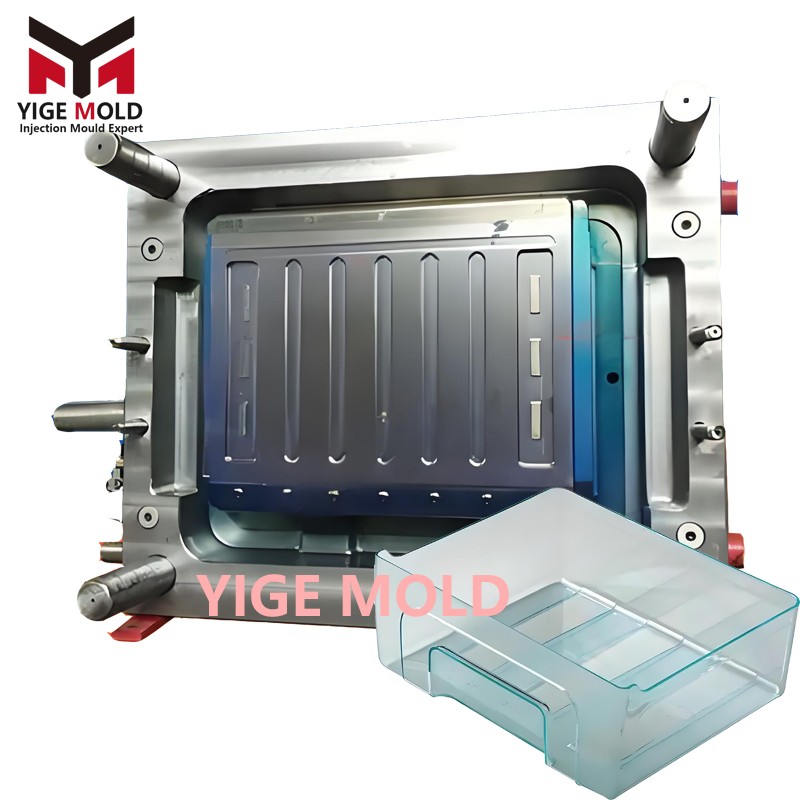
Refrigerator drawer molds are key precision equipment used for the mass production of storage units inside domestic and commercial refrigeration appliances. These molds specialize in manufacturing functional components that conform to the complex internal cavity structures of modern refrigerators. Their technological core lies in achieving high dimensional stability for large, thin-walled parts, excellent surface finish, and durability that meets stringent hygiene standards. Their design integrates appliance aesthetics, ergonomics, and the demands of efficient production.
I. Product Function and Core Mold Design Principles
The refrigerator drawer, as one of the most frequently interacted-with components, has specific functions that profoundly dictate the mold's design direction:
-
Exceptional Dimensional Accuracy and Fit: Drawers must slide smoothly on refrigerator rails and maintain minimal, uniform gaps with the interior walls to ensure good sealing and aesthetics. The mold must guarantee that part deformation due to injection shrinkage and environmental temperature changes is controlled at an extremely low level (typically less than 0.5%), presenting a rigorous test for the mold's thermal balance and structural rigidity.
-
Superior Surface Aesthetics and Tactile Feel: As a directly visible component, the drawer's exterior usually requires a high-gloss or fine matte finish, while the interior must be easy to clean. The mold cavity must meet high-grade polishing standards (typically A1-A2 mirror finish or fine texturing) and possess excellent wear resistance to maintain surface consistency over long production runs.
-
Balance Between Lightweighting and Structural Strength: While meeting load-bearing requirements (full of produce), wall thickness must be minimized to save material and improve energy efficiency. The mold achieves maximum structural strength with limited wall thickness by designing complex 3D rib networks, box-type structures, or arched support surfaces, requiring precise mold flow and structural simulation analysis.
-
Compliance with Food Contact Safety and Durability: The parts must be made from food-grade plastics compliant with FDA/EU standards and maintain performance under long-term low-temperature, high-humidity, and frequent cleaning conditions. The mold's runner and cooling design must ensure stable material properties, avoid dead zones prone to degradation, and result in surfaces free of microscopic defects that could harbor bacteria.
II. Core Mold Structure and Technical Solutions
To meet the above requirements, modern refrigerator drawer molds typically integrate several advanced technologies:
-
Sequential Valve Hot Runner and Multi-Point Balanced Gating:
-
For large, elongated drawers, to control weld line location, eliminate flow marks, and reduce internal stress, a Sequential Valve-Gated Hot Runner System is commonly used. By opening multiple valve pins in a precise, timed sequence, the melt flow front is guided to advance synchronously, confining weld lines to non-appearance areas or structural reinforcement zones. Gates are typically hidden in rail grooves, the bottom, or the back side.
-
-
High-Precision Temperature Control System:
-
Temperature control is critical for dimensional stability. Molds employ a Zoned Closed-Loop Temperature Control System for independent control of the core, cavity, and large insert temperatures. Cooling channel design is extremely dense, often utilizing multi-level circuits, angled channels, and heat pipe technology to ensure uniform cooling in thick and thin sections, eliminating warpage and sinks caused by temperature differentials.
-
-
Complex Ejection and Slide Systems:
-
The deep draw of the drawer and side rail grooves typically require complex side core-pulling. Molds use a combination of angle lifters, long-stroke slides, and hydraulic (or electric) synchronized core-pull mechanisms to achieve smooth demolding. The ejection system employs a large stripper plate working in concert with numerous return pins to ensure the large thin-walled part is ejected stably, without distortion or ejector pin marks.
-
-
Venting and Surface Treatment:
-
Precision vent grooves and vent inserts are placed at the end of fill, rib roots, and slide mating surfaces to prevent burn marks or short shots caused by trapped air. For high-gloss surfaces, cavity steel with superior polishability is used, such as high-grade pre-hardened mold steel, and may receive a Nickel-Phosphorus alloy plating or PVD coating to enhance release, wear resistance, and corrosion resistance, extending mold life.
-
III. Manufacturing Process Chain and Quality Control
The mold's superior performance stems from a complete precision chain from design to validation:
-
Simulation-Based Digital Design:
-
From the initial design stage, Mold Flow Analysis (MFA) software is used to simulate the entire process of melt filling, packing, cooling, and shrinkage/warpage. This optimizes gate location and cooling layout and predicts potential deformation for correction. Structural Finite Element Analysis (FEA) is used to verify stress and deformation of the drawer under full load, optimizing rib design.
-
-
Precision Machining and Assembly:
-
5-Axis High-Speed Machining Centers are used for high-precision milling of complex contours. Critical mating surfaces like rail interfaces and sealing surfaces are finished with Jig Grinding or Precision Wire-Cut EDM to guarantee fit accuracy. All moving components undergo precision fitting to ensure smooth, jam-free operation.
-
-
Systematic Mold Trial and Validation:
-
The trial run is not just for process debugging but for systematic validation. Samples are produced under different process parameters and subjected to strict comprehensive dimensional inspection, rail fitment testing, durability sliding tests, thermal cycling tests, and surface quality assessment. Data feedback is used for final fine-tuning of the mold, ensuring its capability for stable mass production.
-
IV. Industry Value and Trends
Refrigerator drawer molds are a technology-intensive segment within the major home appliance supply chain. Their value is evident in:
-
Enhancing Overall Appliance Quality and User Experience: High-quality drawers are key to achieving excellent refrigerator sealing, large capacity, and ease of use, directly impacting user perception of the brand.
-
Driving Material and Process Innovation: To meet demands for thinner walls, greater sustainability, and integrated functionalities (e.g., antibacterial), mold technology continuously adapts to new materials and processes.
In summary, the refrigerator drawer mold is a systems engineering project integrating precision mechanical design, polymer rheology, thermodynamic control, and advanced manufacturing processes. Its technical sophistication directly reflects the design and manufacturing capabilities for core appliance components. It is indispensable in modern, large-scale, high-quality appliance manufacturing systems. As refrigerators evolve towards larger capacities, multi-zone cooling, and smarter features, the requirements for drawer mold precision, functional integration, and production intelligence continue to advance, driving ongoing evolution in this field.