Complete Set Car Floor Mat Mold System
 Introduction to Complete Set Car Floor Mat Mold System: A Precision Manufacturing Solution for Modular Automotive Interior Protection
Within the modern automotive industry, the specialized and modular manufacturing of interior components has become a key factor in enhancing overall vehicle quality and production efficiency. The Complete Set Car Floor Mat Mold System represents a highly integrated solution in the field of automotive interior protection, exemplifying the technological evolution from single-part manufacturing toward systematic, platform-based mold engineering. This system is not merely a simple collection of independent molds but rather a precision mold ecosystem developed through collaborative design, data linkage, and process optimization based on the vehicle's chassis architecture, interior design language, and production requirements.
I. System Definition and Composition Framework
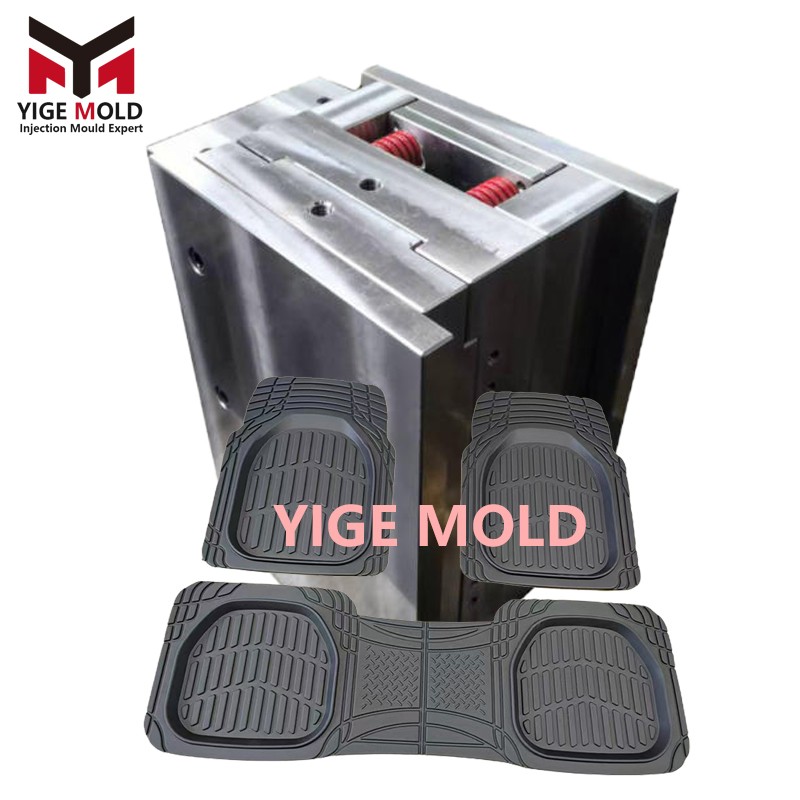
The Complete Set Car Floor Mat Mold System refers to a complete, coordinated set of injection molds designed and manufactured to meet the floor protection needs of the entire cabin for a specific vehicle model (or platform-based model series). Its core objective is to ensure precise fit, visual harmony, and functional synergy of all components within the vehicle environment, while guaranteeing the functionality and quality of each individual mat.
A standard system typically comprises:
-
Front Row Mat Molds
-
Usually designed as left-right symmetrical or mirrored, but mold design must precisely account for structural differences such as the driver's footwell/pedal area and seat rails.
-
-
Rear Row Mat Molds
-
Depending on vehicle positioning, this may be a single one-piece wide rear mat mold, or separate left/right molds (common in luxury vehicles or models with a transmission tunnel hump).
-
-
Trunk/Cargo Liner Mold
-
Covers the entire cargo area floor, often the largest and most structurally complex, requiring consideration of wheel arch contours, anchor point openings, anti-slip nibs, etc.
-
-
Optional Accessory Molds
-
Examples: Rear center console cover mold, sill protector/scuff plate mold, seat back kick plate mold, etc., forming a more comprehensive protection set.
-
All molds are developed systematically through a unified database, coordinated ejection directions, and standardized interface design, ensuring high consistency in the final products' dimensions, color, texture, and finish.
II. Core Technical Features and Collaborative Design Key Points
1. Single Source of Data & 3D Digital Collaboration:
-
Foundation: The entire mold set strictly adheres to the vehicle CAD data provided by the OEM as the sole design basis, ensuring that gaps and flushness with body panels and interior trim (e.g., dashboard, seats, B-pillar trim) meet engineering specifications.
-
Collaboration: Collaborative design platforms are used to ensure that the overlap between front and rear mats, the visual continuity of textures, and color matching are accurately simulated and confirmed during the mold design phase.
2. Unified Material and Process Planning:
-
Material Selection: The full set of molds is typically optimized for the same base material type (e.g., TPE, PVC, EPDM rubber), ensuring consistent hardness, resilience, and weather resistance across all mat components. For dual-material or composite solutions, the secondary injection or overmolding processes for each mold must be designed in sync.
-
Texture and Color: The surface treatment (texturing, blasting, polishing) of all mold cavities follows the same standard, guaranteeing identical visual effects for the produced mats' anti-slip patterns, logos, grain feel, etc. Colorant ratios and mixing processes must be uniformly controlled within the system to prevent batch-to-batch color variation.
3. Systematic Optimization of Manufacturing and Production Efficiency:
-
Cavitation Strategy: The number of cavities for each mold is scientifically planned based on component volume and production demand. For example, front row mats might use a 1+1 cavity layout, while the cargo liner might be a single-cavity large mold. The shot volume and clamping force requirements of all molds must match the factory's injection molding machine resources, forming an efficient production scheduling combination.
-
Standardization & Modularity: Mold bases, hot runner brands, ejection systems, cooling interfaces, etc., are standardized as much as possible to reduce maintenance costs and increase spare parts commonality. Cooling channel design is specifically optimized for different part geometries to achieve similar cycle times across the system.
4. Integrated Consideration of Functionality and Safety:
-
Precise Fixation: Molds must precisely form the anti-slip nibs, clips, hook-and-loop fasteners, etc., on the back of the mats, ensuring they reliably engage with the vehicle carpet's anchor points. This prevents hazardous shifting during driving that could interfere with pedal operation.
-
Perimeter Protection: As a system, the height and coverage of the mats' raised edges are holistically evaluated to ensure effective containment of dirt and liquids without interfering with door operation or seat adjustment mechanisms.
-
Eco-friendliness & Health: For the enclosed cabin environment, mold design must facilitate thorough material plastification, reduce VOC emissions, and allow for efficient post-molding deodorization.
III. Systemic Advantages Compared to Single-Item Mold Development
|
Aspect |
Complete Set Car Floor Mat Mold System |
Discrete Single-Item Mat Molds |
|---|---|---|
|
Fit & Finish |
Exceptionally High. Seamless part interfacing and perfect vehicle fitment, based on single data source and design rules. |
Risk of Issues. Molds from different suppliers or development phases can lead to tolerance stack-up and fit problems. |
|
Quality Consistency |
Excellent. Material, texture, color, and physical properties are controlled within the system for uniform visual and tactile feel. |
Difficult to Guarantee. Variations in molds and production batches can easily cause color/texture mismatches and performance fluctuations. |
|
Development Efficiency & Cost |
Higher upfront cost, lower total cost of ownership. Single-pass system design avoids repetitive communication and revisions. Simplified supply chain management. |
Lower per-item initial cost, higher total cost. Multiple redundant development cycles, multiple tooling trials, and repeated vehicle fitment validations. |
|
Brand Image & After-Sales |
Enhances Brand Value. Provides a high-quality, integrated OEM-like solution, boosting user experience and brand perception. |
Potential for Inconsistency. Products may appear "piecemeal," affecting premium brand positioning. |
|
Production & Inventory Mgmt. |
Efficient. Enables coordinated production scheduling and JIT delivery, reducing inventory SKUs and space. |
Complex. Requires managing multiple suppliers and schedules separately, leading to greater inventory pressure. |
IV. Typical Application Process
-
Requirement Definition & Data Input: The OEM or Tier-1 supplier provides vehicle data, protection level requirements (e.g., waterproof, stain-resistant, anti-slip), material specifications, color/texture standards, and annual production volume forecasts.
-
System Solution Design: The mold supplier conducts feasibility studies, defines the part breakdown, material/process selection, number of mold sets, cavitation layout, and provides cost and timeline estimates.
-
Collaborative Detailed Design: The mold design team develops 3D designs for each mold in parallel, conducting regular virtual assembly reviews to ensure system compatibility.
-
Mold Manufacturing & T0 Trial: After precision machining, each mold undergoes its first trial run (T0) sequentially or concurrently to produce full-set samples.
-
System Integration Validation (Core Stage): The complete set of mat samples is installed in an actual vehicle or a high-precision fixture/vehicle coordinate measuring system for validation. Fitment, gaps/flushness, fixation reliability, and aesthetic consistency are checked.
-
Optimization & Mass Production: Molds are adjusted collaboratively based on validation results until the entire system fully meets specifications, after which mass production commences.
V. Conclusion
The Complete Set Car Floor Mat Mold System is a prime example of the automotive parts mold sector's advancement toward high-tech integration and high-value-added services. It transcends the scope of traditional single-part mold manufacturing, deeply integrating product design, materials engineering, mold technology, production processes, and vehicle application. It represents a value leap for customers—from providing "molds" to delivering a "complete vehicle matching solution."
For OEMs pursuing high interior quality and consistency, and for mold makers aiming to evolve from "mold manufacturers" into "system solution providers," developing and mastering such mold system capabilities is not only a demonstration of technical prowess but also a strategic choice for participating in the deep specialization of the future automotive industry and establishing a core competitive advantage. It represents the future direction of automotive interior protection part manufacturing: systematic, intelligent, and deeply integrated with the vehicle.