Lid Mold
 Introduction to Lid Molds
Lid molds are specialized forming tools used for the mass production of various types of lids, widely applied in packaging, food, daily chemicals, pharmaceuticals, and industrial container sectors. Through processes such as injection molding and compression molding, they process materials like plastic and metal into lid products with specific shapes, dimensions, and functions. They are essential key process equipment in modern industrial production.
1. Basic Structure and Working Principle
A typical lid mold primarily consists of the following major systems:
-
Molding System: Includes the cavity and core, which directly determine the lid's geometry, surface texture, and internal structures (such as threads, snaps, ribs, etc.). Its machining precision determines the dimensional accuracy and appearance quality of the final product.
-
Gating System: Responsible for channeling the molten material into the cavity. Modern lid molds commonly use hot runner systems to save material, reduce waste, shorten the molding cycle, and allow for better control of the filling process.
-
Cooling System: A network of circulatory water channels designed inside the mold to rapidly and uniformly remove heat generated during plastic solidification. Cooling efficiency directly affects production cycle time and product quality.
-
Ejection System: After the part has cooled and solidified, this system, using components like ejector pins and plates, smoothly removes the lid from the core, ensuring the continuity of automated production.
-
Guidance and Venting System: The guidance system ensures precise alignment between the moving and fixed molds; venting channels are used to exhaust gases from the cavity, preventing defects like short shots or burn marks.
Its working cycle is: Clamping → Injection → Packing → Cooling → Mold Opening → Ejection → Part Removal, before repeating.
2. Main Types and Technical Characteristics
Mold design varies significantly depending on lid structure, material, and production process:
-
By Lid Type:
-
Threaded Cap Molds: Require precise design of unscrewing mechanisms or side-action sliders to ensure proper thread formation and release.
-
Flip-Top/Snap Cap Molds: Often involve molding complex hinge structures, demanding high material toughness and specific cooling in localized areas of the mold.
-
Sprayer/Dispenser Cap Molds: Feature complex structures, typically consisting of multiple assembled components. The mold must facilitate the molding of numerous small, precise parts.
-
Tamper-Evident Cap Molds: Incorporate a one-time-break tamper-evident band. The mold must achieve precise molding and reliable separation of this thin-walled structure.
-
-
By Process and Structure:
-
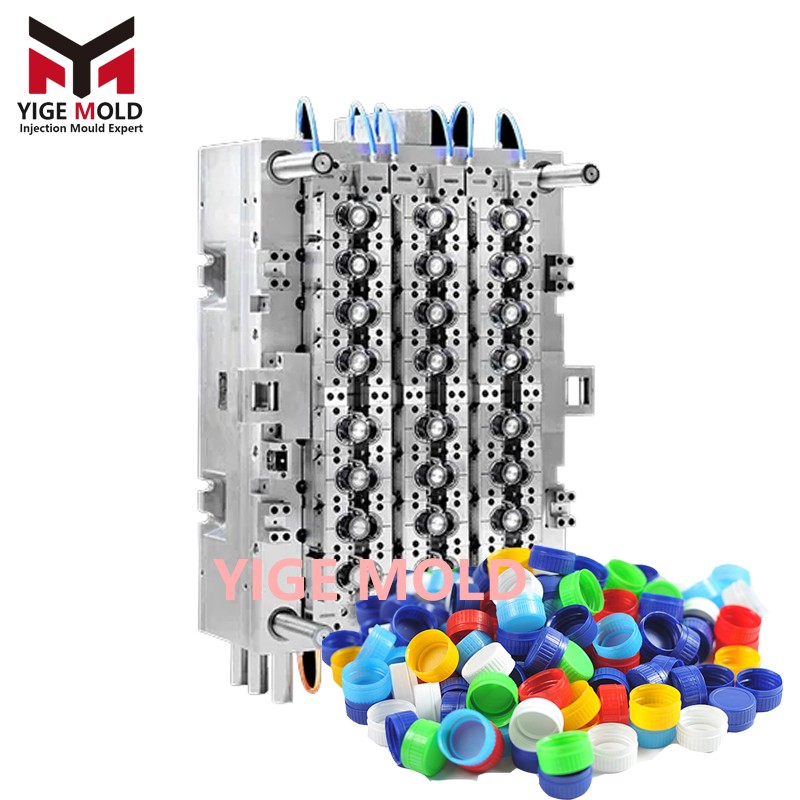
High-Cavitation, High-Speed Molds: Used for high-demand products like water and beverage bottle caps. Cavity counts can reach over a hundred, prioritizing extremely high production efficiency and stability.
-
Stack Molds: Multiply output by adding layers in the mold opening direction, efficiently utilizing the clamping force of the injection molding machine.
-
Two-Color/Multi-Color Molds: Can produce lids made of two different materials or colors in a single cycle (e.g., a rigid body with a soft sealing gasket), enhancing functionality and aesthetics.
-
Metal Lid Stamping Dies: Primarily used for producing tinplate, aluminum, and other metal caps. They often employ multi-station progressive dies to achieve consecutive operations like blanking, drawing, embossing, and gasket insertion.
-
3. Key Manufacturing Requirements
-
High Precision and Long Service Life: Molds require high-quality mold steels (e.g., P20, S136, H13) and often undergo heat treatment to increase hardness and wear resistance. Machining tolerances for key forming areas are frequently at the micron level to ensure stability over millions, or even tens of millions, of injection cycles.
-
Excellent Venting and Cooling: Lids are typically thin-walled with a large projected area. Effective venting prevents gas traps. Balanced, efficient cooling is crucial for controlling warpage and minimizing cycle time (sometimes as short as 3-5 seconds).
-
Targeted Detail Design: Precise dimensional compensation for the shrinkage of different materials (e.g., PP, PE, PET, AS); special surface treatments or structural optimizations for areas prone to sticking.
4. Application Areas and Selection
-
Food and Beverage Packaging: The largest application sector. Requires molds with high output, good hygiene properties, capable of producing lids that meet requirements for sealing, tamper evidence, and easy opening.
-
Daily Chemical and Cosmetic Packaging: Focuses on the aesthetic appearance, feel, and special functions of lids (e.g., dosing, non-drip). Places high demands on mold surface finishes (high polish, texture).
-
Pharmaceutical Packaging: Emphasizes safety, sealing integrity, and usability (e.g., child-resistant closures, Braille lids). Mold design must be extremely rigorous and reliable.
5. Development Trends
-
Higher Efficiency and Lower Cost: Further reduction of per-part cycle time and energy consumption through optimized runner and cooling design.
-
Multi-Functional Integration: Molds capable of producing lids with combined functions, or utilizing in-mold assembly techniques to reduce downstream processes.
-
Adaptation to New Materials: Molds need to accommodate the processing characteristics of new materials driven by environmental demands, such as biodegradable plastics, mono-materials, and high-percentage recycled content.
-
Advancements in Manufacturing Technology: Widespread use of advanced machining technologies like high-speed milling, precision EDM, and laser texturing. Application of 3D printing (Additive Manufacturing) for creating core components with conformal cooling channels, improving cooling uniformity.
In summary, lid molds are the engineering bridge connecting product design to mass production. Their technological level directly determines the quality, cost, and production efficiency of lids. With continuous changes in end markets and advancements in manufacturing technology, lid molds are developing towards greater precision, higher efficiency, and increased intelligence.