GAIM Chair Mold
Gas-Assisted Injection Molding (GAIM) Chair Mold: Professional Manufacturing Solution
1. Product Definition and Market Positioning
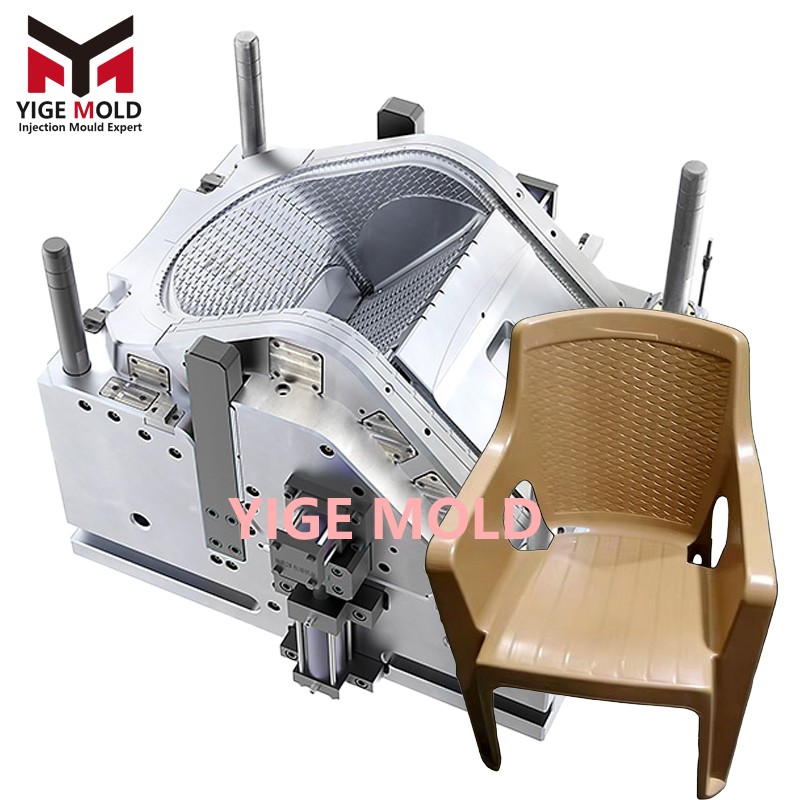
Gas-Assisted Injection Molding (GAIM) Chair Molds are professional molds for producing various types of seats, utilizing Gas-Assisted Injection Molding technology. This technology involves injecting high-pressure inert gas (typically nitrogen) into the molten plastic inside the mold cavity after initial injection. The gas pressure drives the melt to complete filling, packing, and cooling, ultimately forming hollow gas channels within the part. Products cover various types such as office chairs, dining chairs, bar stools, and outdoor lounge chairs, meeting seating posture requirements for different scenarios. As modern living standards improve and public facilities are upgraded, the seating market demands higher levels of lightweighting, strength, and comfort. GAIM technology, with its unique advantages, has become a mainstream choice in the industry.
2. Principles of the Gas-Assisted Injection Molding Process
Gas-assisted injection molding is a precise process controlled by timing, primarily consisting of five stages:
1. Melt Injection (Short Shot)
A certain amount of plastic melt is injected into the mold cavity, but not to full capacity, typically 60%-95% of the cavity volume. This is called the "short shot" percentage. The optimal switchover point must be determined through pressure gradient experiments to ensure complete cavity filling and uniform, full gas channels.
2. High-Pressure Gas Injection
After or simultaneously with melt injection completion, high-pressure nitrogen (pressure typically higher than melt pressure) is injected into the center of the melt through a gas pin. The gas advances along the path of least resistance (usually the thick sections or ribs), pushing the melt toward the end of the cavity until it is completely filled.
3. Gas Packing/Holding Pressure
Once the cavity is full, gas pressure is maintained constant, entering the packing/holding stage. The gas continues to apply pressure from the inside out, compensating for volumetric shrinkage caused by melt cooling, ensuring the part's outer surface remains tightly against the mold, and eliminating sink marks. Compared to traditional "melt packing" in conventional injection molding, the pressure is more uniform and internal stresses are lower.
4. Gas Venting and Recovery
After the part has cooled and solidified, the gas is released and recovered for reuse, reducing costs.
5. Mold Opening and Part Ejection
The mold opens, and the part with hollow gas channels is ejected.
3. Core Advantages of Gas-Assisted Injection Molding
Compared to conventional injection molding, GAIM offers significant advantages:
1. Significantly Reduces Internal Stress and Warpage
Traditional injection molding cavity pressure can be as high as 30-50 MPa, while GAIM is only about 5 kPa. The pressure the part experiences is drastically reduced, resulting in minimal residual internal stress and greatly reduced warpage.
2. Reduces Clamping Force and Injection Pressure
Due to internal gas assistance for filling and packing, the required injection pressure and clamping force can be reduced by 30%-60%, allowing the production of large parts on machines with smaller tonnage.
3. Saves Raw Material
The hollow structure formed inside the part can save 20%-40% of plastic, directly lowering material costs and reducing product weight.
4. Enhances Molding Capability
It enables the molding of large, thick-walled, uneven wall thickness, and complex-shaped parts in a single shot. It overcomes challenges like sink marks and short shots common in conventional molding, greatly increasing design freedom.
5. Improves Surface Quality
Gas packing effectively eliminates surface sink marks, resulting in flat, smooth, Class-A surfaces.
6. Shortens Cycle Time
The hollow structure reduces the amount of plastic needing to cool, and the gas itself is a good heat conductor, accelerating internal cooling, thus shortening the overall cycle.
7. Increases Part Stiffness and Strength
It forms hollow, reinforced rib-like structures (similar to I-beams) in thick sections, improving the part's specific strength (strength/weight ratio) and rigidity while saving material.
4. Core Technical Features of the Mold
1. Gas Channel Design System
Gas Channel Design Principles
Gas channel cross-sections are best designed to be nearly circular, avoiding sharp corners and using large radii to prevent material accumulation in corners. If a rectangular shape is necessary, the channel is typically designed as elliptical. To ensure uniform gas penetration, the condition b ≤ (3~5)h should be met (where b is the channel width and h is the part wall thickness). Channels should be arranged along the part's main load-bearing direction or at the end of melt flow to form a continuous, balanced gas channel network.
Anti-Sink Design
At the junction where the gas channel meets a thin section of the part, a fillet transition should not be used. Instead, an anti-sink groove should be machined to guide the gas and prevent sink marks in that area.
2. Gas Pin System
The gas pin is a critical component of a GAIM mold. Its fit clearance should be less than 0.02mm to prevent melt from entering the gap. The seal between the gas pin's outer circumference and the mold must be excellent, requiring high-temperature-resistant sealing rings. The gas pin location should not be too close to the gate, as the material near the gate has higher temperature and lower viscosity during filling, which can allow melt to enter the gas pin gap, causing part defects like sink marks or gas blow-through.
3. Gate Design
Gate location should facilitate melt filling and gas penetration. Gas pins are typically placed in areas that fill first or in thick sections. Measures must be taken to prevent gas from entering thin sections of the part or blowing through the melt skin. For runner and gate design, because GAIM eliminates the injection compensation phase, fewer runners and gates can be used. To ensure faster filling speed, runners and gates should be enlarged. The diameter of submarine gates is generally around 1.5mm.
5. Materials and Process Standards
1. Mold Steel
-
Cavity Material: Pre-hardened mold steels like S136H, NAK80, hardness HRC 38-42
-
Moving Parts: Hot-work steels like SKD61, H13, hardness HRC 48-52
-
Surface Treatment: Mirror polishing (Ra ≤ 0.05μm), nitriding treatment (HV ≥ 1000)
2. Product Materials
-
PP Material: FDA compliant, temperature resistant from -20°C to 120°C, excellent impact resistance
-
ABS Material: High strength and gloss, suitable for demanding applications
-
PP+TPE: Hard-soft combination for seat surfaces to enhance comfort
3. Injection Molding Process Parameters
-
Barrel Temperature: 190-230°C for PP, 220-260°C for ABS
-
Mold Temperature: 40-80°C, adjusted based on part wall thickness
-
Injection Pressure: 60-120 MPa
-
Holding Pressure: 60-80% of injection pressure
-
Holding Time: Calculated at 1-3 seconds per mm of wall thickness
6. Product Structural Design Highlights
1. Ergonomic Design
The seat surface features a curved profile. The front edge has an anti-slip lip, and the rear edge has a slightly raised arc to match the natural curve of the human hips. Seat thickness ranges from 25-40mm. The surface can include a ventilation hole array with an open area ratio of 10%-20%. Seat edges undergo rounded treatment (R5-R10) to improve comfort.
2. Support Structure Design
The base uses a five-star foot design. Leg tube diameters are Φ30-Φ50mm with wall thicknesses of 2.0-3.0mm. The connection between leg tubes and the central hub incorporates reinforced rib structures. Stress concentration areas use R-angle transitions ≥3.0mm. Leg ends feature non-slip foot pads made of TPE or rubber, with a friction coefficient ≥0.8.
3. Multi-functional Integrated Design
Some products incorporate a gas lift height adjustment system with a travel range of 300-500mm and a load capacity ≥150kg. The interface between the gas lift and base uses a precision guiding structure with a fit tolerance of ±0.05mm, ensuring smooth and stable adjustment. Height adjustment uses a gas spring with customizable force and a service life ≥50,000 cycles.
4. Lightweight and Strength Balance
Through CAE analysis optimization, seat wall thicknesses are 2.5-3.5mm and leg tube wall thicknesses are 2.0-3.0mm. A cross-reinforced rib layout improves bending strength by 40%. Critical connection points feature reinforced corner structures, passing drop tests (from 1.0m height) without cracking.
7. Primary Application Areas
GAIM is particularly suitable for producing hollow or partially hollow parts that are thick-walled, ribbed, or large and plate-like:
-
Office Furniture: Office chairs, conference chairs, reception chairs, etc.
-
Public Facilities: Stadium seating, theater seats, waiting chairs, etc.
-
Household Furniture: Dining chairs, bar stools, lounge chairs, etc.
-
Outdoor Products: Park benches, outdoor lounge chairs, etc.
8. Technology Extension: Water-Assisted Injection Molding (WAIM)
Water-Assisted Injection Molding (WAIM) is a technology similar to GAIM but uses water as the auxiliary medium. Water has a high specific heat capacity, leading to extremely high cooling efficiency, potentially reducing cooling time by up to 75%. It can produce parts with thinner, more uniform walls, saving even more material. The inner walls of the part are smoother, and costs can be lower.
9. Summary of Professional Manufacturing Key Points
Yige mold The successful manufacturing of Gas-Assisted Injection Molding Chair Molds relies on four core elements:
-
Precision Design: Accurate structural design based on ergonomic requirements ensures seating comfort and load-bearing performance.
-
Quality Materials: Matching food-grade raw materials with high-performance mold steels meets safety and durability requirements.
-
Advanced Processes: The synergistic action of intelligent temperature control and venting systems ensures dimensional stability and surface quality.
-
Strict Quality Control: Full-process quality control from mold machining to product molding ensures products meet international standards.