Table plastic mold manufacturing
Plastic Table Mold Manufacturing
Product Definition:
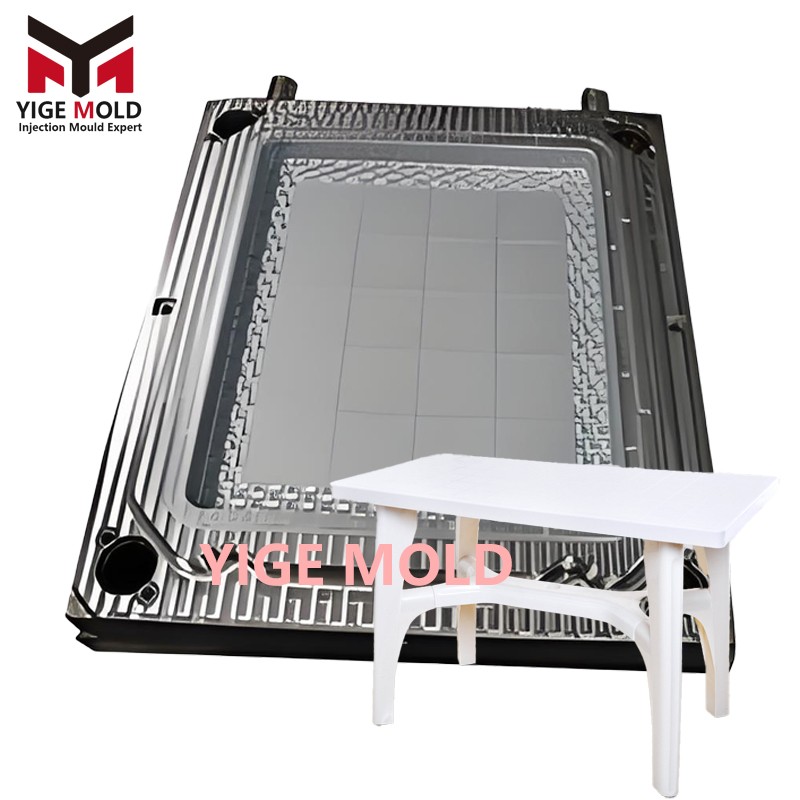
A plastic table mold is a specialized forming tool used to produce various types of tables primarily made of plastic materials. It covers multiple categories, including outdoor leisure tables, indoor folding tables, children's study tables, and commercial display tables. The final products must meet comprehensive requirements for structural stability, load-bearing capacity, weather resistance (for outdoor use), safety (for children), and aesthetics. Commonly used materials include Polypropylene (PP), Polyethylene (PE), ABS, and engineering plastics (e.g., PA, PPO).
Mold Manufacturing Technology System:
1. Structural Design and Analysis
-
Large Thin-Wall Part Design: Table products are typically plate/shell structures with large surface areas (0.5-2.0 m²) and relatively thin walls (2.5-4.5 mm). Mold design requires simulation analysis of warpage, filling balance, and structural strength using CAE software (e.g., Moldflow, ANSYS) to pre-optimize gate locations, cooling layouts, and rib distribution.
-
Modularization and Standardization: For series-produced tables (e.g., square/round tables of different sizes), molds employ a modular design. By exchanging cavity inserts, height adjustment modules, or surface texture blocks, a single mold base can produce multiple product variants, reducing development cost and time.
-
Integrated Functional Structures: The mold must form complex functional features in a single shot, such as table leg connection structures (e.g., embedded metal threaded inserts, quick-release clips), cable management channels, cup holders, and telescopic adjustment mechanisms. This places extremely high demands on the design precision of moving mechanisms like sliders, lifters, and hydraulic core pulls.
2. Manufacturing of Core Mold Systems
2.1 Gating System
-
Hot Runner System Selection: Depending on the tabletop area, a multi-point hot runner system (valve-gated or open) is typically used. For extra-large tabletops (>1.5 m²), a hybrid design combining hot and cold runners may be employed to ensure melt flow balance and controllable pressure drop.
-
Runner Balance Machining: Main and branch runners require precision milling and polishing, with dimensional tolerances controlled within ±0.1 mm, and are often chrome-plated to reduce flow resistance.
2.2 Cooling System
-
Application of Conformal Cooling Channels: For large-area sections like the tabletop, metal 3D printing (SLM) technology is prioritized to manufacture mold cores with internal conformal cooling channels. This enables efficient, uniform cooling, potentially reducing cooling time by 20-40% and significantly minimizing warpage.
-
Zoned Differential Cooling:
-
Tabletop Area: Multi-layer parallel cooling circuits with water temperature control accuracy of ±1°C.
-
Table Leg/Rib Areas: Use of baffle-cooled wells or bubbler pins for focused cooling.
-
Thick-Wall Junction Areas: Embedded high thermal conductivity beryllium copper alloy inserts.
-
2.3 Ejection and Venting Systems
-
Multi-Component Composite Ejection: Combines the use of round ejector pins, flat ejector pins, sleeve ejectors, and gas-assisted ejection. For large tabletops, ejector pin layout requires mechanical simulation to ensure smooth, mark-free ejection. Early return mechanisms are commonly installed to prevent interference.
-
High-Efficiency Venting Design: Venting slots (depth 0.02-0.04 mm) are machined on parting lines, slider mating surfaces, and insert seams. Porous steel vents or sintered metal venting inserts are placed in last-fill areas.
2.4 Surface Treatment Technology
-
Texturing: Creates decorative effects like wood grain, stone texture, fabric texture, or matte finishes on the cavity surface through chemical etching (texturing), laser engraving, or sandblasting.
-
Surface Hardening: Nitriding, PVD coating (e.g., CrN, TiAlN), or hard chrome plating treatments are applied to cavities and moving components to improve wear resistance, corrosion resistance, and release properties.
3. Precision Machining and Assembly
3.1 Key Machining Processes
-
Large 5-Axis High-Speed Milling: Used for machining large, complex curved surfaces, ensuring contour accuracy (≤0.05 mm).
-
Deep-Hole Drilling: Used for machining long cooling channels, requiring high straightness.
-
Precision Electrical Discharge Machining (EDM): Used for cleaning sharp corners, machining deep slots, and creating fine textures.
-
Jig Grinding / Slow Wire EDM: Used for machining high-precision mating surfaces of moving parts like sliders and lifters.
3.2 High-Precision Assembly and Commissioning
Assembly is the crucial step that gives the mold its "soul." It must ensure:
-
Parallelism and perpendicularity of all mold plates.
-
Smooth, synchronized, interference-free movement of hundreds of moving parts (sliders, lifters, ejector pins).
-
Leak-free cooling and hydraulic circuits.
-
Through trial runs,反复调整 process parameters (temperature, pressure, speed, time) are repeatedly adjusted to optimize the packing pressure profile until products with stable dimensions, perfect appearance, and qualified structure are consistently produced.
4. Quality Inspection Standards
-
Dimensional Inspection: Use of Coordinate Measuring Machines (CMM) and laser trackers to inspect critical assembly dimensions, flatness, and profile.
-
Functional Testing: Performance of load-bearing tests, fatigue tests (e.g., leg folding), and environmental tests (high/low temperature, UV) on sample tables produced by the mold.
-
Appearance Inspection: Inspection of surface gloss, color, texture consistency, and any visible defects under standard light booths.
5. Mold Maintenance and Lifecycle Management
-
Preventive Maintenance Plan: Development of detailed daily, weekly, monthly, and annual maintenance procedures, including cleaning, lubrication, tightening, and replacement of wear parts (seals, springs, ejector pins).
-
Key Component Life:
-
Cavity/Core: With proper maintenance, life can reach 800,000 to 1.5 million cycles.
-
Hot Runner System: 1 to 2 million cycles (heating elements require periodic replacement).
-
Moving Parts: 500,000 to 800,000 cycles.
-
-
Repair and Remanufacturing: Worn cavities can undergo welding repair, re-texturing, and re-polishing to extend the overall mold life.
6. Application Fields and Trends
-
Outdoor Furniture: Molds emphasizing weather resistance, UV stability, and impact resistance.
-
Public and Office Furniture: Molds focusing on durability, fire rating, and quick-assembly structures.
-
Trends: Development towards lighter weight (microcellular foaming, gas-assisted molding), greater design freedom (In-Mold Decoration IMD, two-shot molding), smarter production (mold condition monitoring, predictive maintenance), and greater sustainability (use of recycled materials, design for easy recycling).
Conclusion
The manufacturing of plastic table molds is a comprehensive systems engineering project. Its technical level directly determines the final product's quality, cost, and market competitiveness. An excellent mold is the crystallization of design intelligence, precision manufacturing, and rich experience, serving as the critical bridge connecting plastic raw materials to functional tables.