Washing machine injection mold
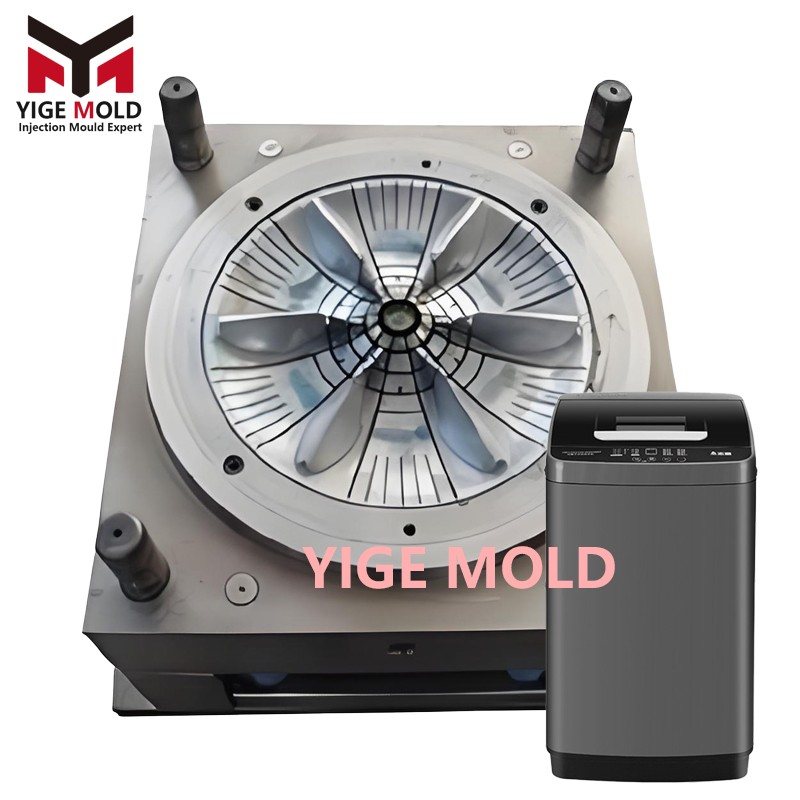
 Washing Machine Injection Mold: The Manufacturing Foundation of Core Components in White Goods
I. Product Definition and Industry Significance
The washing machine injection mold is specialized molding equipment used to produce plastic structural components for washing machines. As a critical link in the manufacturing supply chain of white goods, its quality directly determines the dimensional accuracy, appearance quality, and assembly performance of core components such as washing machine cabinets, inner tubs, and control panels. Characterized by large dimensions, complex structures, and long service life, the manufacturing level of these molds reflects the overall technical capability of the plastic mold industry. In mass production, the stability and reliability of injection molds directly impact production efficiency and product cost control.
II. Mold Structure Composition and Function
Washing machine injection molds typically employ a three-plate mold or hot runner mold structure, comprising the following main components:
Basic Mold Structure:
Standardized LKM or FUTABA series mold bases are used, with sizes ranging from 3030 to 5070 to meet the production needs of washing machine components of different specifications. High-precision ball-bearing guide systems are employed for guide pillars and bushings, with a fit clearance controlled between 0.01 and 0.015 millimeters to ensure guiding accuracy over long-term use. Ejection systems use a combination of ejector plates and ejector pins, with pin diameters varying from φ3 mm to φ8 mm, reasonably arranged according to product structural features.
Molding System Design:
Cavities and cores are typically made from pre-hardened mold steels like P20 or 718, achieving a hardness of HRC 30-35 to ensure sufficient strength and wear resistance. For transparent parts like viewing windows, cavity surfaces require a mirror polish grade of #A1, with a surface roughness Ra ≤ 0.012 micrometers. Parting line design must consider product appearance requirements, placing the parting line on non-appearance surfaces or concealed locations whenever possible.
Gating System Configuration:
The sprue uses a tapered design with a 2-4° angle; its length is determined by the injection molding machine specifications. Runners employ trapezoidal or circular cross-sections, balanced through calculation to ensure simultaneous cavity filling. Gate types (edge gates, pin-point gates, or submarine gates) are selected based on product structure, with gate dimensions optimized via mold flow analysis. For large washing machine cabinet molds, multi-point hot runner systems are typically used, with 8-16 hot nozzles, achieving balanced filling through sequential control.
Cooling System Layout:
Cooling channel diameters are typically φ8-φ12 mm, maintaining a distance of 15-20 mm from the cavity surface. Channels use a combination of series and parallel layouts to ensure uniform cooling. Cooling wells or baffled channels are added in thick-walled areas and hot spots to improve cooling efficiency. The temperature difference between inlet and outlet water is controlled within 3-5°C to ensure stable mold temperature conditions.
Ejection and Venting Systems:
Ejection mechanisms include various forms such as ejector pins, sleeve ejectors, and ejector plates, used in combination based on product ejection requirements. Ejection stroke is precisely controlled by limit blocks, and return is achieved via springs or early return mechanisms. Venting slots 0.02-0.03 mm deep are machined on the parting line, and venting inserts are placed at the end of material flow. Vacuum-assisted venting is used when necessary.
III. Material Selection and Application
Mold steel is selected based on the usage location and requirements:
Cavities and cores use pre-hardened plastic mold steels P20, 718, or NAK80, tempered to hardness HRC 30-40. Moving parts like sliders and lifters use quenched steels H13 or S136, with hardness HRC 48-52. Mold bases use 45# steel or S50C to ensure overall rigidity. Surface treatments like chrome plating, nitriding, or PVD coating are applied as needed to improve wear and corrosion resistance.
Plastic materials are selected based on component function:
Cabinet parts commonly use ABS or HIPS for good strength and surface quality. Inner tub parts use PP or reinforced PP for excellent heat and chemical resistance. Transparent parts use PMMA, PC, or SAN for high light transmittance and good impact resistance. All materials must pass UL94 flame retardancy tests to meet appliance safety standards.
IV. Manufacturing Process Requirements
Machining Processes:
Rough machining uses large gantry milling machines to remove most of the stock, leaving a 1.0-1.5 mm allowance per side. Semi-finishing uses high-speed machining centers, leaving a 0.2-0.3 mm allowance. Finish machining uses high-precision equipment to achieve dimensional accuracy of ±0.02 mm. Electrical Discharge Machining (EDM) is used for deep slots, narrow gaps, and other areas difficult to reach by mechanical machining, achieving a surface roughness of Ra 0.8-1.6 micrometers.
Heat Treatment Processes:
For parts requiring quenching, vacuum heat treatment is used, with distortion controlled within 0.05%. Stress relief tempering is required after heat treatment to eliminate machining stresses. Critical parts like cavities and cores require low-temperature aging treatment to stabilize dimensional accuracy.
Assembly and Debugging:
All components must be thoroughly cleaned before assembly to remove oil, grease, and debris. Precision measuring tools are used during assembly to ensure positional accuracy of all parts. During mold trial fitting, parting surface contact is checked; gaps should not exceed 0.03 mm. Moving parts like sliders and lifters must be adjusted for fit clearance to ensure smooth, non-binding movement.
V. Quality Control Standards
Dimensional Accuracy Control:
Critical dimensions are controlled within a tolerance of ±0.05 mm, general dimensions within ±0.1 mm. Parting surface contact should be 100%, with local gaps not exceeding 0.02 mm. Ejector pin hole positional tolerance is ±0.01 mm, with a fit clearance of 0.01-0.02 mm between pins and holes. Cooling channels are pressure tested at 1.0 MPa, holding for 30 minutes with no leaks.
Surface Quality Requirements:
Appearance surfaces are polished to the specified grade, free from scratches, pinholes, or other defects. Non-appearance surfaces receive corresponding texture treatment, with uniform and consistent patterns. All sharp corners are chamfered to avoid stress concentration. Marks and characters must be clear and legible, accurately positioned.
Functional Performance Verification:
The mold must be validated through continuous trial runs, with an initial batch of no less than 50 samples. Process parameters are recorded during trials to determine the optimal process window. Trial samples undergo full dimensional inspection, with a pass rate not lower than 98%. Moving parts of the mold undergo 5,000 cycle tests with no abnormal wear or binding.
VI. Production Application Requirements
Injection Molding Process Setup:
Appropriate barrel temperatures are set in 3-5 zones according to material properties. Injection pressure is adjusted based on product structure and wall thickness, generally controlled between 60-100 MPa. Packing pressure is 50-70% of injection pressure, with packing time calculated at 1-2 seconds per millimeter of wall thickness. Cooling time is determined by wall thickness, typically 1.5-2 times the wall thickness.
Mold Maintenance:
Mold condition is checked before each shift, cleaning the parting line and vents. Regular maintenance is performed every 5,000 cycles, including cleaning water lines, lubricating moving parts, and checking fasteners. A comprehensive overhaul is performed every 30,000 cycles, replacing wear parts and repairing worn areas. Anti-rust treatment is applied before long-term storage, including coating with rust preventive oil and sealing.
Troubleshooting:
Common issues like flash, sink marks, or short shots are resolved by adjusting process parameters or modifying the mold. Binding of moving parts requires checking fit clearance and lubrication. Poor cooling requires cleaning water lines or adjusting flow rate. Mold usage and maintenance records are regularly kept to establish a complete mold history file.
VII. Economic Benefit Analysis
Mold manufacturing costs mainly include material, machining, labor, and miscellaneous expenses. The total cost of a washing machine injection mold typically ranges from 300,000 to 800,000 RMB, depending on size and complexity. Mold service life generally reaches 800,000 to 1 million cycles, extendable to over 1.2 million cycles through regular maintenance and proper repair.
Regarding production efficiency, the cycle time for a washing machine cabinet is approximately 60-90 seconds, for a control panel 40-60 seconds, and for an inner tub 50-70 seconds. Material utilization can reach over 95% through optimized runner design and reduced sprue waste. Mold failure rate is controlled below 1% through preventive maintenance to reduce unplanned downtime.
VIII. Usage Precautions
Operators must receive professional training and be familiar with mold structure and operating procedures. Mold installation status is checked before production, confirming all components are intact. Mold operation is monitored during production to detect abnormalities promptly. Proper cleaning, maintenance, and protective measures are taken after production.
Specialized tools are used for mold transportation and hoisting to avoid impact and deformation. The storage environment should be kept dry and clean, with temperature controlled between 15-30°C and relative humidity not exceeding 60%. For long-term storage, anti-rust condition is checked periodically, and anti-rust treatment is reapplied if necessary.
IX. Current Industry Application Status
Currently, washing machine injection molds are primarily used by various washing machine manufacturers, covering different product types like front-load and top-load washers. Mold manufacturers are mainly concentrated in manufacturing hubs like the Yangtze River Delta and Pearl River Delta, forming a complete industry chain.
As product update cycles accelerate, requirements for mold manufacturing lead times are becoming shorter. Simultaneously, demands for mold precision and stability continue to increase, driving continuous advancement in mold manufacturing technology. Stricter environmental regulations are prompting mold design to develop towards energy saving and consumption reduction.
X. Development Outlook
Washing machine injection molds will continue to develop towards higher precision, higher efficiency, and longer life. The degree of mold standardization will further increase, shortening manufacturing lead times. The application of new materials and processes will enhance mold performance and service life. The mold manufacturing process will place greater emphasis on environmental protection and resource conservation, aligning with sustainable development requirements.
Mold manufacturers need to strengthen technical accumulation and experience summarization to improve design and manufacturing capabilities. Close attention must be paid to washing machine product development trends for timely adjustment of technical approaches. Collaboration with material suppliers and equipment manufacturers should be strengthened to achieve technological synergy. Emphasis on talent development and technical knowledge transfer is crucial to maintaining industry competitiveness.