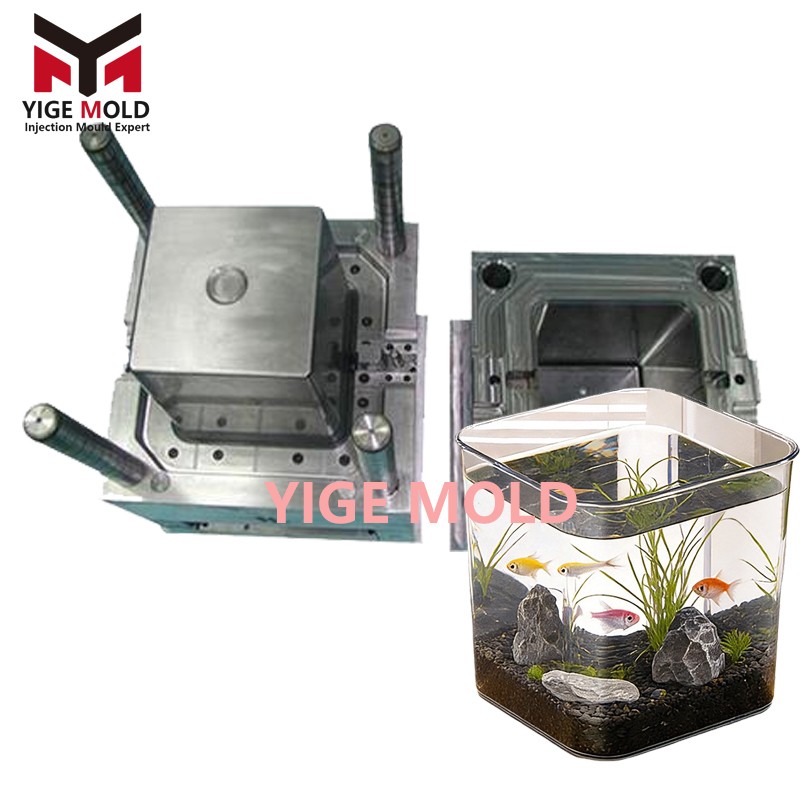
PET fish tank mold
Introduction to PET Fish Tank Molds: The Core of Lightweight, High-Clarity, and Eco-Friendly Aquatic Equipment
In the contemporary fields of aquascaping and home décor, fish tanks have evolved from simple breeding containers into carriers of living aesthetics that integrate ecology, art, and technology. While traditional glass or ordinary acrylic tanks dominate the mainstream, fish tanks manufactured from PET (Polyethylene Terephthalate) material via precision injection molding technology are carving out a new niche in specific market segments with their unique comprehensive advantages. The starting point and core of this innovation is the PET fish tank mold. It is not merely a production tool but a crystallization of materials science, precision engineering, and design aesthetics.
I. Material Innovation: Why Choose PET?
To understand the mold, one must first understand the material it serves. PET is most commonly seen in beverage bottles, but its engineering-grade application properties are significantly underrated. The materials used for fish tank manufacturing are typically modified APET (Amorphous PET) or PETG (PET Glycol) with high clarity and strength. Their properties dictate the primary direction of mold design:
-
Excellent Optical Properties: High-quality PET material can achieve light transmittance of over 90%, comparable to acrylic and far superior to ordinary glass, allowing for a distortion-free display of the underwater world's splendid colors. This is the cornerstone of its use as a viewing vessel.
-
Superior Toughness and Impact Resistance: Its impact strength is dozens of times greater than that of ordinary glass. It is significantly less prone to shattering at the same thickness, greatly enhancing safety during transportation, installation, and use—particularly suitable for environments with children or high foot traffic.
-
Lightweight: With a density about half that of glass, it makes the handling and installation of large-sized tanks more convenient and reduces the load-bearing burden on stands.
-
Good Formability and Dimensional Stability: PET has a relatively stable and predictable shrinkage rate, which is crucial for maintaining precision and preventing warpage when molding large planar surfaces.
-
Eco-Friendliness and Recyclability: PET itself is a highly recyclable material, aligning with green manufacturing trends. Adopting PET fish tanks is a practice of sustainable development理念.
II. The Essence of PET Fish Tank Mold Design and Manufacturing
A PET fish tank mold is by no means a simple scaled-up version of a standard plastic mold. It embodies an ultimate pursuit in the following aspects, tailored to the material properties of PET and the product requirements of a fish tank:
1. Ultra-Precision Design of Runner and Cooling Systems:
-
The Battle for Clarity: Any weld lines, flow marks, or cloud-like defects on the tank wall are fatal flaws. The mold employs a hot runner system (with multi-valve gate control) or an extremely optimized cold runner system to ensure the PET melt fills the cavity at a uniform temperature and speed, minimizing weld lines (typically directing them to non-viewing surfaces or reinforcement ribs).
-
Efficient and Uniform Cooling: Non-uniform cooling of large planar surfaces is the main cause of warpage and internal stress. The mold interior features conformal multi-layered circulatory cooling channels, resembling capillaries, to precisely control the temperature of each zone. This ensures rapid and even cooling, thereby stabilizing dimensions, eliminating stress marks, and shortening the molding cycle.
2. Cavity Surface Treatment and Polishing Processes:
-
The Pursuit of a Mirror Finish: The smoothness of the tank's inner wall directly determines its final clarity, resistance to algae attachment, and ease of cleaning. The cavity undergoes dozens of steps, from fine diamond paste grinding to mirror polishing, to achieve an SPI-A1 grade (mirror finish) surface smoothness. This not only replicates a crystal-clear surface but also reduces demolding resistance.
-
Application of Special Coatings: Some high-end molds may employ nickel-phosphorus alloy plating or PVD (Physical Vapor Deposition) coatings to further enhance surface hardness, wear resistance, and corrosion resistance, extending mold life and ensuring stability in surface quality over long production runs.
3. Structural Design and Ejection System:
-
Consideration of Supreme Rigidity: To withstand enormous injection pressure (up to hundreds of tons) and prevent micro-deformation of the cavity under high pressure (even 0.1mm deformation can cause optical distortion), the mold base requires exceptional rigidity. Pre-hardened alloy steels (e.g., P20, 718) or integral mold structures are commonly used, with dense internal support pillars and interlocks in key areas.
-
Smooth Ejection Design: Due to the relatively hard PET material and large product surface area, the ejection system requires careful calculation. Typically, large-diameter ejector pins, pneumatic ejection, or hydraulic cylinder-assisted ejection are used to ensure the tank body separates from the cavity smoothly and without deformation, avoiding "vacuum suction" or scratches.
4. Venting and Tolerance Control:
-
Nowhere for Air to Hide: Trapped air can cause burn marks, short shots, and other defects. Perimeter venting channels are designed at the parting line and insert seams, with depths precisely controlled between 0.01-0.03mm, allowing gas escape while preventing melt leakage.
-
Micron-Level Precision: To ensure the tank's squareness and the tightness of seams (especially for integrated overflow/filter compartments), the mold's machining precision must reach the ±0.01mm level. Furthermore, the shrinkage rate of the PET material must be accurately considered for precise cavity dimension compensation.
III. Application Advantages and Market Positioning
PET fish tanks produced by such high-end molds demonstrate distinct market value:
-
Customization and Integration of Complex Structures: Molds can integrally form features difficult to achieve with ordinary glass in a single shot, such as one-piece built-in overflow/filter compartments, plumbing channels, decorative textures, and reinforcement grids. This achieves structural and functional integration, resulting in a cleaner appearance and eliminating leak risks.
-
Safety and Adaptability for Mobile Scenarios: Its impact resistance and lightweight properties give it unique advantages in children's rooms, schools, offices, exhibitions, commercial centers, and pet/aquarium retail stores requiring frequent relocation.
-
Vehicle for Mid-to-High-End Innovative Products: Suitable for producing paludariums, vivariums, nano aquariums, and desktop display tanks with modern streamlined designs, meeting the comprehensive needs of younger consumers for safety, aesthetics, and convenience.
IV. Challenges and Future Prospects
PET fish tank molds also face challenges: the initial investment is much higher than standard glass tank production lines; they place extremely high demands on injection molding machine tonnage and process control (drying, temperature, pressure); and while superior to ordinary acrylic in resisting slight yellowing from prolonged UV exposure, continuous improvement in material formulation is still needed.
Looking ahead, with advancements in material modification technologies (e.g., UV-resistant, anti-scratch coatings blended with the substrate) and mold technologies (e.g., variotherm temperature control, smarter embedded sensors), the durability and optical performance of PET fish tanks will reach new levels. Their potential for integrated molding with reserved interfaces for smart control systems (LED lighting, automatic feeding/filtration) will drive aquatic equipment towards safer, more intelligent, and more personalized development.
Conclusion
The PET fish tank mold is a precision bridge connecting advanced engineering plastics with the art of the aquatic hobby. It represents the application of precision manufacturing thinking to reshape a seemingly ordinary material into a safe, lightweight, bright, and design-flexible solution for aquatic life. It does not merely create a container but shapes a new, contemporary way of experiencing and interacting with a living ecosystem.