Vegetable Storage Crate Mold
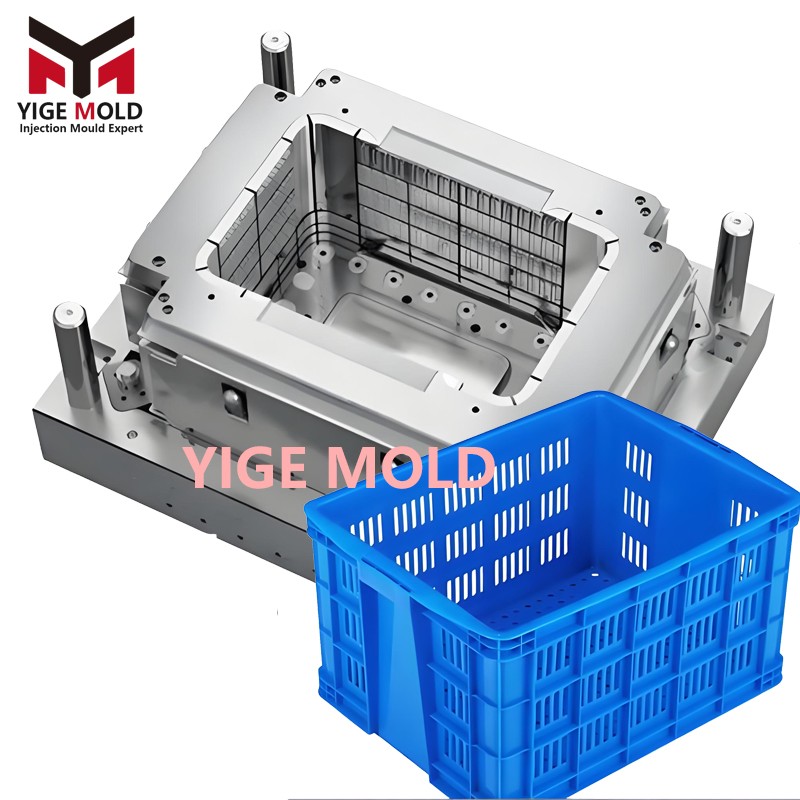
Comprehensive Technical Analysis of Vegetable Storage and Transport Crate Molds
The vegetable storage and transport crate mold is specialized injection molding equipment designed for producing containers used in the cold-chain transportation and short-term storage of agricultural products. Its core technology lies in the systematic integration of structural design, material engineering, and process control to achieve the container's fundamental functions of physical protection, microenvironment regulation, and hygiene safety during logistics. The standardized carriers produced by this mold serve as critical infrastructure in modern agricultural supply chains, spanning from harvesting and sorting to transportation and end-point sales.
I. Product Function and Mold Design Positioning
Vegetable storage and transport crates must meet the practical demands of each stage in the circulation of fresh produce, which imposes clear technical direction on mold design:
-
Logistics-Adaptive Structure:
-
The mold must create a standardized outer profile conforming to common pallet dimensions (e.g., 1200×1000mm). The sidewalls incorporate forklift operation guide channels, and the base features support flanges compatible with standard shelving. The crate height is typically set between 300-400mm to maximize vehicle loading volume utilization.
-
-
Basic Environmental Control Design:
-
The crate sidewalls require a layered ventilation structure: upper sections with circular holes (15-20mm diameter), middle sections with slatted vents, and lower sections with splash guards. The layout of airflow channels, validated through calculation, facilitates natural convection within the crate, controlling the temperature differential to within ±2°C.
-
-
Hygiene Maintenance Characteristics:
-
All interior surfaces must achieve seamless rounded transitions (minimum radius R8), with a surface roughness of Ra ≤ 1.6μm. The drainage system employs a combination of V-shaped drainage channels and centralized drain holes, ensuring complete evacuation of cleaning fluids with no standing water traps.
-
II. Core Mold Structure and Engineering Solutions
To meet batch production requirements, the mold employs robust, engineering-proven design solutions:
-
Large Deep-Cavity Molding System:
-
For cavity structures deeper than 300mm, a segmented ejection mechanism is used. The main ejection plate handles overall pre-ejection, while auxiliary ejector pins manage the demolding of local deep ribs. The molding of sidewall ventilation holes utilizes an internally retracting slide structure to avoid excessive mold size from external core pulling.
-
-
Multi-Zone Temperature Control Solution:
-
An independent temperature control circuit system is established. Series water channels are used in thick sidewall areas, while parallel channels serve thin-wall sections. Spot cooling systems are installed at rib intersections, employing beryllium copper inserts for localized rapid cooling, keeping the overall cooling time within a reasonable range.
-
-
Long-Term Production Assurance Design:
-
The cavity surface receives a dual-layer composite treatment: the substrate is pre-hardened mold steel (hardness HRC 38-42), coated with a hard chrome plating (thickness 0.01-0.02mm). Moving components are made from oil-impregnated bearing steel, with friction surfaces treated with solid lubrication.
-
III. Manufacturing Process and Quality Control
Mold manufacturing adheres to industrial production standards to ensure long-term stable operation:
-
Precision Control System:
-
A digital machining process chain is employed. Large mold plates undergo rough machining via CNC gantry milling, followed by stress-relieving aging treatment, and then finish machining. Key mating surfaces are finished by jig grinding, controlling flatness to within 0.02mm/100mm.
-
-
Manufacturability Verification:
-
Mold flow analysis and structural simulation are conducted during the design phase to predict filling status, cooling efficiency, and potential warpage. Ergonomic verification via rapid prototyping optimizes usage parameters like handle position and opening force.
-
-
Systematic Testing Standards:
-
A comprehensive validation system is established, including load testing (dynamic load 1000kg), stacking testing (5 layers fully loaded), drop testing (1m height), weather resistance testing (cycling -20°C to +60°C), and cleaning testing (high-pressure water jet impact).
-
IV. Application Value and Industry Significance
This mold technology makes substantive contributions to the development of modern agricultural logistics systems:
-
Improving Circulation Efficiency:
-
Standardized containers increase loading/unloading efficiency by 3-5 times and improve vehicle load factor by over 25%. The stackable design reduces storage space occupation by 50%, enabling seamless transition from field to market.
-
-
Reducing Comprehensive Costs:
-
The durable design allows for over 200 reuse cycles per container, reducing the per-use cost by 80% compared to disposable packaging. The modular design supports quick repair and replacement, extending the overall service life.
-
-
Ensuring Product Quality:
-
Reasonable structural design reduces transportation loss rates from 15-20% with traditional packaging to below 5%.
-
Current technological development focuses on enhancing production stability, optimizing material utilization, and improving functional adaptability. As fundamental equipment connecting agricultural production and urban consumption, the advancement of vegetable storage and transport crate mold technology directly drives the standardization and increased efficiency of agricultural product circulation systems. It plays an irreplaceable role in ensuring food supply security and reducing post-harvest losses.