Condiment container mold
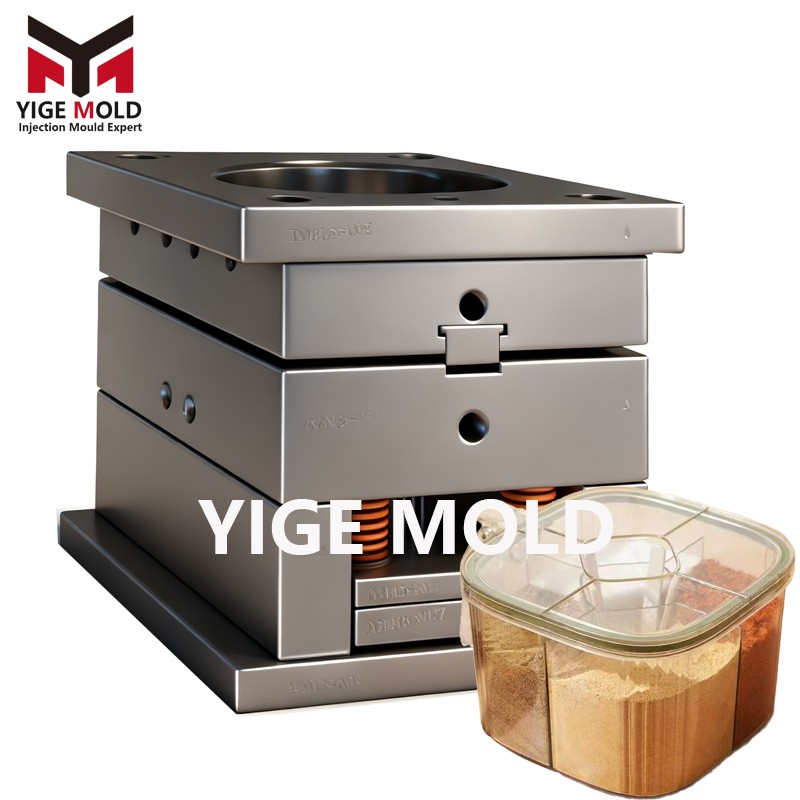
 Precision Condiment Container Mold: Engineering Integration of Function, Design, and Manufacturing
Condiment containers are indispensable storage items in the modern kitchen. Their core function is to effectively preserve condiments, preventing moisture absorption, clumping, and flavor transfer. The key to realizing this function lies at their manufacturing source—the condiment container mold. The manufacturing of such molds represents a concentrated embodiment of precision engineering in everyday household items, with its technical focus entirely centered on product functionality, reliability, and mass-production stability.
I. Product-Function-Oriented Design Requirements
The design of a condiment container mold is wholly dedicated to serving the end-use functionality of the product, which dictates its unique technical path.
-
Molding of Core Sealing Structures: The sealing performance of a condiment container relies on the precise mating structure between the lid and the body. The mold must be capable of molding continuous lip seals, multiple sealing ribs, or precise snap-fit interlocking systems with high accuracy. These structures are typically located on the parting line or sliders, requiring dimensional tolerances within ±0.02 millimeters. Their surfaces must achieve a high-polish finish to ensure the flatness and smoothness of the sealing surfaces after molding, thereby achieving airtightness.
-
Multi-Component Coordination and Assembly Assurance: A complete condiment set usually consists of several independent components such as the lid, body, and measuring spoon. Mold design must ensure dimensional compatibility and assembly interchangeability among all parts. For instance, the thread engagement between the lid and body must be smooth, with starting points strictly aligned; the engaging force of snap-fits must be achieved through precise undercut angles and elastic deformation design, requiring extremely accurate calculation of plastic shrinkage.
-
Precise Realization of Practical Details: To enhance usability, condiment containers often feature anti-slip side textures, easy-open recesses, clear capacity markings, and transparent bodies. These details are achieved through precision texturing (etching), engraving, or high-gloss surfaces on the mold. Markings and logos typically employ raised engraving on the mold to create clear, recessed characters on the product, preventing wear-related fading.
-
Material Adaptation and Production Stability: Condiment containers commonly use food-grade plastics like PP, PS, or AS. Different materials have varying shrinkage rates and flow characteristics. The mold's gating system (e.g., employing a valve-gated hot runner system) and cooling system must be optimized for the specific material to ensure uniform filling and consistent cooling. This minimizes product warpage and deformation, guaranteeing long-term dimensional stability across high-volume production runs.
II. Manufacturing Process System for Mass Production
To meet the demands of large-scale, low-cost, and high-quality production, the manufacturing process system for condiment container molds prioritizes precision and durability.
1. Design Validation Based on In-Depth Analysis
During the design phase, Mold Flow Analysis (CAE) is an indispensable tool. By simulating the filling, packing, and cooling processes of the plastic melt within the cavity, engineers can pre-optimize gate location and size, predict and resolve potential issues like flow imbalance, weld lines, air traps, and uneven shrinkage. This prevents structural defects during the trial stage, ensuring a high first-time success rate for mold trials.
2. High-Precision Machining of Mold Components
The machining of the mold's core—the cavity and core—directly determines product accuracy. Precision CNC machining centers are typically used for 3D contour milling, with critical mating surface accuracy required to reach ±0.005 millimeters. Fine, deep features like sealing ribs and undercuts rely on precision Wire Electrical Discharge Machining (WEDM) and fine-finish Electrical Discharge Machining (EDM), the latter capable of producing sharp corners and complex 3D textures.
3. Specialized Surface Treatment Technologies
Based on product requirements, the mold surface undergoes differentiated treatment: the exterior of the body often receives a fine EDM texture or etched pattern to enhance feel and hide scratches; all sealing contact surfaces require mirror polishing, typically to a #A1 grade (Ra ≤ 0.012μm); text and graphics on the product are created by laser engraving or chemical etching to form recesses in the mold.
4. Efficient Temperature Control System
Condiment containers often have thin walls (1.0-1.5 mm) and require fast cycle times, making efficient cooling critical. The mold incorporates dense and balanced cooling channels to ensure uniform temperature across the cavity. For areas difficult to cool, such as cores or deep ribs, high-thermal-conductivity beryllium copper alloy inserts or spiral cooling channels are frequently used to accelerate heat dissipation, shorten cycle times, and stabilize product dimensions.
5. High-Reliability Mold Structure
Given the substantial market demand, condiment container molds require exceptionally high life expectancy (often exceeding one million cycles). Therefore, molds use standardized mold bases. Moving components like sliders and lifters are made from high-wear-resistant tool steels and undergo quenching and surface hardening treatments. The ejection system, considering the thin-walled nature of the product, employs multiple sets of small-diameter ejector pins in a balanced layout, often equipped with early return mechanisms to prevent interference during mold closing and protect the mold.
III. Quality Control and Production Validation
The mold trial and acceptance process following mold completion are crucial steps for ensuring successful mass production.
-
Systematic Mold Trial Process: On a designated injection molding machine, a systematic adjustment of process parameters—temperature, pressure, speed, time—is conducted to find the optimal processing window. The focus is on verifying complete part filling, dimensional accuracy, smooth assembly, and sealing effectiveness.
-
Comprehensive Inspection Standards: Trial samples undergo full-dimensional Coordinate Measuring Machine (CMM) inspection to verify conformity with design drawings. Rigorous sealing tests (e.g., vacuum decay tests) and lifecycle tests (e.g., repeated open-close tests) are performed to ensure functional requirements are met. Appearance is inspected for defects like sink marks, flash, or bubbles.
-
Mass Production Stability Assessment: Continuous production runs (e.g., 500 to 1000 cycles) are conducted for stability testing. Fluctuations in product dimensions, weight, and appearance are monitored, and Process Capability Indices (CPK) are calculated to ensure the mold is capable of stable, reliable high-volume production.
Conclusion
The manufacturing of a condiment container mold is a systematic engineering process that precisely translates product functional requirements into a repeatable, highly efficient, and cost-effective manufacturing process. It does not pursue conceptual novelty but focuses on pushing precision, reliability, and durability to their limits within a mature technological framework. A successful condiment container mold signifies the ability to consistently output products with uniform functionality and stable quality—cycle after cycle, for years—with production cycles measured in seconds.
This demands that mold manufacturers possess a profound understanding of plastic material behavior, mastery of precision manufacturing processes, and practical insight into end-use scenarios. It is this grounded and focused approach, rooted in engineering fundamentals, that supports every seemingly simple yet crucial detail in our daily lives.