Bubble Tea Cup Mold
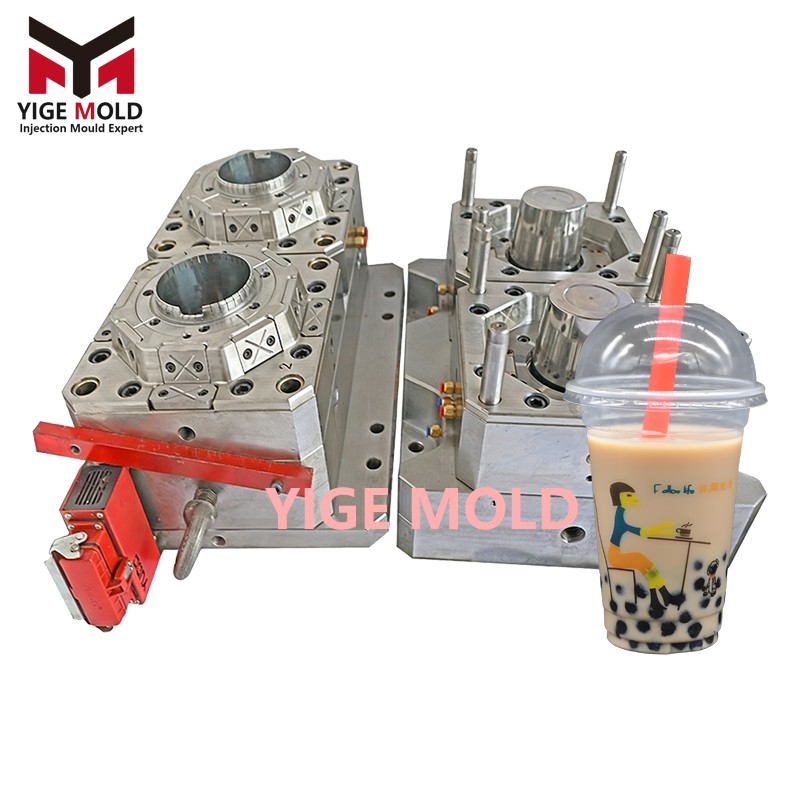
Bubble Tea Cup Mold: The Unseen Artisan Behind Modern Tea Trends
Introduction: The Formative Origin of a Cultural Phenomenon
While the aroma of bubble tea wafts through streets and trendy cups fill social media feeds, few ponder the origin of these diverse cup forms, the perfectly contoured grips, and the flawlessly fitting lids. The bubble tea cup mold—this unseen "artisan"—is the key that transforms liquid plastic into tangible vessels carrying the culture of modern tea beverages. It not only determines the cup's appearance but profoundly influences production efficiency, cost control, and brand identity.
I. Form Aesthetics: From Functional Need to Design Language
1. The Composite Challenge of Structural Design
Modern bubble tea cups have transcended the concept of mere containers, becoming composites of function and aesthetics. This presents multi-dimensional technical demands on mold design.
Grip Ergonomics: The curvature and diameter of the cup wall must be calculated based on ergonomics to ensure comfortable and secure one-handed holding. Well-designed cup walls typically feature a three-stage curve designed in the mold: a tapered top for lip contact, a slightly convex middle section providing a gripping point, and a moderately flared base for stability. The mold must precisely replicate these millimeter-level curvatures.
Sealing Structure System: To accommodate specialty products like cheese foam or layered teas, molds must form complex rim structures. Common designs include triple anti-leak step grooves, inset snap rings, and internal flow guides. The precision of these structures must be controlled within a 0.02-0.05 mm range to ensure universal compatibility with various lids (flat, domed, vented).
The Canvas for Visual Presentation: Embossed logos on cup walls typically have a depth of 0.15-0.3 mm—too shallow risks wear, too deep compromises structural strength. The matte finish for gradient-colored cups is achieved through fine texturing (texturing/graining) of the mold surface. Using abrasive sands of varying grit sizes creates micron-level凹凸 on the steel, producing a unique light-diffusing effect on the finished cup.
2. Precise Calibration for Material Compatibility
Different cup materials require vastly different mold solutions:
Transparent PET Cups: Pursuing crystal-like clarity requires a mirror-polished cavity surface (#A1 grade or higher). Cooling system design is critical, enabling rapid, uniform cooling to avoid hazy streaks caused by uneven crystallinity. Gates are typically hot-runner valve gates to eliminate sprue marks.
Matte PP Cups: The surface texture originates from texturing the mold surface. Chemical etching or laser engraving creates a pattern of 2-5 micron凹凸. The depth, density, and pattern angle of this texture all affect the final tactile feel and are custom-designed based on brand positioning.
Biodegradable PLA Cups: With roughly 20% higher shrinkage than traditional plastics, mold dimensions must be scaled up accordingly. PLA's lower melt strength requires 1-2 degrees greater draft angles. Ejection systems need large-area stripper plates instead of pinpoint ejector pins to prevent piercing the thin wall.
II. Manufacturing Precision: The Contest of Craftsmanship in a Micron World
1. Lifecycle Management of Mold Steel
Mold longevity directly impacts per-unit cost, making steel selection the primary consideration:
Main Mold Frame: Uses pre-hardened mold steel (e.g., P20, 718H) with an as-supplied hardness of HRC 30-35, balancing good machinability and wear resistance. Large cup molds (e.g., for 1-liter sizes) require harder steels like 1.2738 to prevent micro-deformation of the cavity under sustained injection pressure.
Core Forming Components: Cavities and cores use corrosion-resistant, mirror-polish steels (e.g., S136, STAVAX). After vacuum heat treatment, hardness reaches HRC 48-52. Deep-layer ion nitriding creates a 0.1-0.15 mm hardened surface with a Vickers hardness of HV 900-1000, resisting erosion from the plastic melt.
Moving Systems: Sliders, lifters, and other moving components use tough hot-work steel grades like FDAC, with a core hardness of HRC 40-45 for strength and toughness. PVD coatings (e.g., TiN, CrN) enhance surface wear resistance, reducing the friction coefficient to 0.15-0.2.
2. The Art of Accumulating Precision
The precision standards for bubble tea cup molds far exceed those for ordinary containers:
Establishing the Datum System: A 3D coordinate system is established with the mold center as the origin. All machining data references this. The concentricity of the locating ring and sprue bushing must be ≤0.01 mm, ensuring perfect alignment between the injection machine nozzle and the mold gate.
Parting Line Treatment: The moving and fixed mold parting surfaces undergo surface grinding to a roughness of Ra ≤ 0.8μm. After assembly, bluing is used to check contact area, requiring ≥90%. Critical sealing areas undergo hand spotting (fitting) using Prussian blue to identify high spots for manual correction until contact is even.
Cooling Channel Optimization: 3D conformal cooling technology is employed, with channels maintaining a constant distance (typically 8-12 mm) from the cavity surface. Flow rates are optimized via CFD simulation, ensuring cavity surface temperature variation is ≤3°C. Quick-connect couplings and parallel circuit design ensure balanced pressure drop across all circuits.
III. Production Suitability: The Dynamic Balance of Efficiency and Quality
1. Lean Control of the Molding Cycle
Mold design directly determines production efficiency:
Gating System Innovation: Hot runner systems are standard. The number and location of gates are determined via mold flow analysis. For handled cups, three-point gating is typical for balanced fill. Valve gates allow precise control of opening time, preventing drool.
Innovative Ejection Systems: Besides standard ejector pins, large-area stripper plates (covering ≥60% of the cup base) gently eject thin-walled cups. For textured cup bodies, elastic buffer pads are placed between the ejector plate and cup base to prevent "ejector pin blushes."
Venting System Design: Vent slots 0.01-0.02 mm deep are machined into the parting line, covering 20-25% of the projected area. Porous venting inserts (15-20% porosity) are used in deep core areas to ensure gas escape.
2. Mechanisms Ensuring Quality Stability
Consistency in mass production is the ultimate value of a mold:
Balanced Temperature Field: Multi-point temperature sensing and zone control are used. Cavities and cores have 3-5 temperature sensors each, with PID control maintaining temperature within ±1°C. Hot runner nozzles are independently controlled to prevent material degradation.
Stress Control Technology: Holding pressure profiles are optimized to reduce molded-in stress. A three-stage hold is common: high-speed packing (95-98% fill) → medium-speed compacting (eliminate sink marks) → low-speed holding (compensate for shrinkage). Pressure and time are determined via DOE.
Design for Automation: The mold includes standardized interfaces (e.g., Euro-standard) and provisions for robot grippers. A locating ring on the cup rim facilitates vision system positioning. Ejection stroke is precisely timed with the robot's cycle.
IV. Innovation Trends: Responding to Rapid Market Evolution
1. Mold Solutions for Customization
Differentiation in the competitive tea market drives mold innovation:
Modular Design: The base mold frame is standardized, while cavities and inserts are quickly changeable. One mold base can adapt to 320ml, 500ml, and 750ml capacities by changing core inserts, with changeover time ≤2 hours.
Custom Surface Finishes: A single mold can yield diverse effects through different surface treatments: mirror polish for gloss, fine grain for matte finish, laser etching for specific patterns (e.g., subtle brand logo texture).
Integrated Functionality: Molds are increasingly integrating functional structures. Double-wall insulated cups require special sliders to form the air gap. Fold lines for collapsible cups require precise shut-off surfaces in the mold.
2. Adaptive Evolution for Sustainability
Sustainability demands drive mold technology upgrades:
Lightweight Thin-Wall Molding: Using high-rigidity steel and optimized support structures, wall thickness is reduced from 0.5mm to 0.35mm. Molds must withstand higher injection pressure (increasing from ~120 MPa to ~180 MPa), requiring a 25% boost in cooling efficiency.
Multi-Material Compatible Design: One mold must handle different materials like standard PP, rPET, and biodegradable PLA. This is achieved by changing hot runner components, adjusting cooling parameters, and modifying draft angles. Mold steel must resist corrosion from various material additives.
Design for Recyclability: Cup structures are simplified, avoiding metal inserts or complex undercuts that hinder separation. Embossed resin identification symbols on the cup base facilitate automated sorting.
Conclusion: The Invisible Shaper
When consumers admire the play of light on a gradient-colored cup, feel the perfectly contoured grip, or experience the tight seal between lid and rim, they are touching more than a plastic product. They are touching the countless calculations of mold engineers on blueprints, the precise carving of tool steel by machines, and the relentless debugging by technicians beside the molding machine.
The bubble tea cup mold, this invisible shaper, uses its steel body to realize the imagined forms of liquid plastic. It defines the tactile standards of modern tea beverages with micron-level precision and supports the product supply for a multi-billion-dollar market with hundreds of thousands of stable cycles. In the wave of global tea culture, mold technology provides the most reliable physical vessel for every creative beverage in a silent yet steadfast manner, solidifying brand concepts, user experience, and environmental responsibility into a tangible form.
This is perhaps the profound romance of industrial manufacturing: using the most rational engineering to achieve the most sensory consumer experiences; using the coldest steel to shape the warmest touch. The next time you pick up a cup of bubble tea, the perfect temperature and texture in your palm is a wordless poem composed collectively by hundreds of engineers, dozens of processes, and countless precise calculations.