Industrial Trash Can Mold
Industrial Trash Can Mold
Product Definition:
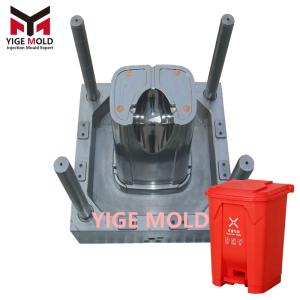
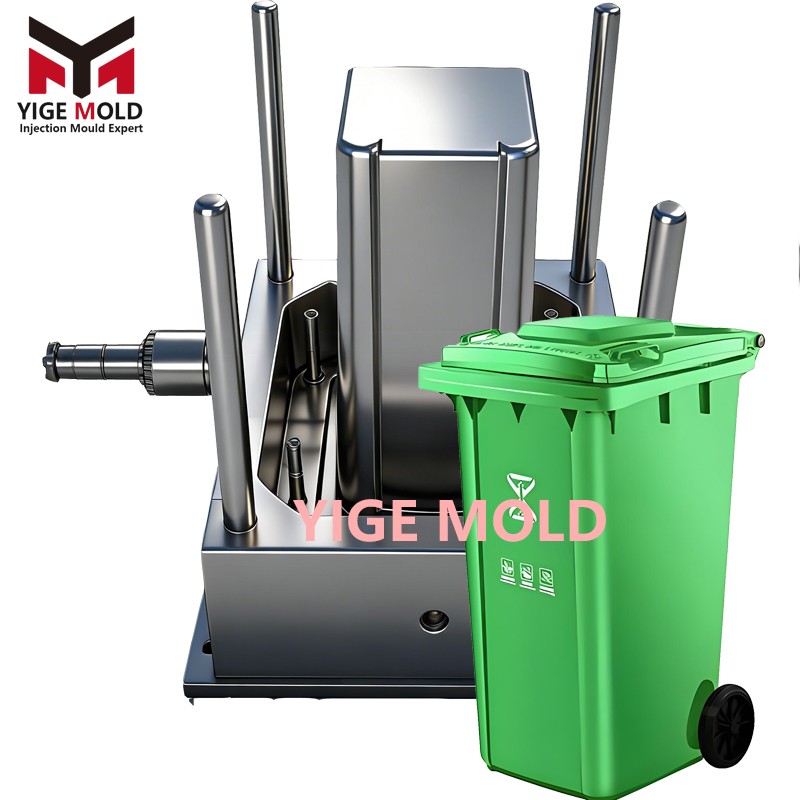
The industrial trash can mold is a specialized injection or blow molding tool used for manufacturing trash cans with capacities typically ranging from 60 liters to 1100 liters. These products are designed for industrial and commercial environments such as factories, warehouses, construction sites, and public areas. Core requirements for the final product include ultra-high strength, exceptional durability, chemical resistance, UV stability, and the ability to withstand harsh operating conditions. Common materials are High-Density Polyethylene or Linear Low-Density Polyethylene.
Mold Technology System:
-
Core Structural Design
-
Oversized Mold Construction: The mold is massive in size, often requiring matching with large injection molding machines in the range of 500 to 4000 tons. Its structure must be extremely robust to withstand enormous clamping forces.
-
Multiple Complex Core-Pulling Mechanisms: To form the intricate features characteristic of industrial containers (such as heavy-duty forklift pockets, multi-directional drain holes, reinforced hinges, extensive rib networks, and integrated wheel axle bases), the mold must incorporate multiple large hydraulic or mechanical sliders along with complex angled lifter systems. These mechanisms require extremely high rigidity and synchronization accuracy.
-
Reinforced Structural Design: The mold itself requires dense networks of support pillars and reinforcing grids on the back of the cavity and core to prevent deformation under high injection pressure.
-
-
Gating System
-
Multi-Point Sequential Hot Runner System: This is the standard configuration. It employs 8 or more large valve-gated hot nozzles, evenly distributed across non-critical areas like the container bottom or side walls. Sequential valve control is essential to optimize weld line location, eliminate long flow marks, and ensure complete filling of the enormous cavity.
-
Runner Balancing: CAE Mold Flow Analysis is used to precisely calculate and design runner dimensions, ensuring balanced flow from all gates. This prevents warpage and prominent weld lines caused by uneven filling.
-
-
Cooling System
-
Multi-Circuit, Zoned Independent Control: The mold is divided into dozens of independent cooling circuits for differentiated temperature control in areas of varying thickness, such as the body, base, ribs, and forklift pockets.
-
High-Efficiency Cooling Technology: In extremely thick sections (e.g., the base of forklift pockets, the center of the container bottom), technologies like conformal cooling channels, beryllium copper inserts, or heat pipes are utilized to drastically reduce cooling time and prevent sink marks.
-
High-Flow Design: Cooling channels have large diameters and high flow rates to ensure sufficient heat exchange efficiency and control the molding cycle.
-
-
Venting and Ejection Systems
-
Multi-Stage Depth Venting: Stepped venting channels (with depths varying from 0.03mm to 0.08mm) are machined on parting lines, slider mating surfaces, and insert seams. Venting pins or sintered metal porous vents are placed in last-fill areas to prevent gas traps and burning.
-
High-Force Ejection System: Due to the product's large projected area and significant holding force, the ejection system requires dozens of large nitrogen springs or hydraulic cylinders to provide adequate ejection force. Ejector pin layout is critical, typically distributed uniformly under the base, at rib ends, and beneath the top rim. The system incorporates early ejector return mechanisms and ejection monitoring systems to prevent mold damage.
-
Manufacturing and Process Key Points:
-
Material Selection: Cavity, core, and large moving components must be made from high-grade tool steels, such as 1.2738, 1.2311 (pre-hardened) or through-hardening steels like 1.2344 (H13), followed by quenching, tempering, and surface treatments to withstand high injection pressure and long-term wear.
-
Precision Machining and Assembly: Mold manufacturing relies on large 5-axis CNC machining, deep-hole drilling, and oversized precision EDM. During assembly, equipment like laser trackers is used to ensure the movement synchronization and positioning accuracy of dozens of sliders and lifters.
-
Molding Process: Multi-stage injection speed and pressure control is employed to fill the massive cavity smoothly. High and prolonged holding pressure is applied to compensate for material shrinkage, ensuring dimensional stability and product strength. Mold temperature control is strict, with the front (cavity) mold half typically cooler than the rear (core) half to facilitate demolding.
Product Types and Mold Variants:
-
Wheeled Trash Cans: The mold must integrate structures to form wheel axles, demanding extremely high precision in sliders and ejection balance.
-
Closed/Leak-Proof Containers: Molds for producing containers with sealing lids have stringent requirements for the molding precision of the container rim flatness and lid fit.
-
Chemical Storage Drums: These have special requirements for mold polish grade and corrosion resistance. Cavities often require electropolishing or special coatings.
-
Large Rotomolded Containers: For extremely large (e.g., 1100L) or shapes that are particularly complex with very uniform wall thickness requirements, blow molding or rotational molding may be used. The mold structure and process for these differ significantly from injection molding.
Market and Trends:
Industrial trash can molds belong to a high value-added, high technical barrier category. Market demand is closely linked to industrial development and environmental policies. Current trends include:
-
Combining Lightweighting with High Strength: Optimizing rib design and materials to reduce weight while increasing strength, placing higher demands on mold cooling and venting.
-
Integration of Smart Functions: Molds need to adapt to producing products with new features like RFID tag slots and sensor areas for automatic lid opening.
-
Quick Color Change: To handle multi-color orders, the mold's hot runner system needs to be easy to clean, reducing color change time and material waste.