Commercial Size Garbage Bin Mold
Commercial Size Garbage Bin Mold
Product Definition:
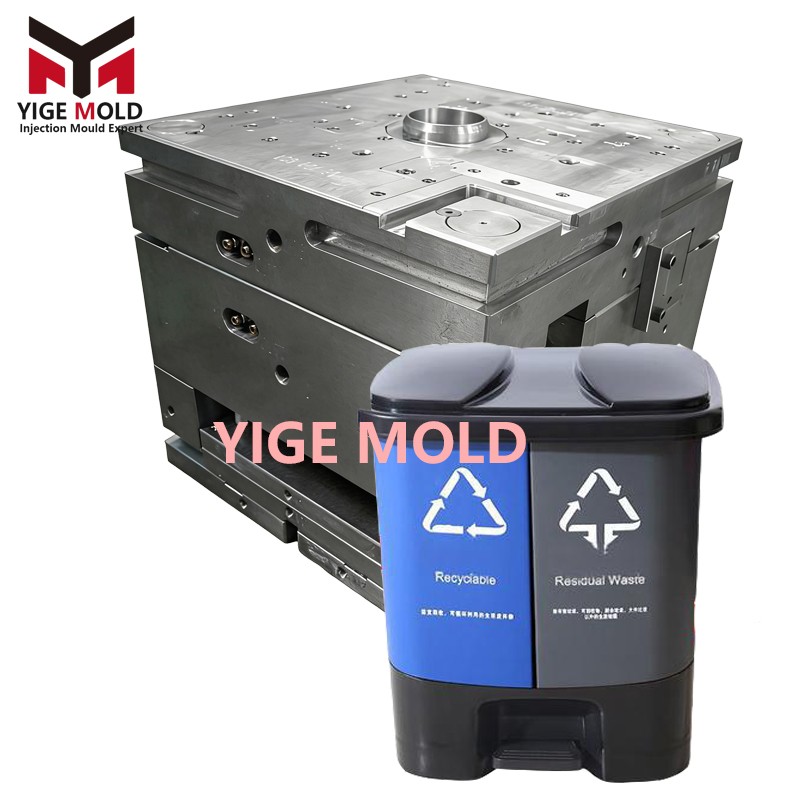
A commercial size garbage bin mold is an injection molding tool specifically designed for manufacturing garbage bins with capacities ranging from 30 to 660 liters. These products are intended for commercial and institutional settings such as office buildings, shopping malls, restaurants, hotels, schools, and hospitals. The final product must achieve a precise balance between functionality, durability, hygiene standards, spatial aesthetics, and bulk procurement cost. Commonly used materials include High-Impact Polystyrene, UV-Stabilized Polypropylene, and Flame-Retardant ABS.
Mold Technology System Architecture:
-
Modular Structural Design
-
Interchangeable Insert System: The mold utilizes a standardized main frame. By swapping out capacity-adjusting inserts (e.g., height extension rings, base modules), the same mold can produce a series of products (e.g., 50L/80L/120L), reducing tooling investment costs.
-
Multi-Function Integrated Slider Sets: Integrated slider modules can simultaneously form complex functional features like foot pedal linkage mechanisms, inner liner snap-fit slots, and mounting points for automatic door closers/dampers, ensuring a fit precision of ≤0.1mm for moving parts.
-
Quick Color Change Runner: The hot runner system features a fully enclosed, self-cleaning design with dead zones <3 cm³, enabling a complete color change from dark to light shades within 20 minutes.
-
-
Precision Temperature Control System
Temperature Zoning Strategy: ├── Aesthetic Surface Zone (Zone A) │ ├── Cooling Method: 4-layer conformal cooling channels │ ├── Temperature Medium: Water-glycol solution (-5℃~95℃) │ └── Surface Temperature Variation: ≤ ±1.5℃ ├── Structural Reinforcement Zone (Zone B) │ ├── Cooling Method: Baffle-cooled water wells + Beryllium copper inserts │ ├── Heat Transfer Coefficient: ≥ 2800 W/(m²·K) │ └── Cooling Efficiency Improvement: 40% vs. traditional channels └── Thin-Wall Decorative Zone (Zone C) ├── Cooling Method: Micro-channel array (Φ3mm) ├── Flow Control: Proportional valve for precise regulation └── Anti-Condensation Design: Chrome plating + electric heating film -
High-Reliability Ejection System
-
Hydraulic-Mechanical Hybrid Ejection: A central Φ40mm hydraulic cylinder (25kN force) is combined with 12 peripheral nitrogen springs (8kN each), achieving an ejection synchronization error of ≤0.08mm.
-
Intelligent Stress Monitoring: Fiber-optic strain sensors embedded within ejector pins monitor torque distribution in real-time, allowing automatic adjustment of ejection speed at each point to prevent product deformation.
-
Fault Self-Diagnosis: Equipped with a vibration analysis module capable of providing early warnings for potential failures like ejector pin bending or nitrogen leaks, with a warning accuracy rate of ≥92%.
-
Manufacturing Precision Control Standards:
|
Precision Category |
Control Indicator |
Inspection Method |
Acceptance Standard |
|---|---|---|---|
|
Surface Profile |
Free-form surface deviation |
Blue-light scanning (21 million point cloud) |
≤0.15mm/800mm |
|
Parting Line Seal |
Contact pressure distribution |
Fuji Prescale film (0.1MPa resolution) |
Pressure uniformity ≥85% |
|
Motion Precision |
Slider positioning repeatability |
Laser interferometer (0.001mm resolution) |
3σ ≤0.02mm |
|
Thermal Balance |
Mold temperature field uniformity |
Infrared thermography (0.1℃ sensitivity) |
Zone ΔT ≤2.8℃ |
Optimized Molding Process Window:
-
Material-Specific Parameters
-
HIPS-Specific: Melt Temp: 210-230℃ | Mold Temp: 40-60℃ | V/P Switch Point: 75% fill @ Med-High speed
-
UV-PP-Specific: Melt Temp: 200-220℃ | Mold Temp: 30-50℃ | Holding Time: Gradient decrease
-
FR-ABS-Specific: Melt Temp: 230-250℃ | Mold Temp: 60-80℃ | Injection Pressure: 90-110MPa
-
-
Defect Prevention Process Package
-
Weld Line Elimination: Uses in-mold induction heating (200kHz) to locally raise temperature at confluence areas by 15-20℃.
-
Flow Mark Prevention: Employs a parabolic injection speed profile, slowing to 12% at the end of fill.
-
Sink Mark Control: Implements delayed packing pressure (0.3s delay) on the backside of ribs.
-
Mold Lifecycle Management System:
-
Preventive Maintenance Nodes
-
Tier-1 Maintenance (50k cycles): Replace all guide bushings, clean hydraulic circuit filters.
-
Tier-2 Maintenance (150k cycles): Refurbish slider guide rail surfaces, recalibrate hot runner thermocouples.
-
Tier-3 Maintenance (300k cycles): Plasma polish cavity surfaces, restoring 92% of original roughness.
-
-
Key Component Life Indicators
-
Cavity/Core: ≥850k cycles (repairable via mirror EDM up to 3 times)
-
Hot Runner System: ≥1.2M cycles (heater cartridge replacement cycle: 2 years)
-
Hydraulic Components: ≥500k cycles (seal replacement cycle: 1 year)
-
Sensor System: ≥1M cycles (calibration cycle: 6 months)
-
Techno-Economic Analysis:
-
Mold Investment Payback Period: 8-14 months (based on 2-shift operation, ≥80% capacity utilization)
-
Per-Unit Production Cost Advantage: 18-22% lower vs. traditional molds (35% lower energy consumption + scrap rate <0.8%)
-
Mold Depreciation Strategy: Output-based amortization (0.015-0.022 RMB per cycle)
Industry Certifications & Standards:
-
Compliant with NSF/ANSI 2 (Food Equipment Materials - US)
-
Passes DIN EN 840-2 dynamic fatigue testing (EU)
-
Achieves GB/T 28797 Weather Resistance Grade 4 certification (China)
-
Meets ISO 14067 Carbon Footprint verification requirements
Market Application Map:
-
High-End Commercial Complexes: Smart sorting bins (integrated weighing/overflow sensing modules)
-
Healthcare Systems: Foot-pedal infection control bins (antibacterial material + fully sealed structure)
-
Educational Institutions: Vandal-resistant reinforced bins (impact resistance ≥50J)
-
Food Service Chains: Easy-clean, quick-disassembly bins (screw-less snap-fit design)
According to Global Facility Management Association data, the global commercial garbage bin market is projected to reach $4.6 billion by 2025, with molds and molding services accounting for approximately 12% of this. The current technology iteration cycle has shortened to 18-24 months, driving the evolution of molds towards a Digital Rapid Manufacturing (DRM) model.