Armless rattan chair mold
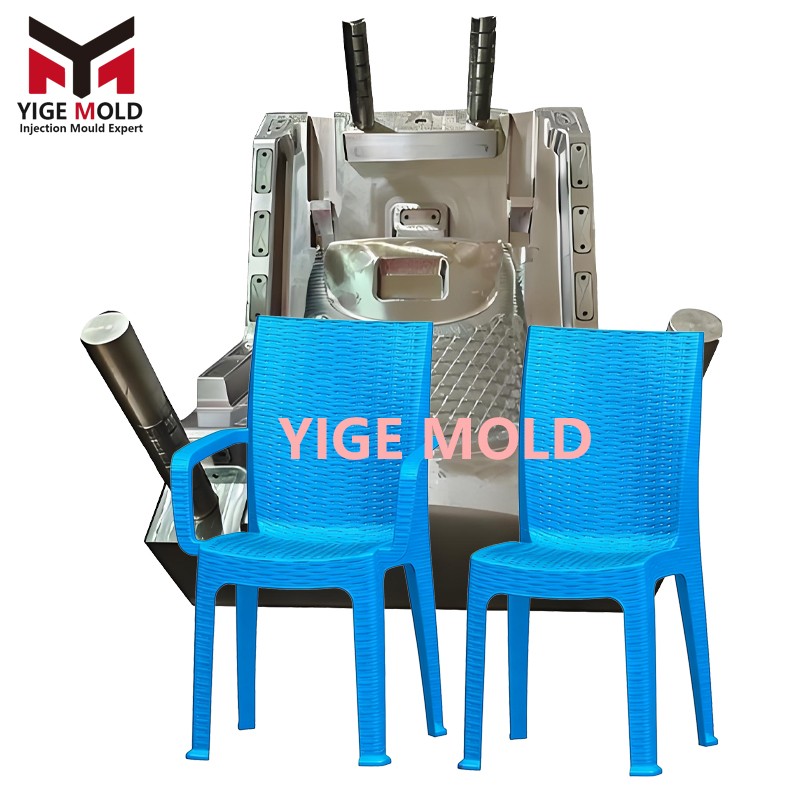
Armless Rattan Chair Mold: Engineering Implementation of Complex Woven Structures
I. Redefining the Product Scope
Within the injection molding industry, the "Armless Rattan Chair" is not merely a simple chair; it is a network of interconnected closed-loop flow paths. Unlike chairs with armrests or high backs, the armless design results in a fully open annular structure for the seat. In mold design terminology, this is classified as a "Freeform Thin-Wall Component Under Peripheral Constraints." The core objective of the mold is to reconstruct the physical contact points and mechanical load paths of intersecting rattan strands through biomimicry, all without any central support.
II. Topological Reconstruction of Parting Logic
Traditional molds rely on "surface-to-surface" contact for parting, whereas rattan chair molds involve "line-to-line" penetration.
1. Dynamic Interference (Collapsible Core Logic)
Due to the interwoven rattan pattern, the mold must perform a "Secondary Parting" action upon closure, where male cores on the moving side interlock with female grooves on the fixed side.
-
Angle Compensation: To prevent the "Snowplow Effect" (where the core scrapes against the groove like a shovel), interference angles are set at 3°–5°, significantly steeper than the standard 1° for plastic parts. Furthermore, the steel in these areas (typically SKD11 or DC53) must achieve a hardness above HRC 52 to resist high-frequency frictional impact.
2. Strategic Deployment of Overflow Wells
Severe gas entrapment inevitably occurs at the dead corners of rattan intersections.
-
Micro-Venting and Overflow: Instead of conventional exhaust grooves, these areas feature "Overflow Wells." These microscopic cavities (0.02 mm deep, 2 mm wide) allow a small amount of cold slug to escape, carrying trapped air with it, which is subsequently trimmed off. This ensures the texture clarity at intersection nodes.
III. Frontline Control of Material Flow
1. Sequential Valve Gating Technology
Given the absence of a central hub and the tortuous path of the rattan strands, conventional gating would result in weld lines appearing in highly visible areas.
-
Multi-Point Sequential Injection: The mold integrates a hot runner system configured with 4–6 valve gate nozzles. During injection, valves open and close in a preset sequence (e.g., injecting at 12 o'clock first, then 6 o'clock after a 0.5‑second delay). This "Wave-like" filling effectively eliminates weld lines and aligns molecular chains along the strand direction, enhancing longitudinal strength.
2. The Trade-off Between Viscosity and Shear Heat
PP/PE materials commonly used for rattan chairs are highly sensitive to shear rate.
-
Runner Optimization: The main runner is designed as a "Trapezoidal Submarine Runner" rather than circular. This cross-section utilizes shear-induced heating during high-speed filling to lower melt viscosity but freezes rapidly during packing to prevent backflow.
IV. The Micro-War of Manufacturing Processes
1. EDM Replication of Rattan Texture
The concave-convex texture of rattan surfaces cannot be directly machined by CNC and relies on EDM (Electrical Discharge Machining) texture transfer.
-
Electrode Fabrication: Copper electrodes are first crafted via 3D printing or precision casting, featuring authentic rattan textures. Using "Orbital Machining" on the EDM machine, these textures are replicated onto the mold steel surface with micron-level accuracy.
2. Gas-Assisted Pre-embedding for Hollow Structures
To achieve genuine "rattan-like" hollowness, the mold must accommodate Gas-Assisted Injection Molding (GAIM).
-
Gas Pin Layout: Micro gas pins are pre-embedded on non-appearance surfaces (e.g., bottom grooves). When filling reaches 95%, the gas pin pierces the melt, injecting high-pressure nitrogen. The mold interior features "Gas Deflection Channels" that guide the gas along the center of the rattan strands, forming uniform hollow conduits.
V. Precise Calculation of Ejection Mechanics
The armless structure means there are no convenient gripping points, making ejection highly prone to tearing.
1. Finite Element Analysis (FEA) for Ejection Planning
CAE software simulates deformation trends immediately after mold opening.
-
Ejector Pin Distribution: Pins must be positioned exactly at the 3D coordinates of Rattan Nodes. The ejection force at each node is calculated to ensure the resultant force is zero (preventing overturning moments), stopping the chair from tilting and jamming during ejection.
2. Negative Pressure Relief Mechanism
For the sealed cavities formed by hollow rattan strands, the mold incorporates "Micro One-Way Valves."
-
Operating Principle: At the instant of mold opening, vacuum negative pressure pulls the valve core open, allowing external air to rush into the hollow channels through 0.5 mm micro-holes. This equalizes internal and external pressure, preventing the product from collapsing inward due to suction.
VI. Conclusion
The Armless Rattan Chair Mold exemplifies the industrial design principle of "Less is More." It abandons bulky solid structures in favor of balancing strength and aesthetics within wire-thin flow paths. This approach tests not only the wear-resistance limits of mold steel but also the designer's comprehensive command of rheology, thermodynamics, and structural mechanics. Every mature mold is essentially a precisely woven industrial net.