Heavy plastic tray mould
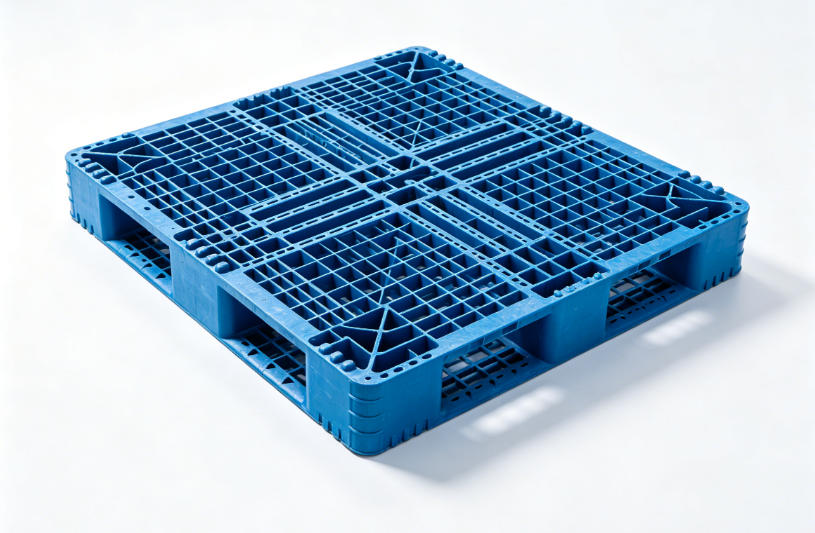
Introduction to Heavy-Duty Plastic Pallet Molds: Empowering Heavy-Load Logistics, Forging the Industrial Backbone for Efficient Operations
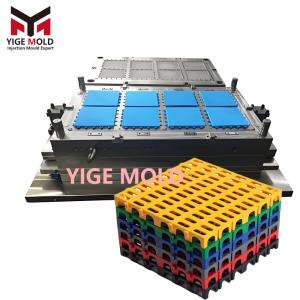
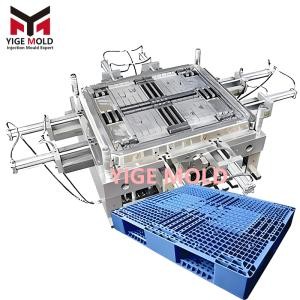
In modern industrial and logistics systems, the efficient transfer, storage, and stacking of goods are inseparable from heavy-duty pallets that boast strong load-bearing capacity and high stability. As the core production equipment supporting the operation of heavy-load logistics, the heavy-duty plastic pallet mold is not only a precision carrier that transforms plastic raw materials into high-strength pallets, but also the key cornerstone that guarantees the load-bearing performance, durability, and standardization level of pallets. With its high-rigidity structural design, rigorous manufacturing precision, and stable molding capabilities, it breaks through the quality bottlenecks of pallets in heavy-load scenarios. It builds an efficient, safe, and cost-effective logistics carrying defense line for heavy-load logistics fields such as manufacturing, chemicals, cold chains, and port terminals, becoming the core link connecting raw material production, pallet manufacturing, and heavy-load logistics, and supporting the stable operation of the industrial supply chain.
I. Core Value: Anchoring the Dual Core Demands of Heavy-Load Capacity and Cost Reduction
The core value of the heavy-duty plastic pallet mold precisely anchors the key pain points of heavy-load logistics scenarios—it must meet the rigid demands of high-frequency heavy-load handling and stacking, while also resolving the cost reduction challenges of enterprises' large-scale production, achieving two-way empowerment of production-end efficiency and application-end reliability, and becoming the core engine for cost reduction and quality improvement in the heavy-load logistics industry.
For pallet manufacturing enterprises, the mold is the core tool for large-scale production and cost control. The production of heavy-duty pallets imposes extremely high requirements on the molding stability and durability of the mold. A mature heavy-duty plastic pallet mold can achieve a stable daily output of hundreds of units. Relying on the mold's high-strength cavity structure and precise temperature control system, it significantly reduces raw material waste and the defect rate, cutting production costs by 18%-28%. At the same time, the mold adopts a multi-cavity parallel design and a rapid ejection structure to shorten the single-unit production cycle, helping enterprises quickly respond to bulk order demands from heavy-load industries and seize the initiative in the heavy-duty pallet market. This is particularly crucial for pallet demands in heavy-load scenarios such as chemical raw materials, mechanical equipment, and bulk cargo, providing core support for the large-scale expansion of enterprises.
For the heavy-load logistics application end, the mold directly determines the core load-bearing performance and safety baseline of the pallet. In heavy-load scenarios, pallets need to withstand cargo weights of several tons or even over ten tons, while resisting the tests of forklift handling, high-altitude stacking, and outdoor exposure to wind and sun. The requirements for load-bearing capacity, impact resistance, weather resistance, and deformation resistance are extremely strict. The mold ensures that the pallet has uniform overall load-bearing and strong impact resistance by precisely controlling the uniformity of pallet wall thickness, the layout of reinforcement ribs, and the structure of support feet, avoiding deformation and fracture under heavy loads. At the same time, it is compatible with high-strength modified plastic raw materials, guaranteeing from the source that the pallet meets heavy-load transportation safety standards and eliminating the risks of collapse and sliding during cargo transfer. In addition, the precise molding of anti-slip textures, forklift entry holes, and stackable positioning structures makes the pallet both heavy-load adaptable and operationally convenient, truly realizing the dual guarantee of production-end efficiency and application-end safety, and supporting the efficient operation of all heavy-load logistics scenarios.
II. Mold Design: Building a Rigid Architecture Guided by Heavy-Load Adaptability
Mold design is the starting point for the quality and load-bearing performance of heavy-duty plastic pallets. It must strictly anchor the three core elements of heavy-load scenarios—load-bearing demands, standardization specifications, and durability requirements—to build a scientific plan from the dimensions of structural strength, standardization compatibility, and material adaptability, laying a precise blueprint for subsequent manufacturing and ensuring that the design accurately matches the core demands of heavy-load logistics.
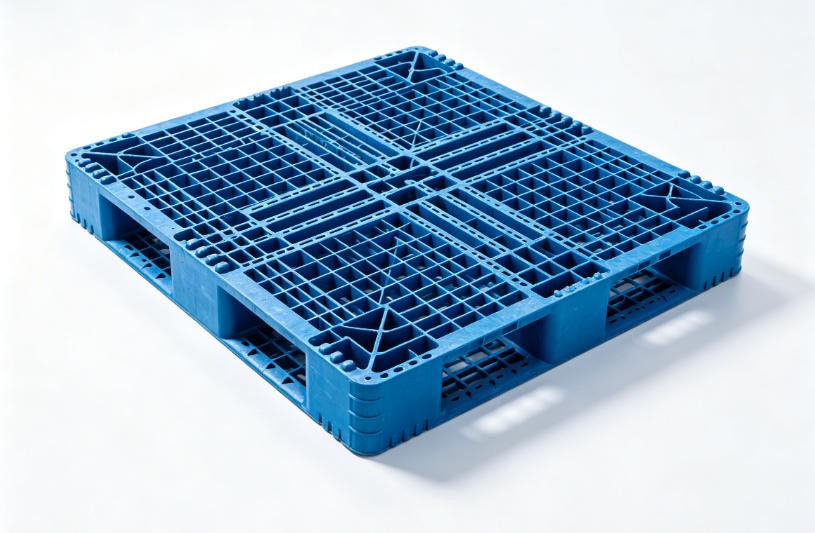
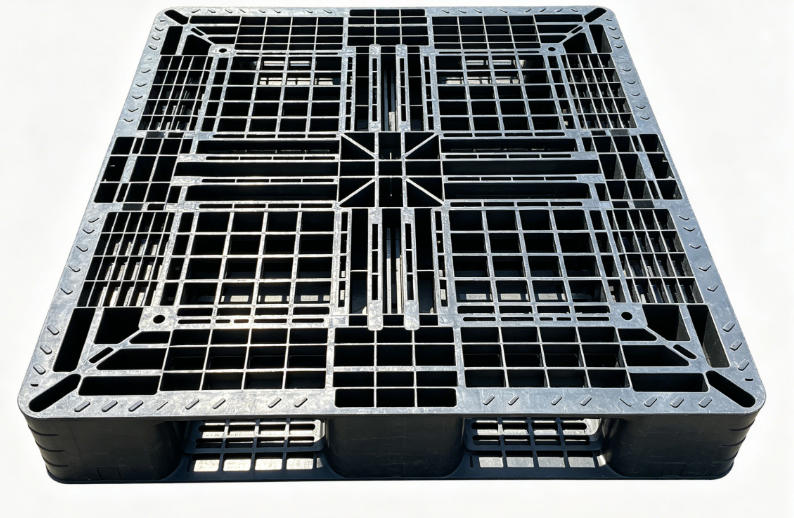
The rigid control of structural strength is the core baseline of mold design. Heavy-duty plastic pallets mostly adopt high-rigidity structures such as double-sided blow molding, reinforced "Chuan" (川)-shaped, and "Tian" (田)-shaped load-bearing patterns. During the design phase, CAE mold flow analysis technology is used to simulate the flow trajectory of the plastic melt within the mold cavity, accurately predicting potential risks such as uneven wall thickness, stress concentration, and weak load-bearing points, and then targetedly optimizing the runner layout and cooling system. By rationally designing the position and number of gates, it ensures that the melt evenly fills key stressed parts such as the frame, reinforcement ribs, and support feet, strictly controlling the wall thickness tolerance within ±0.15mm to guarantee uniform overall load-bearing and up-to-standard impact resistance of the pallet. At the same time, for high-frequency stressed parts such as pallet support feet and load-bearing beams, innovative designs combining rounded transitions and multi-level reinforcement rib superposition are adopted. Through the precise molding of the mold, it ensures that the support feet are stable under load and the load-bearing beams are resistant to bending, preventing the risks of deformation and fracture under heavy loads from the design source, and consolidating the safety defense line of heavy-load logistics.
The detailed refinement of standardization compatibility is the core criterion for fitting heavy-load scenarios. During the design process, international standards and industry specifications for heavy-duty pallets are strictly followed to precisely control pallet dimensions, ensuring that the molded pallets seamlessly integrate with heavy-duty forklifts, racks, containers, and other logistics equipment, avoiding transfer obstacles such as forklifts being unable to enter and unstable stacking caused by dimensional deviations. In response to the demand for automation in heavy-load logistics, RFID tag slots and smart weighing module installation positions are reserved in the mold cavity, making space for intelligent pallet management. Meanwhile, the stackable positioning structure of the pallet is optimized. Through the precise molding of the mold, it ensures that the pallets are stable when stacked and not prone to slipping, improving warehouse space utilization. This addresses the pain points of standardization adaptation and efficiency improvement in heavy-load scenarios from the design end, making the product more suitable for all heavy-load logistics application needs.
The forward-looking planning of material adaptability is the core prerequisite for ensuring durability. During the design phase, the weather resistance, wear resistance, and corrosion resistance requirements of heavy-load scenarios are fully considered, and a structure compatible with high-strength modified materials is reserved. This ensures that the mold can accommodate high-strength PP, PE, ABS, as well as modified plastics with anti-ultraviolet, low-temperature resistance, and corrosion resistance properties, preventing problems such as low-temperature brittleness, high-temperature deformation, excessive wear, and corrosion aging from the source. At the same time, the mold cavity dimensions and ejection structure are optimized based on the shrinkage rate and fluidity differences of different materials, ensuring that the molded pallets have precise dimensions and smooth ejection. This not only meets the durability requirements of heavy loads but also guarantees stable product quality, laying a solid quality foundation for subsequent production and adapting to diverse heavy-load scenarios such as outdoor storage, chemicals, and cold chains.
III. Mold Manufacturing: Implementing a Process Centered on Precision
Mold manufacturing is the core stage that transforms the design blueprint into a physical object. It requires reliance on advanced equipment, exquisite craftsmanship, and rigorous quality control to convert design precision into physical precision, ensuring the mold has high strength, high durability, and high stability, providing reliable support for the mass production of heavy-duty pallets, and ensuring that the mold can withstand the high-frequency operation of heavy-load production.
The empowerment of precision processing equipment is the hardware foundation for guaranteeing the precision and strength of the mold. The entire mold manufacturing process relies on high-precision processing equipment. Large gantry machining centers are used for the rough and finish machining of the cavity, controlling the processing accuracy within ±0.02mm to ensure that the cavity dimensions highly match the design drawings. Five-axis linkage machining technology is employed to precisely form complex surfaces and stressed parts such as pallet load-bearing beams, support feet, and reinforcement ribs, ensuring accurate structural dimensions and meeting heavy-load strength requirements. Meanwhile, high-precision EDM (Electrical Discharge Machining) equipment is introduced to finely process detailed parts such as forklift entry holes and anti-slip textures, ensuring that the dimensions of details are consistent with design requirements. Precision grinding equipment is used to process the mold's guide and positioning components, guaranteeing the accuracy and stability of the mold's opening and closing movement, consolidating the foundation of precision and strength at the hardware level.
The detailed control through process optimization is the core support for enhancing the durability and stability of the mold. During the mold assembly stage, standardized assembly procedures are strictly followed. Core components such as sliders, ejector pins, guide parts, and load-bearing structural parts are meticulously ground and adjusted to ensure smooth opening and closing of the mold and stable ejection, avoiding defects on the pallet such as flash, short shots, and ejection marks, and guaranteeing the molding quality of heavy-duty pallets. For the cooling system, precision drilling and sealing processes are adopted to create a uniform and efficient cooling circuit. By precisely controlling the cooling temperature and speed, product molding stress is reduced, improving the dimensional stability and anti-deformation capability of the pallet, and ensuring structural stability under heavy loads. In addition, special heat treatment and coating processes are applied to the mold surface. Wear-resistant and anti-corrosion coatings are selected based on the needs of different parts, which not only ensures the surface hardness and wear resistance of the mold but also improves the release performance, extending the mold's service life to adapt to the demand for high-frequency heavy-duty pallet mass production.
The quality assurance of full-process quality control is the key line of defense for ensuring mold reliability. A full-process quality management system from raw material arrival to finished product delivery is established. The mold steel undergoes strict composition testing and performance testing to ensure that its hardness, toughness, and fatigue resistance meet the design requirements of heavy-duty molds. During the processing, dimensions are checked after each procedure, and key stressed parts are fully dimensionally verified using a coordinate measuring machine (CMM) to prevent non-conforming products from proceeding to the next step. After assembly, multiple rounds of trial molding are conducted. Through small-batch trial production, the pallet's load-bearing performance, impact resistance, weather resistance, and dimensional accuracy are tested, and limit tests are carried out by simulating heavy-load scenarios. Based on the trial results, the mold is finely adjusted and optimized until the product fully meets heavy-duty pallet standards and design requirements, ensuring that the delivered mold can stably support high-frequency heavy-load mass production demands and providing reliable guarantees for pallet manufacturing enterprises.
IV. Application Empowerment: Demonstrating Core Efficiency in Multi-Scenario Deployment
The value of the heavy-duty plastic pallet mold is fully validated in diverse heavy-load scenarios. It provides customized solutions for the heavy-load logistics needs of different fields, helping enterprises achieve efficient and safe logistics operations, and demonstrating the core supporting role of the mold.
In the chemical raw materials warehousing scenario, corrosion-resistant heavy-duty pallets produced by the mold, with their high strength and corrosion resistance, withstand the heavy-load stacking of chemical raw materials and avoid corrosion damage to the pallets. After a certain chemical enterprise introduced corrosion-resistant heavy-duty pallets produced by the mold, the service life of the pallets was extended by 40%, the pallet loss during raw material transfer was greatly reduced, and warehouse turnover efficiency was improved by 22%, ensuring the safe transfer of chemical raw materials and verifying the mold's precise adaptation to special working conditions.
In the mechanical equipment manufacturing scenario, high-load-bearing pallets produced by the mold are adapted to the transfer needs of large mechanical components, withstanding the weight of components weighing several tons and ensuring stable transfer. A certain machinery manufacturing enterprise relied on customized high-load-bearing pallets produced by the mold to achieve efficient transfer of large components. The pallet deformation rate was controlled at a very low level, and the material turnover time on the production line was shortened by 28%, supporting the efficient production of heavy machinery and highlighting the mold's precise control over heavy-load bearing.
In the port terminal heavy-load logistics scenario, weather-resistant heavy-duty pallets produced by the mold adapt to the outdoor environment of wind and sun, withstand the heavy-load stacking of container cargo, and ensure port transfer efficiency. After a certain port introduced weather-resistant heavy-duty pallets produced by the mold, the pallets maintained stable performance in the outdoor environment, the safety factor of cargo stacking was improved, and port cargo turnover efficiency was enhanced by 25%, demonstrating the core supporting role of the mold in outdoor heavy-load scenarios.
As the core support of the heavy-load logistics industry, the heavy-duty plastic pallet mold, guided by heavy-load adaptability and centered on precision manufacturing, continuously breaks through the boundaries of heavy-load bearing and durability through the deep integration of scientific design and exquisite manufacturing. It provides a solid guarantee for the large-scale production and quality upgrade of heavy-duty plastic pallets. In the future, with the continuous advancement of automation and intelligence in heavy-load logistics, this type of mold will play a greater role in adapting to diverse heavy-load scenarios and empowering industrial innovation. It will become the core engine driving the efficient operation of the heavy-load logistics industry and forge a solid backbone for the stable operation of the industrial supply chain.